Welcome to ZUTTO
Free shipping for newsletter subscribers (some areas excluded)
- トップページ/
- ZUTTO Journal/
- お手入れ・エイジング/
- Time to rethink h...

A closer look at caring for your backpack, the everyday essential
The backpack has become one of those items used by people of all ages and genders, regardless of gender.
Rucksack, backpack, daypack, knapsack, and so on—
there are many names for it, but they all refer to a bag-shaped item
that is carried on both shoulders and can securely hold your belongings.
Because both hands are left free, it's easy to move around, and since your belongings are carried in a stable way,
it also has the advantage of making it easier to carry heavier items.
The backpack is well known as a bag that's easy to use every day, but
have you ever taken the time to care for the one you own?
This time, we'll introduce the many different types of backpacks
along with some care methods you can practice on a daily basis.


One of the great things about a backpack is its capacity.
From small, compact ones to large-capacity ones, it's a delightfully varied item to choose from.
Let's start by looking at backpacks according to their capacity.

HILDA (13L)
If you're using one for a day out on the weekend, we recommend one with a capacity of 15L or less.
Many bags of this size fit valuables like a wallet or a paperback book,
and can be worn in a compact way.

STANDARD SUPPLY DAILY DAYPACK (approx. 18L)
For those who want to keep their belongings light and compact,
or for women, a capacity of around 15 to 20 liters is a good guideline.
At this capacity, in addition to small items like a wallet or notebook,
you can fit a lunch box, a paperback book, and several A4-size notebooks.

Rucksack Large (30L)
If you need to carry heavy or tall items,
or want to pack for a day trip in your backpack,
we recommend a size of 25L or more.
Many of these have ample gusset width and height,
and are built with a sturdy construction
designed to hold a large amount of belongings.
Now, let's take a look at pockets.
Since a backpack is carried on your back, both hands are free, but
when putting things in, you usually need to open the main compartment and rearrange the contents.
If there are pockets on the outside of the backpack, though,
you can store things even while it's still on your back.
Also, if there are plenty of pockets on the inside,
you don't need to worry about your belongings getting jumbled together inside the bag!


The KNAP SACK series from STANDARD SUPPLY
features a large pocket on the outside, so
small items can be stored even while wearing it on your back.
What's more, the inside of the pocket is further divided into sections,
making it a thoughtfully designed piece.


The DANTE series from SANDQVIST features
a vertical zippered pocket on the front of the bag.
Because the zipper runs vertically, it's even easier to operate
while the bag is being worn.
Even though we simply call them "backpacks," when you look at them from the standpoint of usability,
there really are so many different types.
Next, let's look at backpacks in terms of material.

There's a wide variety of materials used for backpacks.
First, let's look at cotton, which is common in everyday-use backpacks.

The Simple Pack Organic Rawcycled from QWSTION
uses organic cotton and recycled cotton throughout.
It comes with a carrying handle strap in addition to the shoulder straps, so
it can be used in two ways—as a backpack or as a hand-carried bag.
A cotton backpack, with its excellent flexibility, changes shape
depending on how much you're carrying, which is nice because it becomes compact when you don't have much with you.
Also, since it's made entirely of cotton, the soft material fits comfortably against your body,
letting you enjoy the texture unique to natural materials.

Along with cotton, nylon is another material often used for backpacks.
Nylon has strong water-repellent properties and resists stains, while
its greatest appeal is that it's remarkably lightweight.
The Small Pack from FILSON, which combines cotton and nylon,
offers plenty of capacity
while still being finished as a lightweight backpack.
The opening features a drawcord closure,
giving it a look well-suited to outdoor use as well.

There's one more material we'd like to introduce as a backpack material: leather.
Leather, which is also widely used for small accessories and bags other than backpacks,
is a material valued for its high durability and beautiful appearance.
Leather has a suppleness and luster that no other material possesses, and
you can also enjoy the way it changes over time as you use it—growing softer
and gaining richer color.
A leather backpack has a character all its own, one that creates an atmosphere
beyond the "casual" impression that backpacks tend to carry.

Now, as we've introduced, backpacks come in a wide variety of shapes and materials,
but when it comes to actually using one, there's something worth keeping in mind
no matter which backpack you own.
That is, not to overpack it.
With a spacious backpack, it's easy to end up putting in more than you should,
but there are parts of the bag that end up bearing strain without you even realizing it.

The parts that tend to bear the most strain when the bag is packed and worn
are the upper part of the shoulder straps (where they rest on your shoulders) and the bottom of the backpack.
Putting too much strain on it can cause fraying or holes to form.
Anticipating that stress will be placed on certain areas,
the shoulder belts are often made thicker than other parts,
and leather may be used on the bottom surface.

Additionally, the fasteners and cords used for opening and closing the bag
are areas that tend to bear a lot of strain. Pulling on them too forcefully
can cause damage, so handling them gently is essential.

Bag-in-bag: PACKABLE SHOULDER/S BEIGE
To avoid overpacking, it's important to choose a backpack with a capacity
that matches its intended use.
We also recommend using a bag-in-bag to help distribute the load.
By keeping a compact, foldable bag inside your backpack,
you can carry just your valuables and small items when out and about.
It's sure to come in handy for things like travel, so keep one tucked away in your backpack.

Care for your backpack should match the product itself.
Some items can be washed entirely, but others—due to the use of leather
or certain construction methods—cannot be fully washed.
First, please check whether your product can be washed with water.
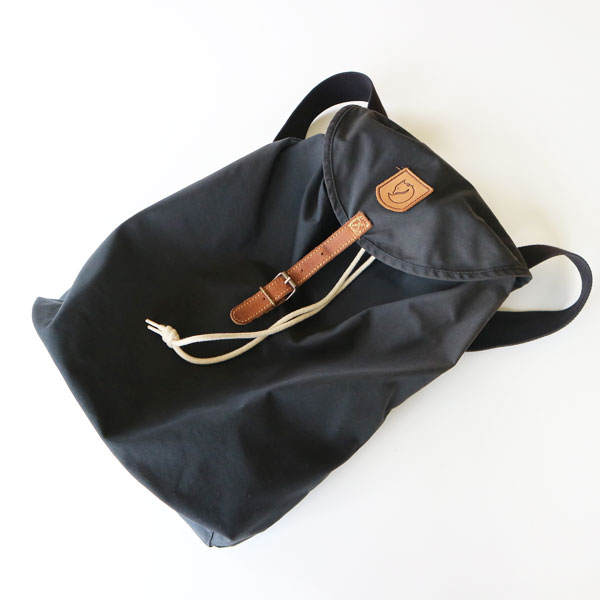

This is a FJALLRAVEN Greenland Small Black
that has been used for about a year.
Overall, it has taken on a softer, more relaxed look compared to before use,
and the leather has deepened in color, while the surface of the fabric and the shoulder straps
clearly show signs of sun exposure.

Since it cannot be fully washed, care is carried out using the following steps.
1. Remove all belongings and open the flap all the way.
Dust may have accumulated on the interior bottom, so
turn it inside out and brush away any dirt.
2. Wring out a cloth dampened with water thoroughly, and wipe down the entire bag (excluding the leather parts).
The areas facing forward, the bottom, and the shoulder belts tend to get dirty especially easily,
so wipe these carefully.
3. Clean the leather parts as well. A fine-bristled brush made for leather bags is handy for this.
Brush in one direction, as if sweeping the dirt away.
If the leather looks noticeably dry, applying a small amount of leather cream will restore its shine.
4. Let it dry in a well-ventilated spot. Keep the following points in mind while drying:
- Keep the flap fully open. It's also fine to hang the bag upside down.
- Dry it in a place away from direct sunlight.
Sunlight exposure can sometimes cause fading.
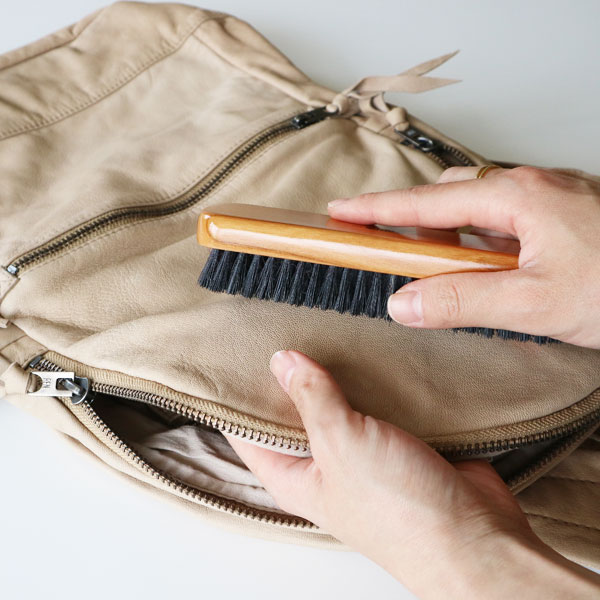
For backpacks made entirely of leather, getting them wet is strictly off-limits, so
we recommend focusing on dry wiping and brushing for care.
Wipe the entire surface with a dry cloth, then use a soft brush made with horsehair or similar material
to gently brush the leather.
Pay especially careful attention to the stitched seams.

A waterproof spray suitable for leather goods: Leather Waterproof Spray
Finally, finish by spraying a leather waterproofing spray over the entire surface.
Using a waterproof spray makes the leather more resistant to dirt.
Be sure to hold the spray about 20 to 30 cm away to avoid uneven application.
--
How did you enjoy this backpack feature?
Since it's an item you'll use every day,
it's worth choosing one that truly fits your needs.
If you avoid overpacking and keep up with basic care,
your backpack can become a companion you rely on for years to come.

GUIDE »
CONTENTS »
CATEGORIES »
- + Gifts by recipient
- + Gifts by scene
- + Clothing
- + Bags / Backpacks
- + Wallets / Card cases
- + Jewelry
- + Shoes
- + Rainy day outfits
- + Kitchen
- + Home
- + Babies / Kids
- + Japanese products
Earn Miles


Payment & Security