
.jpg)


.jpg)
.jpg)
.jpg)


- トップページ/
- ZUTTO Journal/
- お手入れ・エイジング/
- Living with Natur...

Living with natural materials. Nurturing a hand-woven basket bag
The "basket" is one of the folk crafts made widely around the world. Baskets made entirely from natural plants have been cherished as tools for carrying belongings, thanks to advantages like high durability, light weight, and the flexibility to take on different shapes depending on their use.
Even today, baskets remain in use as tools, but it's the basket bag that has become widely embraced as a fashion item. Woven by hand, one by one, by skilled artisans, these bags retain the character of a functional basket while offering a refined look that has made them a popular item.
The basket bag is the perfect companion for the warmer seasons. This time, we focus on hand-woven basket bags made from natural materials and introduce some points for enjoying them for years to come.
Basket bags that make the most of their materials
Hand-woven basket bags are made from natural plants. Since there are many different types, let's first look at the characteristics of each material.
Reed basket bags

Reed Handbag with Leather Handle
Aquatic plants that grow at the water's edge tend to grow straight upward, giving their stems a naturally sturdy quality.
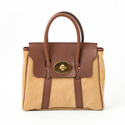
The Reed Handbag with Leather Handle by CANDRIA TOMMASO is a basket bag notable for its distinctive combination of reed—a grass-family plant—and cowhide. As reed grows straight upward, the material itself becomes harder, which is why it has long been used as a sturdy, lightweight material for items like sudare (bamboo blinds).
At CANDRIA TOMMASO, the reed is finely woven, almost like rope, to create these basket bags.


The Reed Handbag with Leather Handle is shaped into a cylindrical form using a wooden mold to combine reed and cowhide, with a magnetic closure at the opening and fabric lining on the inside—resulting in an elegant finish that also offers plenty of functionality. Because the reed is woven tightly and densely, the bag holds its beautiful shape without deforming, even when loaded with belongings.

Basket S/NAVY
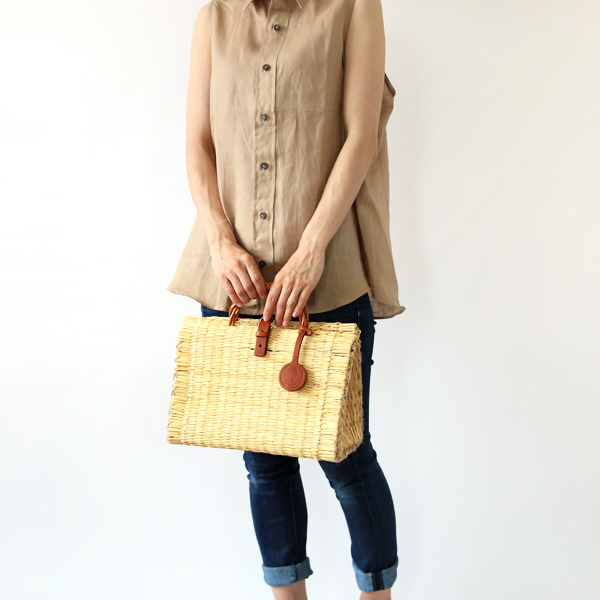
Basket M/BE
The basket bags from the Portuguese bag brand TOINO ABEL are also hand-woven from reed. By weaving blue and black fibers together, they create an all-over stripe pattern, and while the handles are made from sturdy reed branches, the shoulder strap is made of cowhide—resulting in a bag that delights with its playful mix of materials.
The hardness of the reed means there's no need to worry about deformation, and the fact that the entire process is done by hand speaks to the remarkable skill of the artisans behind these basket bags.
Elephant grass basket bags
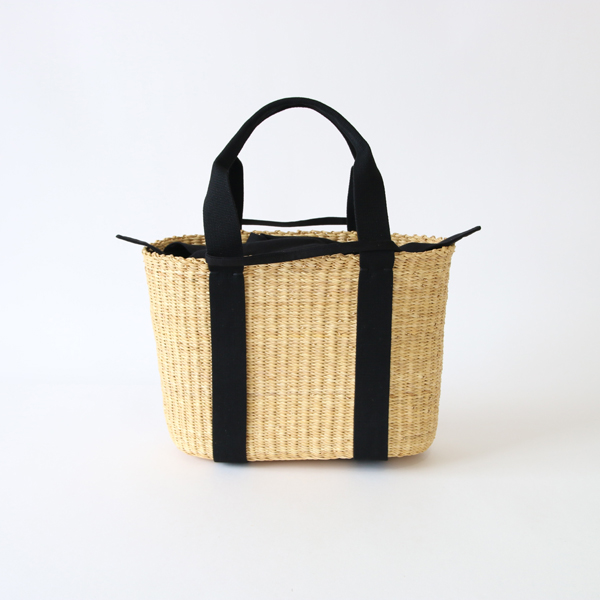
Handbag Basket 005
Next, here's a basket bag by MUUN, made in Ghana. The material chosen here is elephant grass, another type of aquatic plant. Elephant grass grows in the tropics of Africa, reaching heights of over 5 meters, and is known for its exceptionally sturdy stems.


Shoulder Basket 006
Africa has long developed intricate patterned weaving techniques, and in the small village of Nyariga, where MUUN's basket bags are made, this craft continues to be passed down. Elephant grass, among aquatic plants, has a resilient quality—even if it becomes deformed, it naturally returns to its original shape.
Akebi basket bags
Vine plants that grow by winding themselves around supports have also long been used as material for basket bags. Akebi, which grows in the mountains of Japan, and rattan, which grows in warm regions such as Southeast Asia, are prime examples.

Akebi Basket (Thin Two-Strand Hora Weave)
Miyamoto Kogei, based in Hirosaki, Aomori Prefecture, has been hand-making akebi (Japanese chocolate vine) baskets since the Taisho era. As many folk crafts, including baskets, were traditionally hand-woven during the agricultural off-season, the result is a basket bag with a rich, distinctive character that machines simply cannot replicate.

Akebi Basket (Trapezoid Plain Weave)
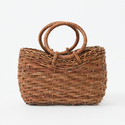
Akebi vine is known for its natural thickness and elasticity, which makes for exceptionally sturdy baskets. Another notable feature is that, as you can see when the vine is cut, the material itself has a rounded shape, meaning the surface is less prone to splintering—so it's gentler on whatever you carry inside the bag.
Raffia basket bags
Plants of the palm family, common in tropical regions, are also favored as a raw material for basket bags. Raffia palm, native to the island of Madagascar in the Indian Ocean, is highly flexible, allowing for detailed processing, and its beautiful appearance once woven is another reason for its popularity.

Bucket-Shaped Raffia Bag
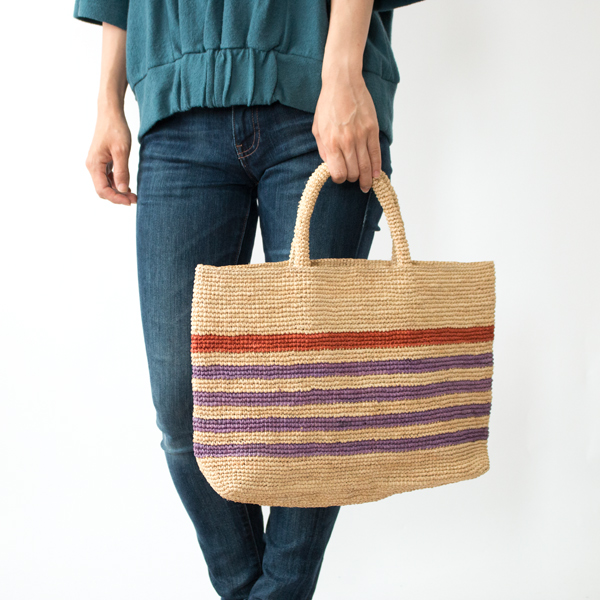
Striped Raffia Bag
Sans Arcidet creates basket bags that make the most of raffia's flexibility. Using top-quality raw material harvested from raffia palm leaves grown in a nature reserve in the Majunga region on Madagascar's west coast, roughly 450 artisans hand-weave each bag one by one.
With distinctive shapes such as round and square, combined with materials like leather and colorful dyeing, these basket bags have a one-of-a-kind presence.

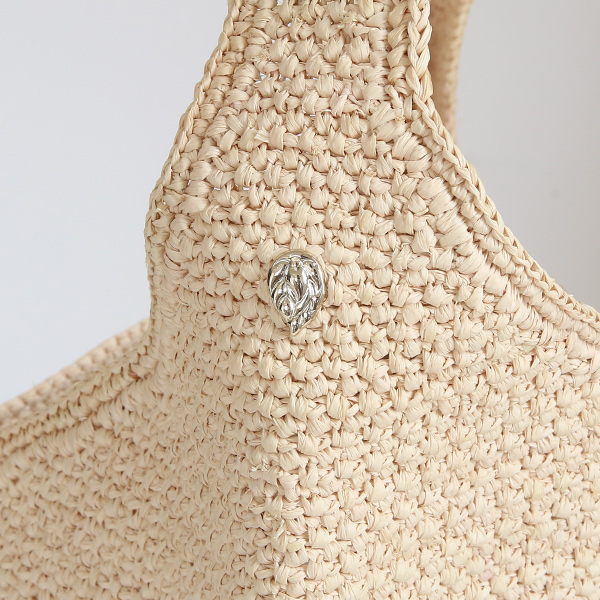
Carillo Natural

Shoulder Bag LOTO Natural
Also working with high-quality raffia from the island of Madagascar is HELEN KAMINSKI, known for its hats and basket bags. Each of these basket bags is crocheted one by one, showcasing meticulous craftsmanship.
This shoulder bag, woven from raffia, conforms softly to the body, and its shape shifts depending on the amount of luggage inside—a quality that clearly reveals the distinctive character of raffia.
For a Long Relationship with Your Basket Bag
Being made of natural materials, and in the case of hand-woven basket bags in particular, these products have characteristics that differ from machine-made bags. By understanding the product's features and how to store it properly, you'll be able to enjoy it for a long time to come.
Cut Ends and Looseness
Basket bags are woven after natural materials have been cut to the appropriate length. Because of this, the cut ends may sometimes appear on the surface, or small frayed bits may be visible on the bag.

Example of Cut Ends
Even if the cut ends are visible on the surface, there is little risk of unraveling thanks to the material's strength. However, when you first start using the bag, please be careful not to snag it on clothing, fabric, or accessories. Bags that come with an inner pouch or have a fabric lining on the inside help reduce this kind of snagging.
If your basket bag doesn't come with an inner pouch, we recommend placing a fabric drawstring pouch inside for use. ZUTTO also carries original inner bags, so please take a look at those as well.

See ZUTTO's inner bag product page here

Example of a Hand-Woven Joint
Miyamoto Kogei's akebi (Japanese akebia vine) baskets are entirely hand-woven, and even the section connecting the handle to the body of the bag is made entirely of akebi. Given the nature of natural materials, the joint may occasionally loosen unavoidably with continued use, but in the case of Miyamoto Kogei's products, repairs can be arranged.
If you would like to request a repair, please contact Customer Support.
ZUTTO Customer Support: support@zutto.co.jp (Weekdays 10:00-16:00)
Everyday Care
For everyday care, we recommend simply wiping the bag down. Using a soft cloth, wipe the surface of the basket bag as if you were polishing it.
For basket bags with finely woven patterns, dirt tends to accumulate inside the weave, so be sure to focus your wiping there.
For materials that are themselves fairly thick, such as akebi, brushing with a clothes brush can also work well. Choosing a brush made with natural animal hair will have the added effect of bringing out more luster in the basket bag.
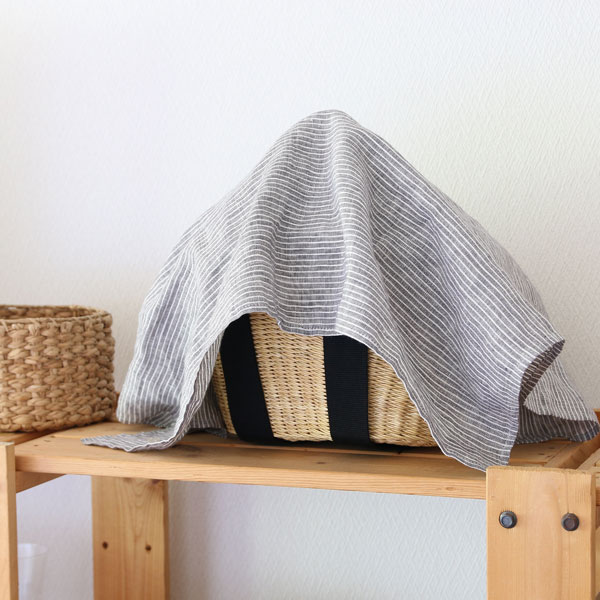
How to Store Your Bag
Moisture is the greatest enemy of a basket bag. Because these bags are made from natural materials, exposure to water can lead to mold, insect damage, and even loosening of the weave. For this reason, avoid using your bag on rainy days or setting it down on wet surfaces, and also be mindful of how you store it.
When storing a basket bag, choose a well-ventilated spot out of direct sunlight. Since the bag can easily absorb moisture if left as is, we recommend covering it with a cloth, or, if you have non-woven fabric on hand, wrapping the entire bag in it.
Using and Touching Your Bag Keeps It in Its Best Condition

We've covered how to handle a basket bag, but when it comes to nurturing a basket bag made of natural materials, the best method by far is simply to use it. Handling the bag smooths away any rough spots, natural oils gradually deepen its color, and exposure to air keeps dust from settling on it. That's the ideal state for a basket bag.
Of course, if using it every day proves difficult, keep it somewhere you'll see it often, and touch it with your hands from time to time. Through touch, you'll come to appreciate the true appeal of a natural-material basket bag.
▽See the full lineup of basket bags here

GUIDE »
CATEGORIES »
- + Gifts by recipient
- + Gifts by scene
- + Clothing
- + Bags / Backpacks
- + Wallets / Card cases
- + Jewelry
- + Shoes
- + Rainy day outfits
- + Kitchen
- + Home
- + Babies / Kids
- + Japanese products
Earn Miles


Payment & Security