

.jpg)




.jpg)

.jpg)
.jpg)




- トップページ/
- ZUTTO Journal/
- お手入れ・エイジング/
- Summer Fragrance ...
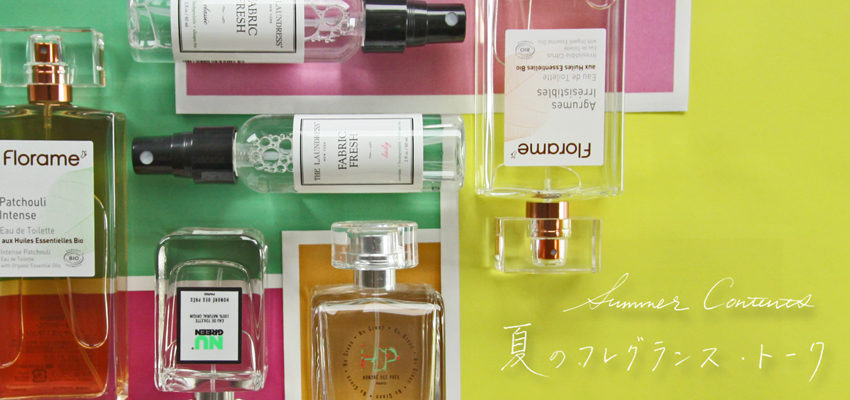
A Summer Fragrance Talk
This time, our theme is "fragrance."
A good scent has a mysterious power to draw people in.
And the very act of wearing a beautiful fragrance
carries with it a certain indescribable elegance.
Though invisible, scent is said to linger in people's memories more than almost anything else.
Here, we've gathered together some thoughts on the charm of fragrance.

In French, perfume is called "parfums," and in English, "perfume," but
both words trace back to the Latin phrase "per fumum," meaning "through smoke."
In ancient times, people burned fragrant plants and resins, offering prayers through the smoke that rose to the heavens.
The scent released when this "smoke" was burned is thought to be the origin of what we now call perfume.
Later on, perfume came to be used as a way to enjoy fragrance alongside grooming and fashion,
and this is how its use came to be established.
When talking about the history of perfume, two key elements come into play:
the aromatic essence that forms the scent, and the alcohol that serves as its base.
Essential oils, now widely used in perfumery and aromatherapy,
are made through the steam distillation of plants.
This history goes back a remarkably long way—the distillation method for extracting fragrance
is said to have been discovered by an Arab physician in the 10th century.
Around the same period, it also became possible to extract alcohol from fermented substances using the same distillation apparatus.
This discovery of alcohol later made it possible to combine it with fragrance to produce perfume.
Something resembling today's perfumes and eau de toilettes—fragrance dissolved in alcohol—
was first created at the end of the 16th century.
It's said that this spread throughout the world after Catherine de' Medici, an Italian woman,
married into the French royal family and brought knowledge of perfume with her.

Next, let's talk a little about "fragrance materials."
Our planet is filled with countless scents.
Think of the fresh, juicy aroma of fruit,
or the rich fragrance flowers use to attract insects.
We humans, too, receive all kinds of stimulation and information through scent—
our appetite awakened by the smell of food, or the changing seasons sensed through the scent of trees.
A "fragrance material" refers to something derived from plants,
a substance with an aromatic quality, or a blend of such things—
in other words, a substance used to impart scent to various products such as food and cosmetics.
Fragrance materials fall into two categories: "natural fragrance materials," obtained from natural scent components such as flowers through pressing, extraction, or distillation,
and "synthetic fragrance materials," artificially created aromatic substances.
By combining these in countless ways, an enormous variety of scents is created.
As a bit of a side note, let's talk about a classic symbol of summer: kakigori, or shaved ice.
Strawberry, melon, lemon—anyone who's stood at a summer festival stall,
torn between which flavor to choose, probably shares this memory.
Interestingly, the syrups poured over shaved ice generally share nearly the same base, with the "fragrance" added to each
playing the key role in determining the flavor.
It just goes to show how significant a role fragrance materials really play.
Let's bring the conversation back to fragrance.
If we compare "perfume" to a painting, then what makes up that painting is the paint itself.
For perfume, the fragrance materials play the role of this paint.
Of the roughly 400,000 scented substances said to exist on Earth,
only around 500 to 800 are widely used in our daily lives as "fragrance materials."
Since synthetic fragrance materials only became practical to use in the 19th century,
it follows that all perfumes made before that time were created entirely from natural fragrance materials.
However, natural fragrance materials—true to their nature—have scents strongly influenced by natural variation,
and tend to suffer from inconsistent quality, yield, and pricing.
As synthetic fragrance materials developed remarkably, natural ones gradually fell out of favor.
For example, imagine discovering an essential oil with a scent you love,
and wanting to purchase the same one again.
With natural-origin scents, prices can fluctuate, and even oils with the same name and origin
can somehow feel subtly different from one another.
And yet, the complex character of scents born from natural ingredients
is something synthetic fragrance materials can rarely replicate,
so it's rather lovely to think of each encounter with a scent as a once-in-a-lifetime moment.
A fragrance is mainly made up of:
・Fragrance material
・Alcohol
・Water (distilled water)
These three elements combine to create a fragrance,
and the proportion of fragrance material among them is what determines the type of fragrance.
・Parfum (fragrance material 15–30% / lasts 5–7 hours)
・Eau de Parfum (8–15% / about 5 hours)
・Eau de Toilette (5–8% / 3–4 hours)
・Eau de Cologne (3–5% / 1–2 hours)
These figures are rough guidelines, but they show that the higher the proportion of fragrance material,
the longer the scent tends to last.
Among these, eau de toilette has a casual feel
that makes it comfortable to wear even in the morning, and since it lasts reasonably well,
it has become the most popular type.
Now, let's pick out a few fragrances made with natural fragrance materials
that we carry here at ZUTTO.

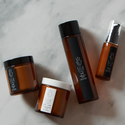
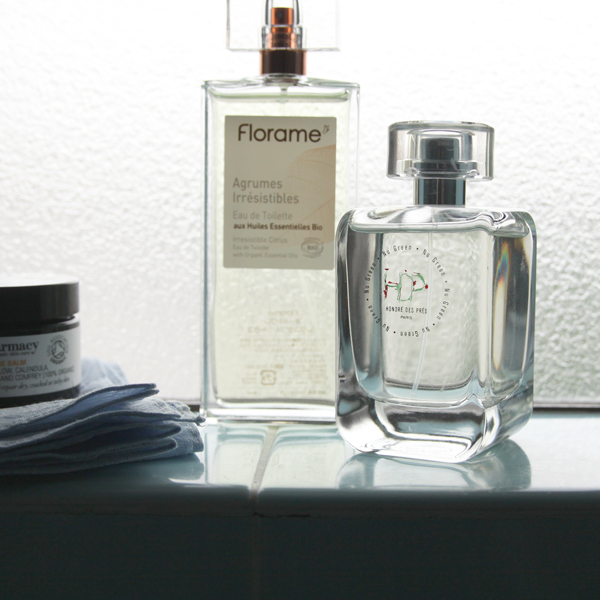
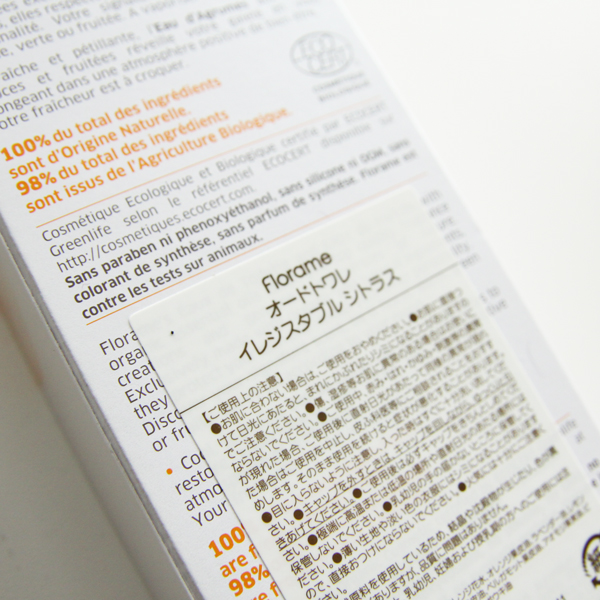
Florame's eau de toilette is
a fragrance made using 100% natural fragrance materials.
What's more, an astonishing 98% of it is organic.
Made with organic essential oils,
Contains floral water and grain alcohol.

This HONORÉ DES PRÉS is made using only 40 kinds of natural fragrance materials certified by ECOCERT,
crafted by the renowned Robertet company of southern France, known for its natural fragrances.
The products contain no mineral raw materials, synthetic fragrances, dyes, or diethyl phthalate,
and no animal-derived ingredients or skin-irritating substances are used.
If we were to compare it to a painting, the way it feels when worn is like a fresh, vivid watercolor.

Also, though somewhat different from perfume,
spray-type aromas are another fragrance item you can easily try.
With just a single spritz on your room or clothing, you can enjoy a pleasant scent.
Left: THE LAUNDRESS Fabric Fresh
A simple spritz on clothing, hats, the inside of bags, shoes, bed linens, curtains,
fabric sofas, and other spots where odors tend to linger
refreshes them with a scent of your choosing.
Right: Juniper Ridge Cabin Spray
A cabin spray made by blending essential oils with flower water
distilled and refined from plants.
With a scent born from the blessings of nature,
it refreshes your room or the inside of your car.

Perfume is very delicate.
Depending on how it's stored, its scent can change,
so it's worth trying to keep it in the best condition possible.
◇Avoid direct sunlight and places with extreme heat, cold, or high humidity.
◇Be sure to close the cap tightly. Wiping down the spray nozzle can also help prevent it from clogging.
◇For perfumes you use less often, close the cap securely, place them back in their packaging box,
and keep them in a cool, dark place with little environmental change.
◇If a perfume has darkened in color or otherwise changed, this may indicate that the scent has deteriorated. In that case,
applying it directly to the skin as is may cause irritation, so please be careful.
Even if you're careful about storage, you might find that you rarely have the chance to wear a perfume,
and quite some time has passed since you opened it…
Have you ever had that experience?
Even if the scent seems fine when you test it,
you might still feel a little uneasy about applying it to your skin
since so much time has passed.
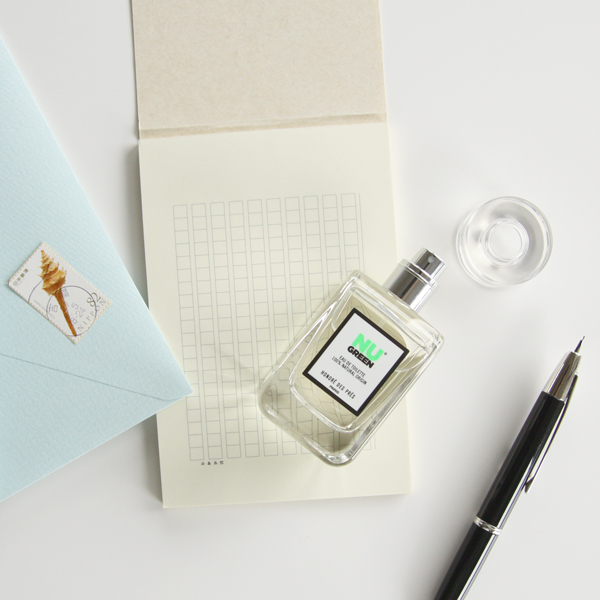
For a perfume like that, why not try using it as a letter fragrance—
for instance, giving a light spritz to the inside of your stationery or envelope
when writing a letter?
It's a fleeting scent that will eventually fade away,
but even that kind of scent is a wonderful form of communication.
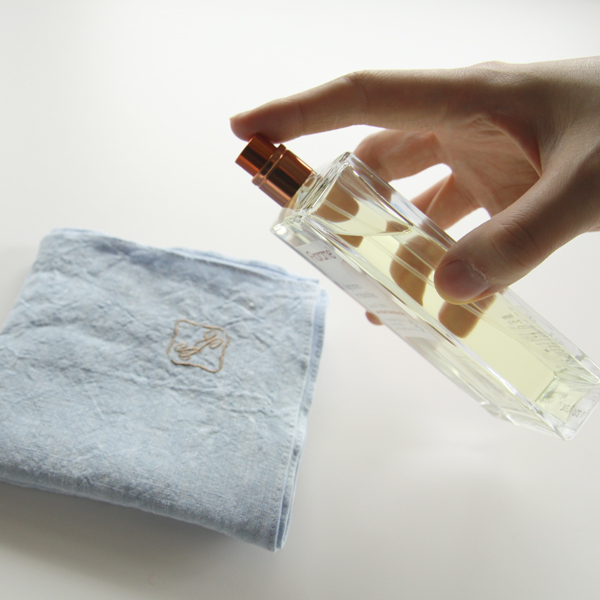
You might also try giving a light spritz to a handkerchief and carrying it with you,
or placing a piece of gauze scented with the perfume in your bedroom
to enjoy a pleasant aroma.
Even without spraying it directly on your skin,
you can enjoy fragrance in everyday life this way.
*Please note that colored perfumes may transfer color onto fabric items,
so please be careful.
The power of scent, though invisible to the eye, is remarkable.
Even the most glamorous fragrance sealed within a bottle
will, once it touches human skin, eventually fade away on the wind,
yet when you consider how people noticed its charm and carried it forward as a culture,
there's something rather romantic about it.
Why not try finding your favorite fragrance among those made with natural aromatics?
And if you have a gifted perfume that you haven't had much chance to use,
why not take it out and try its scent once again?
GUIDE »
CATEGORIES »
- + Gifts by recipient
- + Gifts by scene
- + Clothing
- + Bags / Backpacks
- + Wallets / Card cases
- + Jewelry
- + Shoes
- + Rainy day outfits
- + Kitchen
- + Home
- + Babies / Kids
- + Japanese products
Earn Miles


Payment & Security