


.webp)


.webp)


.webp)


.webp)


Welcome to ZUTTO
Free shipping for newsletter subscribers (some areas excluded)
- トップページ/
- ZUTTO Journal/
- お手入れ・エイジング/
- Comparing How Two...

Comparing How Two People Use It: The Kurashiki Ishō "Drawer Box" Edition
This is the "Comparing How Two People Use It" series, which introduces how different people experience using the same item. In this fourth installment, we feature Kurashiki Ishō's drawer box, where the beauty of traditional woodworking—ishidatami-gumi (cobblestone joinery)—coexists with an endearing, charming presence. In an age overflowing with countless things, what we wear or own is entirely up to us, but there must be a reason when different people choose the very same item. This time, the drawer box gently fit into the daily lives of two different users.
Why Two Different People Each Chose the Same "Drawer Box"

This time, our two users are as follows.
(Left) M, in charge of custom orders:
Has used the drawer box for 3 years. A fan of many wooden products, including plates and cutting boards.
(Right) Y, in charge of editing:
Has used the drawer box for 3 months. Earlier this year, organized her belongings in preparation for a move.
M: I had originally been wanting something to store my accessories in. Around that time, I saw this drawer box during a photoshoot, and I was drawn to the just-right size.
Y: I chose it because I was looking for a storage box I could leave out in the open. I did a big clean-up in preparation for moving, and for storage too, I wanted to consolidate the things I use regularly into one place. That's when I thought that a drawer box with drawers of different heights would let me fit all kinds of items. I've only been using it for 3 months, but you really understand how just right the size is once you actually use it.
M: I really think the phrase "just right" fits perfectly. Both the way each drawer has a different height, and the size of the box itself.

Y: It's not too big and not too small, so it doesn't feel overwhelming even when placed out. Personally, I also love the smooth texture.
What's Inside Reveals How Each of Them Uses It
When it comes to storage boxes with drawers, it's not uncommon for all the drawers to be the same height, but the Kurashiki Ishō drawer box is characterized by its three tiers, each a different height. What you put in and how you sort it might be said to show off each user's own sense of style. We asked them to show us a little of what's inside their drawers, which also offers a glimpse into their daily lives.
Staff M: The Contents Change to Match Her Lifestyle

First tier: Everyday accessories
Second tier: Handkerchiefs
Third tier: Cosmetics used occasionally
M: The first and second tiers hold things I use every day, so I open them without fail each day. The third tier is for cosmetics I don't use regularly and had trouble finding a place to store—the kind I only use when doing my makeup properly, for occasions like weddings or funerals. I wanted to keep them separate from my everyday makeup items.
Y: I see—the third tier does have enough height, so it's perfect for storing things you're not sure where else to keep.
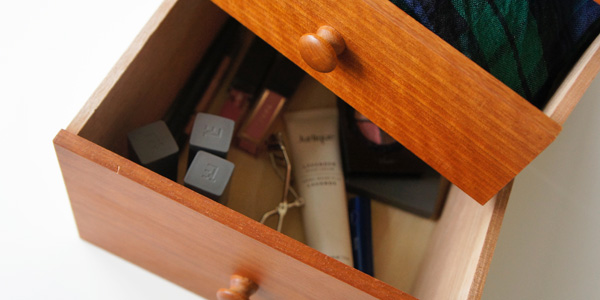
M: Exactly. Because the heights differ, it's convenient—you can fit all kinds of things in. Also, since I've been using it for 3 years, the contents have gradually changed to match my lifestyle. There was a time when I kept my bankbook and personal seal in the first tier, but that role has since been passed on to a different storage spot, and now I keep everyday items in this box instead. I have it placed on top of a display shelf in the living room.
Staff Y: A Home Base for Things She Needs Every Day

First tier: Office supplies, like a memo pad and Wi-Fi device
Second tier: Everyday wristwatches and accessories
Third tier: Daily cosmetics, everyday medicine, and the like
Y: This is the only visible storage in my room, so compared to M, I might have a relatively wider variety of items inside. Everything in it is something I use regularly. As for accessories, all the ones I wear on a daily basis are kept in here too.
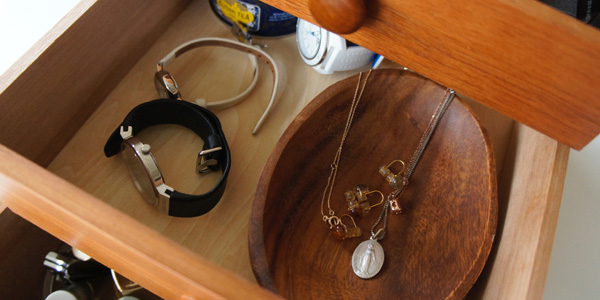
M: That's nice and compact! Since the maximum capacity is fixed, it seems like—in a good way—things won't keep piling up.
Y: Exactly. I keep it on the desk in the living room where I do my makeup and work on my computer. It seems we both have it in common that we place it in the spot where we spend the most time.
Time Told by the Object: Comparing the Aging

Left: used for about 3 months, Right: used for about 3 years
M: I don't think there's been much change in the color or texture. Comparing it with Y's, mine might be just a bit darker. But I think differences like that in color or wood grain are within the range of natural individual variation. Since I use it every day, if you look closely there are a few small scratches here and there, but I think that's part of its character too.
Y: So the nato wood used in the drawer box is less about enjoying the aging process and more about enjoying each piece's own individual character.
Something Fellow Users Want to Secretly Ask Each Other: "How About This?"
① When you first started using it, did the individual variation or the scratches and wood grain unique to wooden products bother you?
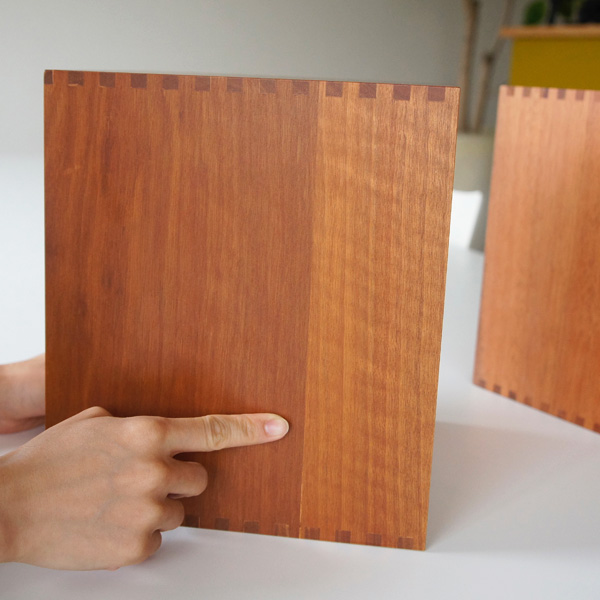
M: It didn't really bother me. Now that you mention it, there are places on the sides where the coloring differs, but that's proof that the individual character of the nato wood is coming through.
Y: Nothing bothered me either. Oh, that reminds me—I noticed just now when we lined them up side by side that the color of the wood panel looks quite different when viewed from behind.
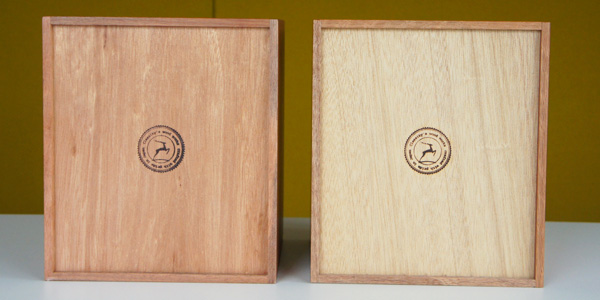
M: You're right! I hadn't noticed that.
Y: Mine, which I've only just started using, is actually the darker one, so this really is a storage box where the individual character of the wood comes through as is, rather than it being about aging.
② As for the sense of size, is it bigger than expected?
M:In the sense that it holds more than it looks like it can, that might be true. It's a size you can hold with both hands, but not too small. If it were too small, what you could put in it would be limited, so I liked this sense of size. It fits anywhere, so to speak.
Y:I agree! Next to this, I'm also able to place a tissue box and a mirror. That said, I'd recommend it more for people who want solid storage rather than just a little catch-all for small items.
③ Do the drawers open and close smoothly?

M:I've been using it for 3 years, and there's no catching in particular—it's smooth.
Y:It's not something I worry about, but the first and second tiers do catch a little sometimes when opened about 3cm. In that case, if I lift the drawer up slightly as I open it, it opens without any problem, so it's not really a source of trouble for me.
When our editorial staff heard this and later asked the maker, Kurashiki Ishō Keikaku Shitsu, about it, they explained that since the back part of the board between the drawers is open, the edge of that board might be touching the drawer. We were told that a little sanding with sandpaper could fine-tune this, so we actually tried it ourselves.
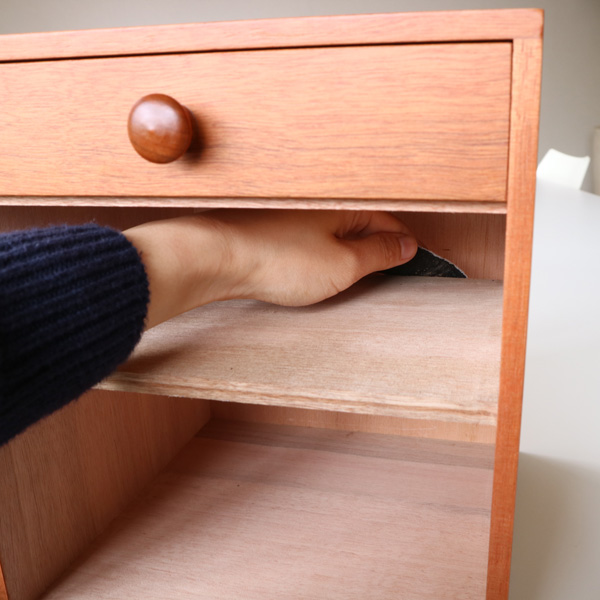
*Since wood shavings will come out, please pull out the drawer beneath the board you're sanding beforehand, and then sand.
Then, after about 5 minutes of sanding, the drawer began moving more smoothly than before.
According to Kurashiki Ishō Keikaku Shitsu, this space was originally left open on purpose as a path for air, so that air wouldn't get in the way when inserting the drawers. They also mentioned that since wood is sensitive to changes in humidity and temperature and can shift shape slightly, the drawers might start catching after long use—but even in that case, this sandpaper adjustment method is effective. It's reassuring to know this now, with an eye toward using it for years to come.
④ Does it require any special care?
Y:Since I use it every day, I think just touching it with my hands ends up serving as its care.
M:They say that simply wiping it with a dry cloth, or a cloth wrung out tightly after being dampened with water, when it seems to need it, is enough. I avoid detergent since it may affect the urethane coating on the surface. Applying oil as a form of care is also apparently a matter of preference, so I'm thinking of trying that while keeping an eye on how it goes.
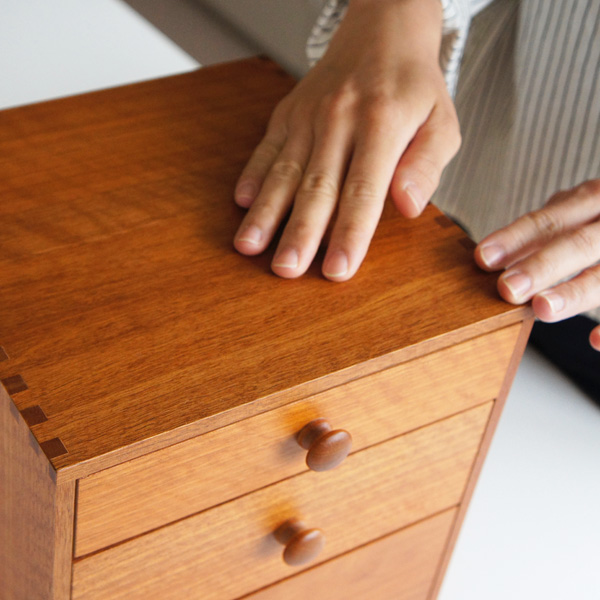
Three drawers of different heights. Despite its compact appearance, the ways it can be used seem to hold as much possibility as there are people who own one. Perhaps the fact that you can gradually change how you use it to fit your lifestyle is one reason it can be loved for so long.
Delivering tools filled with warmth: "Kurashiki Ishō Keikaku Shitsu"

Founded in 1981 in Kurashiki City, Okayama Prefecture—known for its beautiful townscape dating back to the Edo period—Kurashiki Ishō began as a textile printing design and silkscreen printing workshop. Treasuring materials, they continue to make warm, handcrafted goods by refining the process of making things and the texture born from it into a distinctive character all their own. In Kurashiki, a place where the tradition of handwork still remains, their creations—born from the intertwined skills of experienced craftspeople—become everyday items that, through daily use, grow more beautiful over time, becoming irreplaceable tools for those who own them.
>>See the full product lineup from Kurashiki Ishō Keikaku Shitsu here
>>The "Drawer Box," which helps organize the user's daily life, can be found here
▽Past editions of "Two People Compare Their Everyday Use."
Part 1: PATRICK STEPHAN "3-Way Leather Pochette" edition

Part 2: Odate Kōgeisha "Koban Bento Box" edition

Part 3: fog linenwork "Linen Massage Bath Mat" edition
GUIDE »
CONTENTS »
CATEGORIES »
- + Gifts by recipient
- + Gifts by scene
- + Clothing
- + Bags / Backpacks
- + Wallets / Card cases
- + Jewelry
- + Shoes
- + Rainy day outfits
- + Kitchen
- + Home
- + Babies / Kids
- + Japanese products
Earn Miles


Payment & Security




