


.webp)


.webp)


.webp)


.webp)


Welcome to ZUTTO
Free shipping for newsletter subscribers (some areas excluded)
- トップページ/
- ZUTTO Journal/
- お手入れ・エイジング/
- The Mystery of Ta...

The mystery of a vessel that grows with use. Do you know the charm of kohiki plates?
"I love white tableware." Many of you probably enjoy plating food on a simple white plate, much like adding paint to a blank canvas. The ware we're focusing on this time, called "kohiki (こひき)," is also a type of white ware. Through an extra step known as shirogesho (white slip coating), it achieves a look that is white, yet not quite pure white—we invite you into this deeply nuanced world of ceramics.
The white of ceramics, and the white of kohiki
White is arguably the most popular color among tableware. There are many reasons for this—it makes the colors of food stand out, and it pairs easily with any cutlery, glassware, or bowls. Yet in the end, it seems the classic path always leads back to something minimal, stripped of excess. Within that world, we want to draw attention to the variations of "white" itself. That's because the kohiki ware we're introducing today is finished with a technique called shirogesho (white slip coating).

Here, we've prepared four types of ware, including kohiki.
1: Minoyaki / ceramic ware (kohiki ware)
4: Ware made with 3D digital technology / ceramic ware (matte finish)
Depending on the type of ceramic and differences in surface finish, you can see a variety of expressions, yet all four of these share the common base of "white." Numbers 2 and 3 have a familiar texture, the kind of ware you might find in almost any home. Number 4, on the other hand, stands out for its modern design combined with a pure white color, thanks to its matte finish.
And the one we're highlighting today is plate number 1, the kohiki plate. As mentioned earlier, a kohiki plate refers to ceramic ware finished with the technique called shirogesho. Rather than pure white, its color leans closer to gray, and when compared with other white ware, you can truly appreciate the depth of its character.
Unraveling the secret behind the beauty that comes from shirogesho

The name kohiki comes from the phrase "as if dusted with white powder," and the ware was originally a traditional craft that came from the Korean Peninsula. The country known as the Joseon Dynasty lasted for as long as 500 years, so tracing the full history of this ware in detail would make for a very long story—one we'll set aside here. Still, it's not hard to imagine the deep affection people felt for this white ceramic culture that arrived from a foreign land, and the care with which they passed it down through generations.
There exist sake vessels and rice bowls that have been handed down for as long as a century, and it's said that ware which has absorbed moisture and "breathed" over and over again develops a texture quite different from something brand new. In our modern age, where all kinds of ceramics circulate widely, mass-produced white ware is easy to come by at accessible prices. Against that backdrop, taking a fresh look at these humble vessels—carried forward with such historical depth—offers a particularly profound kind of appreciation.
The charm of kohiki plates like these can be unraveled through three keywords: "three-layer structure," "gohon," and "the shinogi pattern."
The identity of the kohiki plate lies in its "three-layer structure"

Generally speaking, ceramic ware is made by applying glaze over clay (the base material) before firing. This glaze turns into a glass-like substance when fired at high temperatures, preventing moisture from seeping into the clay, which is naturally quite absorbent. Kohiki was originally developed as a technique to make red clay appear white—by coating the base with white slip to add color before applying the glaze, a distinctive texture is created. This is the "shirogesho" of kohiki ware. As you can see in the diagram above, rather than the usual two-layer structure of "①base + ②glaze," the shirogesho layer is inserted in between, creating a three-layer structure of "①base + ②shirogesho + ③glaze."
When you see gohon (御本) appear, that too is part of the charm

Also, ware finished with shirogesho may develop pale pink spots after being removed from the kiln. These are called gohon, and they're one of the qualities that give kohiki plates their character. In the photo here too, you can spot patches of pink gohon here and there. Whether or not gohon appears depends on the individual piece—sometimes the whole surface takes on a pinkish tint, and sometimes there's no gohon at all, leaving the whiteness to stand out on its own. Since this falls into the realm of one-of-a-kind encounters, it's best to simply enjoy it as the unique character of the particular piece you happen to meet.
The "shinogi" pattern that brings out the shirogesho
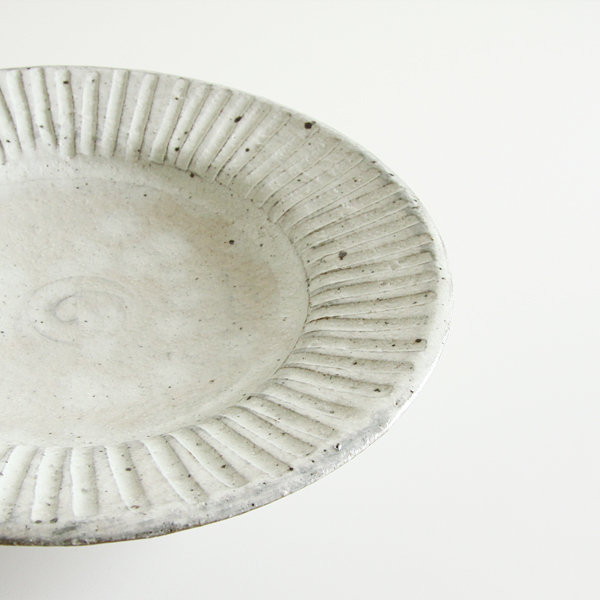
Another distinctive feature of kohiki plates is a pattern known as "shinogi." Written with the character for "shave" or "carve," it's read shinogi. This pattern is made by hand after the clay has been shaped and dried—craftspeople carve the surface of the piece with a tool resembling a chisel, creating an uneven texture. There are also smooth, flat designs without this shinogi pattern, but when the pattern is present, it creates shading within the shirogesho, giving rise to a distinctive character. The shirogesho becomes thinner or thicker in places, and this element of chance is what makes each piece one of a kind. The "rim plate" shown in the photo is a beautiful example, with a pattern that could be seen as ripples on water or as a flower.
Soft and delicate: a report on breaking in a kohiki plate

Kohiki plates are full of character, but as mentioned earlier, because a layer of slip is sandwiched between the base and the glaze, they have the following characteristics:
・Softer compared to other ceramic ware
・Prone to absorbing moisture
Ceramic ware made from clay (known as tsuchimono, or "earthenware") naturally has tiny cracks called kannyu, caused by the difference in shrinkage rates between the base and the glaze. When moisture or oil seeps into these cracks, it tends to leave stains on top of the shirogesho. In addition, because the piece is coated with a layer of slip, it's more vulnerable to chipping and cracking in terms of strength. It makes sense, then, that people say the character of kohiki ware can change for better or worse depending on how it's used.
So we had the ZUTTO staff actually use a brand-new kobiki plate to test out how it performs in daily use.
Test 1: Is "medome" (pore-sealing) necessary before first use?
When we looked into "kobiki" ware, a lot of information came up saying that, like with donabe (clay pots), a medome (pore-sealing) treatment is necessary. Medome refers to the process of pre-filling the tiny pores found in unglazed clay ware, typically using starchy substances such as rice-rinsing water. On the other hand, there was also information suggesting that sealing the pores with starch could actually cause mold or deterioration in kobiki plates, which already have high water absorbency. Since the question of whether or not to do medome came up, we asked TOJIKITONYA, the maker behind the "Kobiki Rim Plate" featured here, and
"For this particular piece, there's no particular need for medome before first use. That said, because it's unglazed clay ware, dishes with strong colors or a lot of oil can leave stains fairly easily. This comes down to personal preference, so if it concerns you, one approach would be to start with lighter-colored dishes like salads and gradually work your way up. Also, as the plate gradually absorbs more moisture, a wet-looking pattern may appear on the surface. We hope you'll enjoy the plate, including these individual variations, as part of its character."
That was the advice we received. It seems it's fine to start using the plate without doing a starch-based medome treatment.
Test 2: Does soaking it in water cause any change?

It became clear that what matters most in caring for a kobiki plate is, it seems, "the relationship between the piece and water." We were told that medome isn't necessary, but digging further, we found some people who say things like "soak it in water overnight before using it for the first time" or "give it a quick rinse in water every time before plating food." So we decided to actually soak it in water overnight.


We left the plate fully submerged in a wash basin of water all night, but no significant change seemed to occur. As shown in the diagram above, the outermost surface of the plate is covered in glaze. Since this glaze is glass-like, it's built in a way that doesn't easily let water soak through. How the glaze is applied and its thickness also affect how easily water penetrates, so with a brand-new piece, there doesn't seem to be much need to worry too much about it.
Going forward, as kannyu (fine surface cracks) develops with continued use, water-based patterns may start to appear on this plate as well. Perhaps this room left open for such changes over time is itself a characteristic unique to unglazed clay ware.
Test 3: How does it look once food is plated?


With the initial-use testing done, we actually went ahead and plated some food. The "Kobiki Rim Plate" comes in two sizes: 7-sun (22cm) and 9-sun (26cm). This time, we chose the 7-sun size, which is just right for plating a single serving of salad. There's a saying that "a dish is like clothing for the food," but it's curious how the dish itself only seems to truly come alive once food has been plated on it.
・Works well with both Japanese and Western dishes, without feeling out of place
・Though called white, it's not a pure white but closer to gray, making it easy to coordinate with other tableware
・Even after using an oily dressing, we didn't notice any bothersome staining or lingering odor afterward
These were our impressions once we actually plated food on it. It's a very versatile size, so if you gradually try dishes with stronger colors and smells, like curry or tomato sauce dishes, it seems like it could become a well-loved, frequently used piece.
This time we picked out kobiki plates to introduce, but it really shows two things clearly: that encountering a piece of tableware truly is a once-in-a-lifetime meeting, and that ware born from clay is, in a sense, breathing. When gently soaked in water, it's as if the piece quenches its thirst, drinking in moisture, and the more it's used, the more kannyu develops, accumulating character the way years accumulate with age. There's something mysterious about a piece that grows through years of companionship, even if the change isn't obvious right away. This appeal likely isn't limited to kobiki plates, but is something shared across various kinds of unglazed clay ware.
▼About TOJIKI TONYA (トウジキ トンヤ)

In 2007, TOJIKITONYA (トウジキトンヤ) was founded by three companies that had been running wholesale businesses, with the mission of making the most of materials nurtured by the region's history and culture, and passing on quality ceramic and porcelain products suited to modern life. Even in pottery-producing regions, traditional techniques and craftspeople are rapidly disappearing, and there is a strong desire to pass on the excellent skills and products of the ceramics industry, which has developed alongside the history of Japanese food culture.
In addition, so as not to stray from their founding purpose and to take full responsibility for the products they make, TOJIKITONYA (トウジキトンヤ) operates without support or subsidies from public institutions, standing close to both producers and consumers to propose ceramic and porcelain ware that can be cherished for years as everyday items. Beyond the Mino ware kobiki plates introduced here, we also carry a variety of other pottery and porcelain pieces.
▼See the full list of Japanese-style plates here

GUIDE »
CONTENTS »
CATEGORIES »
- + Gifts by recipient
- + Gifts by scene
- + Clothing
- + Bags / Backpacks
- + Wallets / Card cases
- + Jewelry
- + Shoes
- + Rainy day outfits
- + Kitchen
- + Home
- + Babies / Kids
- + Japanese products
Earn Miles


Payment & Security




