


.webp)


.webp)


.webp)


.webp)


Welcome to ZUTTO
Free shipping for newsletter subscribers (some areas excluded)
- トップページ/
- ZUTTO Journal/
- ブランドストーリー/
- Homespun mufflers...

A homespun muffler you'll grow more attached to the more you use it
Have you ever heard the word "homespun"?
Home = household
Spun = to spin
A technique born overseas has now been passed down
as a traditional industry in Japan, and its craftsmanship
is trusted deeply even by top fashion brands around the world.

As the word suggests, homespun means yarn "spun at home."
Originally it was a general term for fabric woven from yarn spun at home,
but today it refers to coarse, loosely woven
fabric made using thick spun yarn.
It originated in Scotland and Ireland, where,
in the 1800s, spinning yarn and weaving fabric at home
was said to be winter work in each household.
It was fabric worn by the farmers and fishermen
of harsh, cold regions as protection against the cold, made for their own use.

Around 1877, a British missionary brought
the technique of homespun to the Tohoku region.
At the time, demand was high for wool fabric for military uniforms, and the encouragement of
sheep farming led to the homespun technique spreading widely across eastern Japan.
However, during World War II, wool was managed by the military
as a war material, homespun production was restricted, and many producers went out of business.
Homespun, which had lain dormant, was revived after the war.
Because Iwate's homespun was protected as a traditional industry,
its techniques could be passed down and further developed.
(Today, Iwate accounts for about 80% of domestic production.)
Meanwhile, homespun in Scotland, where the technique originally came from,
gradually disappeared as spinning and weaving became mechanized.
For this reason, homespun can be described as an industry that was
brought over from Scotland and grew up in Iwate.

Originally, homespun meant "yarn and fabric spun at home,"
and did not necessarily imply hand-spinning or hand-weaving,
but over time the word gradually took on a broader meaning.
Today, it has become a general term for the coarse-textured
fabric known as tweed.
Iwate's nihon home spun (Japan Homespun) has developed
the technique brought over from Scotland,
adding the value of stable quality achieved through mechanization.
What nihon home spun aims to be is a manufacturer with the technical capability
to mass-produce the texture and feel that hand-spun, hand-woven fabric has.
By improving old-style shuttle looms and, counterintuitively, weaving slowly
on machines whose supposed advantage is speed,
they succeeded in producing fabric with the texture of hand-spun, hand-woven cloth.
Rather than simply speeding up for mass production,
they introduced a slowdown that preserves the texture of hand-weaving,
weaving without putting excessive tension on the yarn to achieve a soft,
gentle feel against the skin. Furthermore, whereas hand-weaving could only
produce fabric as wide as the span of a human hand, mechanization made it possible
to produce fabric of greater width, literally expanding the range of products they could create.
Of course, even after succeeding at mechanization, they still put craftsmen's hands to work where needed,
and put effort into passing down that skill as well.
At the root of nihon home spun's philosophy of "not fearing change" is
the desire to "keep engaging in activities that continually create something new."
That desire has led to new techniques and to the creation of products
with a distinctive character.

We mentioned that nihon home spun has introduced machine weaving that retains the texture of hand-weaving,
but of course they also produce items by hand-weaving,
and the specially ordered muffler currently featured on ZUTTO
is also hand-woven.
Let us introduce you to that process.
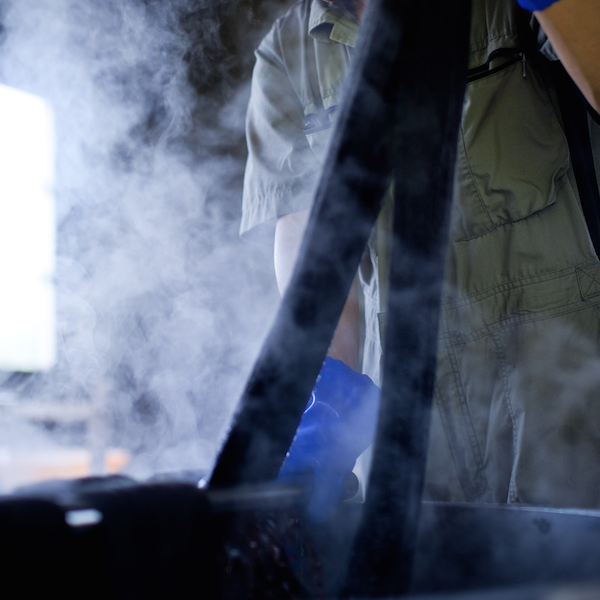
Dyeing
Homespun uses yarn-dyeing. The wool is dyed at the fiber stage,
before it is spun into yarn.
It is dyed over 1 to 2 hours and then thoroughly dried.
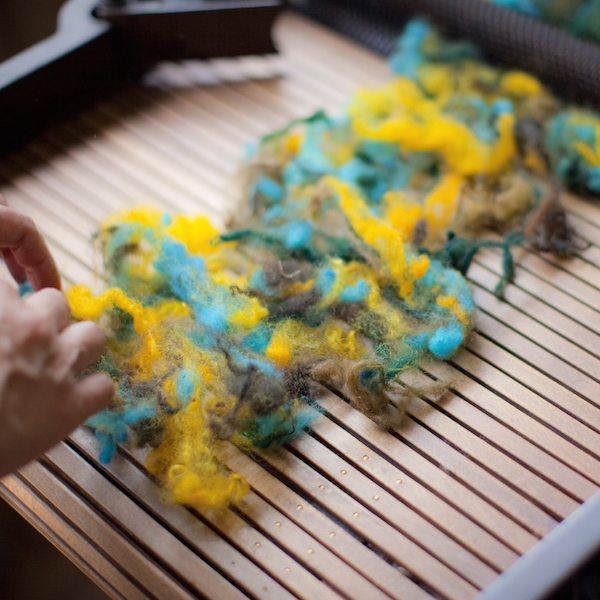
Carding
This process combs and arranges the tangled fibers.
The wool is passed through a roller covered with many short needles, combing the fibers
so that they all flow in one direction.
At this stage, various colors are combined and carded together to create
new colors, and since a single strand of yarn contains a mixture of various
colors, a rich, complex hue can be expressed once the fabric is woven.
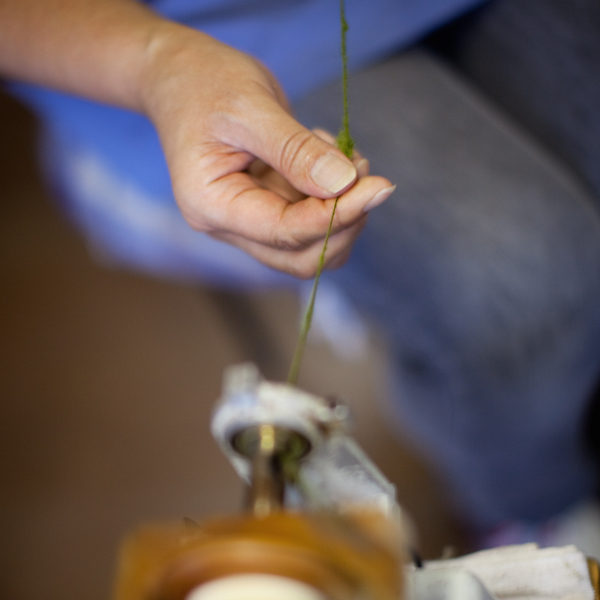
Spinning the yarn
The carded wool is held in the left hand while the right hand twists it into yarn.
Because the amount of fiber must be constantly adjusted to keep the thickness consistent,
this is a moment where the skill of the craftsperson truly shines.
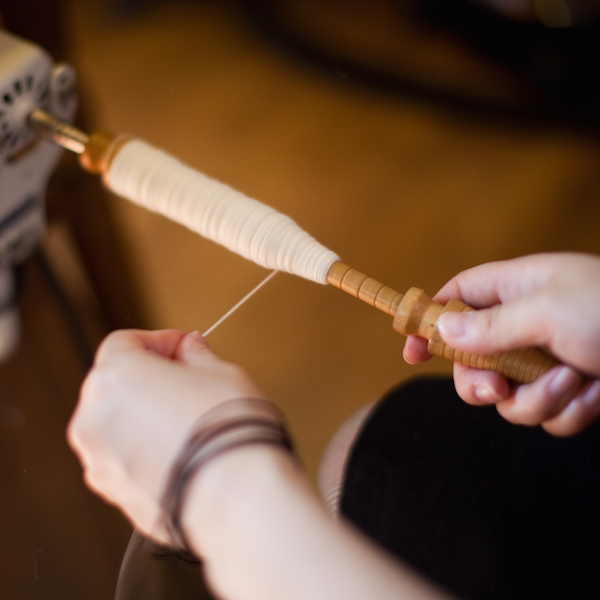
Winding the yarn
The finished yarn is neatly wound onto bobbins.
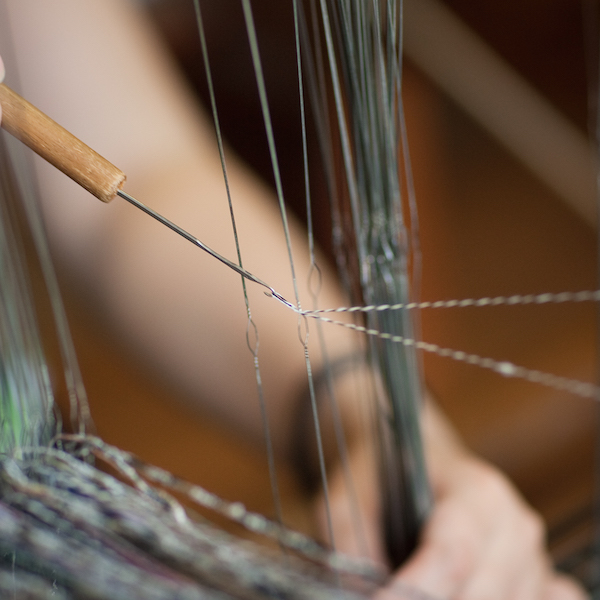
Heddle threading
The warp threads are set onto the loom. Each individual thread is threaded
through wire-like devices called heddles (sokou).
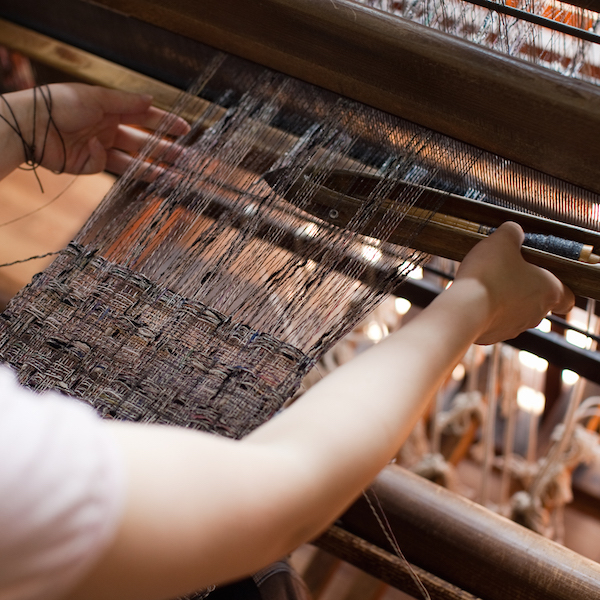
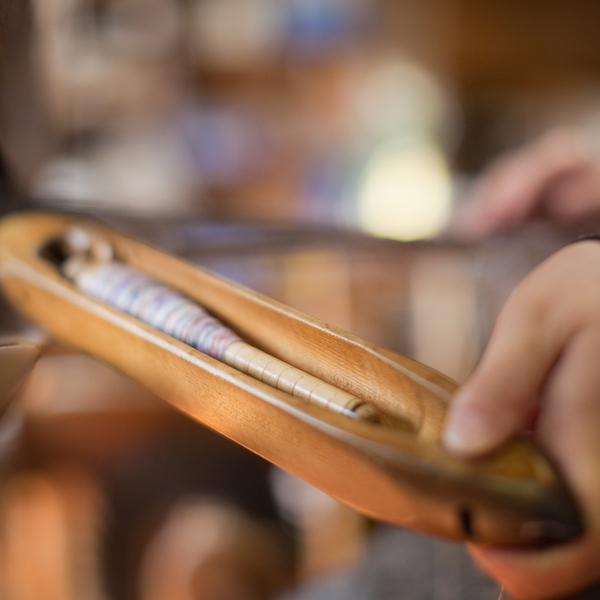
Weaving
The weaving process passes weft threads through the stretched warp threads.
The weft thread is set into the shuttle, and the shuttle is passed left and right through the warp.
Weavers carefully adjust for unevenness in thread thickness and for the pressure applied,
weaving carefully so that the result comes together as a single, consistent piece of fabric.

The nihon home spun muffler combines thick and thin threads,
as well as threads of different materials and textures,
creating variation in both appearance and feel.
Looking closely at the weave, you can see thick threads popping up here and there,
and spots where neps (small clumps of wool fiber) seem to burst
out of the weave — these details give the fabric a sense of depth and character.
It is a fabric that lets you feel the comfort and gentleness
found in its lack of uniformity.

There are three points to keep in mind when using it:
1. Snagging
2. Pilling
3. Washing
1. Snagging
As you can see from the weave, one characteristic of homespun is that
it's woven in a rather loose, coarse texture. Because the yarn is woven
without putting excessive strain on it, the fabric traps air and has a soft, fluffy feel—but on the other hand,
this also means it's more prone to snagging.
Please be careful of things like the zipper pull on a coat, or items
inside a bag that might catch on the fabric when placed inside.
2. Pilling
Pilling refers to those little fuzzballs that form on fabric.
Since this is primarily a wool weave, pilling will occur with use over time,
but rather than pulling them off, please snip them away with a small pair of scissors.
Also, to help prevent pilling, it's effective to brush the fabric after use
to smooth the direction of the fibers—but in that case,
please use a soft horsehair brush.
With a stiffer boar-bristle brush, the bristles may work their way into the weave
and cause the gaps to widen, so please be careful.
3. Washing
Since the weave isn't tightly packed, washing may cause the fabric to shrink.
Rather than washing at home, we recommend dry cleaning.


At ZUTTO, we're introducing a specially commissioned design for the ninon home spun muffler.
Since the design isn't overly long and can be wrapped in a compact way, it also pairs wonderfully with a men's suit, making it a great Valentine's Day gift as well.
▼nihon home spun Brand Page
Recommended Back Issues of "ZUTTO no Yomimono"
>>> Getting Familiar with Hand-Wound Watches
>>> Everyday Wool and Cashmere Care
GUIDE »
CONTENTS »
CATEGORIES »
- + Gifts by recipient
- + Gifts by scene
- + Clothing
- + Bags / Backpacks
- + Wallets / Card cases
- + Jewelry
- + Shoes
- + Rainy day outfits
- + Kitchen
- + Home
- + Babies / Kids
- + Japanese products
Earn Miles


Payment & Security




