


.webp)


.webp)


.webp)


.webp)


Welcome to ZUTTO
Free shipping for newsletter subscribers (some areas excluded)
- トップページ/
- ZUTTO Journal/
- ブランドストーリー/
- About the Japan-m...

What undyed+ means for Japanese-made blankets

undyed+ is a brand built around unbleached, undyed wool, offering products that bring a sense of comfort through the soft touch of natural fibers and a craftsmanship spirit that never grows old.
At ZUTTO, we've introduced their rugs and chair pads, and it's hard to believe that the rugs have now been part of the ZUTTO family for ten years.
From undyed+, a brand that has long focused on craftsmanship in Tibet and Nepal, comes a blanket (wool blanket) made in Japan as their final release this winter. With a quality you can appreciate through both sight and touch, it's one of the new everyday essentials we're excited to welcome into the ZUTTO family.
Last year, unable to bear the cold, we tried moisture-absorbing, heat-generating polyester bedding from a major manufacturer, but in the end we realized that natural materials do a better job of regulating body temperature. Japanese wool blankets have a comfort and gentleness all their own, quite different from European ones, and in that difference you can see a craftsmanship that carefully considers the delicate sensibilities of Japanese people.

Wool, as a material, has excellent moisture absorption and release properties, which helps regulate humidity inside bedding when made into a blanket. Its springy, fluffy texture also fits comfortably against the body, and its high insulating properties provide a solid sense of warmth. These are the very qualities that specially processed synthetic fibers advertise as their selling points—yet perhaps, in the end, they can never quite match the real thing they've been chasing.


We spoke with the folks at undyed+ about what makes this Japanese-made blanket (wool blanket) different from overseas products and synthetic fibers—the differences we could feel for ourselves.
A. This blanket (wool blanket) uses wool from New Zealand, woven for us in Izumiotsu City, Osaka. Izumiotsu is actually Japan's leading center for blanket production.
A. The trigger was the two years of the COVID-19 pandemic, but we'd long been interested in Senshu, and a good connection with a blanket manufacturer there gave us the chance to take on this challenge.
A. Japanese factories understand very well what Japanese people prefer and where their attention to detail lies. Since Japanese consumers place great importance on materials and texture, these factories can meet that discerning standard with the quality of their work. When we once made kilims in Turkey, for instance, the wool wasn't washed thoroughly enough and retained an odor—that kind of careful, meticulous attention to material and quality that's so common in Japan is rare to find overseas.
A. High insulation and moisture absorption—wool absorbs humidity while you sleep, which I think makes for better sleep than synthetic fibers can offer. Beyond that, it's less prone to static electricity, and it's durable, developing character the more you use it.
A.The blanket (wool blanket) uses yarn that's even finer than what's typically used, and through our own carefully balanced design, we've achieved a softer texture—one with a feel we believe is unlike anything else out there.
A. The designs are by Wakisaka-san, a Japanese designer we've worked with for many years who also designs for Nordic brands. We've prepared two designs with a warm feel that suits any interior. They're left undyed and woven in jacquard, so the color appears differently on the front and back.
Both designs are so charming it's hard to choose, and each has an undyed, natural quality that blends beautifully into a Japanese interior.


Jacquard weaving is a technique often heard of in products like tablecloths, curtains, and carpets—it refers to a way of weaving fabric so that the pattern or design appears three-dimensional and stands out prominently.
Osaka is home to a variety of textile and weaving industry regions, which developed from the Meiji era onward as different weaving techniques were introduced from Europe. Jacquard weaving is one such technique, one that has developed as an industry with a long history.

Here, we asked them to tell us about the manufacturing process.
The manufacturing is handled by Hinode Keori, a blanket and textile factory in Izumiotsu, Osaka, with a history of about half a century. Founded in 1968, this long-established maker produces about 90% of Japan's domestically made blankets. In 1993, during an era when acrylic blankets dominated the market, it became the first factory in Japan to successfully produce organic cotton blankets, leading the industry ever since.
A. Woven blankets begin with creating the pattern card for the design, followed by weaving, washing, raising the nap, and finishing—every step carried out by skilled artisans using techniques honed through years of experience.
The process is as follows:
Creating the pattern card (carving in the design)
↓
Weaving the fabric
↓
Washing
↓
Drying
↓
Raising the nap
↓
Finishing the edges
Final finishing
↓
Complete
and it goes in this order.
It's not just weaving—there's washing, drying, and raising the nap, each step taking real effort. Imagining old machines being run through all this really shows how demanding the work is.
We also received photos taken during production. Let's take a factory-tour feel and follow along with the process.

The pattern above is made up of a gathering of fine dots resembling a red-and-black checkerboard design, apparently the stage before creating the template used to produce the pattern on the Jacquard loom. Below is a close-up of that same pattern.

The long paper set up in the machine in the photo below is called monshi (pattern card paper). It's the state in which the red and black design shown above has been converted into data-like form on paper, so that the loom can reproduce it.
The monshi used to weave designs on a Jacquard loom is essentially the "printing plate" of the weaving world, but it's remarkably intricate. Just looking at the monshi, you can't tell what the pattern will be at all.

The image of the monshi hoisted up from above, with fine threads gathering below it, has quite a striking presence.

This shows the monshi set on the loom (hata), with the threads loaded and the loom in motion.

It's exciting just to imagine the wooden loom clattering and banging away, slowly weaving the fabric.

Once woven, the fabric goes through washing, drying, and then the napping process. Napping is judged by human eyes. It seems to be a delicate task—if napped too much, the fabric weakens and can tear, but if not done properly, it won't achieve that pleasantly soft texture.
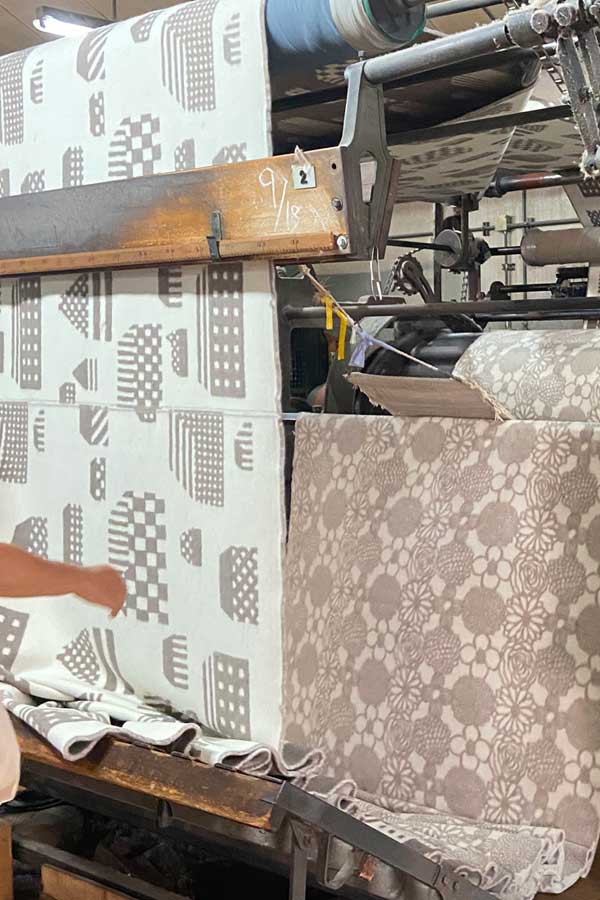
After passing through all these various processes, the Jacquard-woven blanket (wool blanket) is finally complete. The comfort you feel when you hold the blanket comes from the delicate sensibility of the Japanese craftspeople and the accumulated skill of a long-established blanket-producing region.


The blanket (wool blanket) measures approximately 100 cm wide by 150 cm long. It's not only great as a lap blanket for the sofa or car, but also recommended for laying over a down comforter. Those seeking extra warmth can also use it as an "under blanket" to place beneath the body. It's a blanket that will likely bring more comfort and warmth than any you've used before, making you look forward to getting into bed.
This makes a wonderful gift for those mindful of their health or for someone living far away. It's also well suited as a return gift, since the recipient can enjoy using it for a long time. That was our introduction to the undyed+ blanket (wool blanket).

Image: wool blanket (Katsuji Wakisaka-designed Jacquard-woven blanket), Little Cuddle Bear, garabo-spun pillowcase
We've heard that many people, during the self-restraint of the COVID pandemic, made discoveries in their everyday lives—realizing how grateful they were for family and friends, or noticing the charm of a neighborhood shop they'd never paid attention to before. Watching how things unfold around the world, this was a ZUTTO find that has once again sparked our interest in Japanese craftsmanship.
GUIDE »
CONTENTS »
CATEGORIES »
- + Gifts by recipient
- + Gifts by scene
- + Clothing
- + Bags / Backpacks
- + Wallets / Card cases
- + Jewelry
- + Shoes
- + Rainy day outfits
- + Kitchen
- + Home
- + Babies / Kids
- + Japanese products
Earn Miles


Payment & Security




