.webp)


.webp)


.webp)


.webp)


- トップページ/
- ZUTTO Journal/
- ブランドストーリー/
- Wool, reborn. An ...

Wool, brought back to life. An original ZUTTO stole born from the wool-regeneration techniques of Bishu, a collaboration between Keshichi and ZUTTO.
Not letting precious natural resources go to waste. Wool regeneration—not a trend
The "mass production" and "mass disposal" that are the dark side of the fashion industry have come under increasing scrutiny, and sustainable items and recycled fabrics are being used more and more. Perhaps moving away from fashion as pure self-expression and display, centered purely on design, and toward materials, methods, and brands that resonate with one's own personal values is becoming the kind of "choosing what to own" that grown-ups should aim for.

In the fashion industry, where this kind of movement has been gathering momentum, there is Keshichi—a textile born from wool regeneration that has continued in Bishu long before the term "recycled wool" ever existed.
Keshichi wasn't born out of the "trend" of sustainability or recycling. It came about as a way to preserve, as part of the local culture, both the technique of wool regeneration and the spirit behind it.
This time, we're introducing an original ZUTTO stole made using Keshichi fabric.
"Keshichi," a fabric that embodies the history, culture, and technique of Bishu in its entirety
In Bishu (the area centered around Ichinomiya City in Aichi Prefecture), Japan's largest wool textile producing region, a technique for reclaiming worn-out sweaters and scrap wool from spinning mills by processing them back into raw fiber has been developing for over half a century.
Even during the era of postwar shortages, sheep farming has never been widespread in Japan due to its climate. Naturally, domestically produced wool remains very scarce even today. Wool regeneration technology developed as a way to avoid wasting this precious natural resource, one that Japan has always had difficulty producing for itself. Against this historical backdrop, wool regeneration gradually became a defining characteristic of the Bishu region.

Oshika Co., Ltd., the company behind the Keshichi brand, is a textile maker that runs several wool fabric brands, including "blanket (coats)" and "Ito to Iro (cut-and-sew items)," both of which are also featured on ZUTTO. Since its founding in 1922, the company has led the way in Bishu wool-making as a weaving mill, fabric wholesaler, and manufacturer.

The brand philosophy of Keshichi is "to pass on to future generations a culture that values resources."
Oshika had long been making fabric from regenerated wool, but in 2019 they launched Keshichi as its own brand, with the aim of making the wool-regeneration technique and the spirit of not wasting wool more widely known as part of Bishu's culture—and of getting people to actually wear it.
"A kimono is made from a single bolt of cloth, cut in a way designed to leave no fabric scraps behind. That reflects the spirit and skill of the Japanese people, who have always made a habit of not wasting resources. Keshichi's wool regeneration is the same—it's a culture."

The term "Keshichi," which comes from the blend ratio of the yarn, has long been recognized and used in Bishu, but because it referred to used clothing, it apparently carried a negative image for a long time. These days, however, recycling and sustainability have become the norm, and Bishu's wool-regeneration culture is now drawing attention from around the world.
Wool, brought back to life with a fiber-reclaiming machine
Essential to wool regeneration is the "hanmouki" (fiber-reclaiming machine). This is a machine that breaks fabric back down into raw fiber, and it was developed in Japan, inspired by cotton-carding machines used to loosen cotton fibers and remove impurities.
How regenerated wool is made
1. Collecting resources

A wide range of "resources"—used sweaters and fabric, thread scraps and offcuts from sewing factories, and scrap wool from spinning mills—are collected from all over the country. (Wool materials only.)
2. Sorting by color

Materials are sorted by color, and the blend ratio is adjusted so the result is 100% wool. (Any tags attached to the products are also removed at this stage.)
Since dyeing is generally not done, matching colors so the same shade comes out consistently every time—especially when making the same fabric repeatedly—is an extremely important sorting task, carried out by skilled craftspeople with deep knowledge of wool regeneration. The care and precision of this work directly determine the quality of the resulting yarn and fabric.
3. Passing through the fiber-reclaiming machine to return to raw fiber

This is the process of loosening the fabric and returning it to a raw fiber state. The cut fabric passes through roller after roller fitted with countless needles on the fiber-reclaiming machine, gradually growing smaller and looser.


Left as is, the fibers would be too short to spin into yarn, so a small amount of synthetic fiber is blended in to balance strength and texture. This blend—70% wool ("ke-shichi," literally "wool seven")—is where the brand name comes from. (70% wool is combined with 15% polyester, 10% acrylic, and 5% nylon.)
4. Making yarn: carded spinning
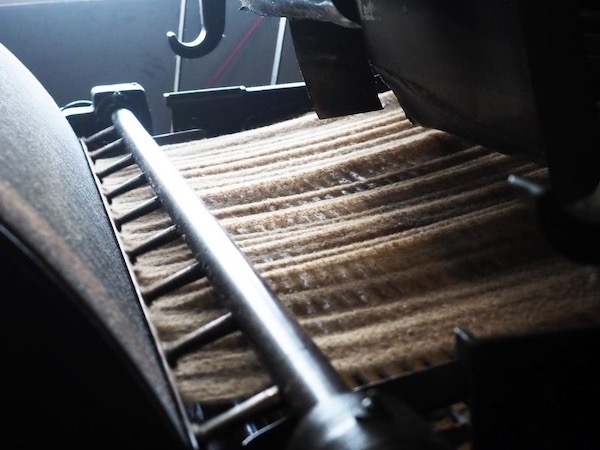

The fibers are gathered together, evened out, and spun, and through this process wool yarn is created.
5. Slowly woven into new fabric


Using old-style looms unique to the Bishu textile region, skilled craftsmen weave slowly and carefully, taking their time. By not putting excess tension on the thread and weaving as if incorporating air along with it, the fabric becomes plump and soft.
Keshichi weaves a variety of wool fabrics, including flannel, chambray, melton, and denim.
Maintaining these old-style machines, which surely are no longer manufactured, must be a great challenge. Yet Keshichi continues this work out of a belief in the value of the colors and texture unique to reclaimed wool made from a mix of different materials—qualities even richer than what brand-new wool can offer—and in the importance of carrying this culture forward.

A ZUTTO original stole made using Keshichi flannel
Using Keshichi's flannel fabric, revived through this process, we created a ZUTTO original stole to wrap yourself in this autumn and winter.
Before choosing the fabric, our planning staff and designer had originally envisioned making a thin, plain-surfaced stole. But after falling in love with the wonderful qualities of Keshichi's flannel fabric, they changed direction and decided to create a stole designed specifically for this fabric.

Here are the characteristics of Keshichi's flannel fabric.
・It has a moderate thickness while still feeling light and supple.
・Its fluffy texture provides excellent warmth and a wonderful feel against the skin.
・Different colored threads are used for the warp and weft, and the surface is further brushed to create a heathered, softly toned color impression.
・It is woven slowly and carefully by craftsmen using an old-style loom called a "rapier," taking care not to strain the thread.

To let people fully appreciate the qualities of this distinctive flannel fabric, we decided to keep the design as simple as possible. The key feature is the piping that runs around all four sides. By using a rustic cotton piping, it blends naturally with the fabric, creating a design that further highlights the fabric's appeal. We used piping in a similar but slightly different shade, adding a subtle accent when wrapped around the neck, even within the overall simplicity.

Also, since the material has a certain firmness, we added a slit so the stole can be held in place once wrapped. This slit allows for variations in how you wear it, letting you enjoy far more styling options than with a plain stole.

The basic way to use the slit is very simple. Wrap the stole once around your neck so both ends hang down in front, then thread one end through the slit and adjust the shape.

We've prepared 5 colors. None of them are flashy; every color has an easy-to-wear quality that gently complements autumn and winter styling. The planning team's top recommendation is "brick." Different from both brown and orange, it's a lovely seasonal color reminiscent of autumn fallen leaves. If you already own a black or gray stole, we highly recommend this brick color.


When we think of "monozukuri" (craftsmanship), it may feel like the process of shaping the final products we pick up and use. But the fabric that exists before it becomes a product is also a form of monozukuri. This journey between Keshichi and ZUTTO made us feel how one act of monozukuri connects to another, ultimately becoming the items we actually use.
▼Click here to purchase the Keshichi Flannel Piping Stole

GUIDE »
CATEGORIES »
- + Gifts by recipient
- + Gifts by scene
- + Clothing
- + Bags / Backpacks
- + Wallets / Card cases
- + Jewelry
- + Shoes
- + Rainy day outfits
- + Kitchen
- + Home
- + Babies / Kids
- + Japanese products
Earn Miles


Payment & Security