.webp)


.webp)


.webp)


.webp)


Welcome to ZUTTO
Free shipping for newsletter subscribers (some areas excluded)
- トップページ/
- ZUTTO Journal/
- ブランドストーリー/
- Nagatani-en's Don...

The appeal of Nagatanien's donabe (Japanese clay pots), just what you want in the cold season. Including staff favorites and a new product.
Now that the season has turned properly cold, you might suddenly find yourself thinking, "I wonder how that person is doing these days?"—recalling a friend you haven't seen in a while. Gathering in large groups is still something to hesitate over, but I'd love for there to be something to look forward to during small home parties or when relatives gather at year's end and New Year's.
How about a slightly unusual piece of cookware that's fun to place in the middle of the dining table? Add the pleasure of delicious food to weekends spent with family from now on, long holiday periods, home parties with friends you haven't seen in a while, or gatherings with relatives. This time we're introducing Nagatanien's Iga donabe, including the newly launched Roast Donabe.
The appeal of Nagatanien, which brings the goodness of Iga donabe to the present day

The landscape of Iga
Since building its kiln in 1832 (Tenpo 3), Nagatanien has carried on the tradition and techniques of Iga-yaki (Iga ware). As a maker that keeps a keen sense of the lifestyle evolving alongside civilization, they are always crafting with an eye toward the times.
On Iga clay, ideal for cooking
Iga-yaki, whose production began in the Kamakura period, was once used as chatou (ceramics for the tea ceremony) and today serves as everyday tableware. Iga City, the production area, is said to have once been the bottom of Lake Biwa, and the clay taken from this stratum contains abundant organic matter that lived there as far back as four million years ago.
When this clay is fired at high temperatures, the organic matter foams up, creating numerous fine pores within the clay. Clay in this state doesn't conduct heat immediately but first stores it, allowing heat to be transmitted slowly and thoroughly—which is exactly what makes it suited for cooking. Among the clays found in Japan, Iga clay is said to be the only one with enough heat resistance to be made into donabe.

Nagatanien's "Noborigama" (climbing kiln), which is also designated as an Important Cultural Property
Taking advantage of its heat-resistant properties, Nagatanien employs a firing method called "Iga's seven firings," which fires the clay repeatedly at high temperatures. However, some pieces end up breaking inside the kiln from being fired too much. Only a small portion can be taken out as finished products, making this an extremely labor-intensive form of pottery. Iga-yaki that emerges through this process is characterized by its powerful shapes and the distinctive texture of the clay.
Bringing donabe, the long-lasting kitchen staple, to more people

Ibushigin (tabletop smoker), for enjoying smoked dishes at home
Nagatanien's pots and cookware made from Iga clay are all items designed to fit modern life. They serve multiple purposes, and you can really feel the goodness of donabe through them. Even with simple seasoning that lets the flavor of the ingredients shine, the results are surprisingly delicious—so there's hardly anyone who doesn't like them. Since you don't have to fuss over seasoning, they're also convenient when you're having people over. And unlike electric cooking appliances, all you need is a flame, so they come in handy for camping and barbecues too.
There are many different kinds of donabe. Which "Nagatanien donabe," specialized for the dish you want to make, is right for you?
NEW! Roast Donabe

As its name suggests, the Roast Donabe is a clay pot that can roast food. Thanks to the properties of Iga's coarse clay (its porous structure), it has excellent heat-retaining ability, and its far-infrared effect lets heat penetrate thoroughly to the very core of ingredients. A major feature of this pot is that it can be used empty over direct heat despite being a donabe, giving it the versatility to handle "grilling," "sautéing," and "simmering" in addition to roasting—truly multifunctional. (It cannot be used for deep-frying.)


What it's especially good at is "waterless cooking". In this method, the moisture naturally contained in ingredients like vegetables, meat, and fish is used for simmering or steaming, so the flavors stay concentrated and full of umami rather than becoming diluted. For example, curry or beef stew can be transformed into a rich, deeply flavorful dish using only the nutritious moisture released from the vegetables and meat—no added water needed. The sealing structure between the body and lid, which creates an airtight seal, is patented, and the fact that this single pot can produce an impressively varied table—from roasted dishes to steamed vegetables to baked sweet potatoes—is the greatest appeal of the Roast Donabe.
Kamado-san, for enjoying new-crop rice at its best

"Rice cooked in a donabe"—even knowing how delicious it is, this might be one of those things people hesitate over because it seems like a lot of trouble. For those who've held back with excuses like "these days we have such functional rice cookers...," Nagatanien created a pot that lets you cook delicious rice easily: the Kamado-san.

No need to adjust the flame
The Kamado-san (rice donabe), which is porous and thick-walled, is built so that the pot itself handles the traditional wisdom of "start low, then bring it up to a boil" ("hajime chorochoro, naka pappa"). The included instructions say, "Aim for a flame that reaches about halfway up the white, unglazed portion at the bottom of the pot." When you actually use it that way, you get fluffy, delicious rice even without paying close attention while it's cooking.
A double lid prevents boil-overs
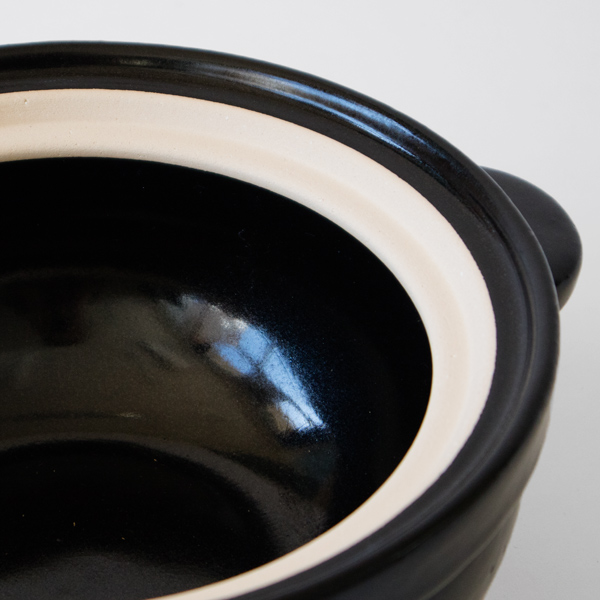
The Kamado-san has a double-lid structure, and the combined weight of the inner and outer lids applies pressure to the rice inside, preventing boil-overs. Not having to worry about a mess around the stove from boiling over, or the flame weakening as a result, is very convenient while you're juggling the various steps of cooking.
Once cooked, let it steam and then bring it straight to the table. Because a glaze with high far-infrared effect is used, heat passes all the way through to the core of the rice, and the thick-walled construction stores heat before gently transmitting it, resulting in truly plump, fluffy rice. Rice served straight from the donabe (earthenware pot) looks so delicious that it's a feast in itself. Please try tasting the seasonal flavors from Kamado-san, whether it's hearty takikomi gohan (mixed rice) or delicious freshly harvested rice.

The coarse Iga clay breathes just like a wooden ohitsu (rice tub), preventing the rice cooked in Kamado-san from becoming sticky. A wooden Miyajima rice paddle is included as well.

Our staff love using Kamado-san too. This time of year, they say they especially look forward to slowly simmering freshly harvested rice.
A thick-walled donabe for thorough simmering, the Iga Donabe Ame Glaze

Because each piece is handmade one by one, Nagatani-en's Iga donabe has a natural, distinctive character. It's perfect for winter hot pots like mizutaki, and of course for cooking rice, but you can also take advantage of the donabe's ability to draw out moisture from ingredients to make classic stir-fried dishes like yakisoba. The Nagatani-en Iga Donabe Ame Glaze has a flat design, so it's also nice that you can bring it straight to the table as a large serving platter. Since it can be used in the microwave and oven as well, you can even easily make dishes like kabocha squash gratin.

The base is made using coarse clay unique to Iga, engineered so that heat passes through easily, and the glaze with its high far-infrared effect ensures that heat is applied evenly to the ingredients, allowing the flavors to soak thoroughly into the food. Because it also has strong heat retention, it has the same effect as slow simmering over low heat even after the flame is turned off, drawing out even more of the ingredients' natural umami. This is a donabe that professional chefs have long favored as a cooking vessel for simmering, grilling, steaming, and roasting. Enjoy the limitless possibilities of this donabe, which reflects Nagatani-en's ongoing pursuit of letting people gather happily around the table and fully savor the true deliciousness of their ingredients.
A versatile donabe, the Bistro Steaming Pot

This Bistro Steaming Pot is an all-purpose donabe that can steam, simmer, roast, stir-fry, and grill. It comes with a ceramic steaming rack, so you can enjoy healthy steamed dishes. It's ideal when you want to savor the natural flavors of fresh vegetables and meat. Of course, you can also remove the rack and use it as a regular pot, making it a lively, festive addition to bring to the table.

Its compact size means it doesn't take up much space and is easy to care for. Its tasteful, stylish design also makes for a lovely centerpiece when placed on the table.

Trying Out the Roast Donabe with a Staff Member Who Loves It
We asked a staff member who actually uses Nagatani-en's Roast Donabe regularly what makes it so good.
"I think it's easier to understand the appeal by actually trying it than by just hearing about it!" So we decided to cook something right away.
Staff member: Today I'm making waterless curry. It really can be made without adding any water, so please take a look.

First, I just toss the chopped ingredients into the pot. Since the dish is made using the moisture from the vegetables and meat, the key point is to include vegetables with plenty of water content. I find it works well when I use a generous amount of tomatoes, so I put in plenty.

Put the lid on and let it simmer. The great thing about the Roast Donabe is that, even though it's a donabe, it can be dry-heated—when you put it on the stove, the base doesn't get too hot, and the flame doesn't accidentally go out. It lets you cook thoroughly with low heat, so you don't need to worry about burning. Its weight, combined with a groove on the inside of the lid where steam from inside collects, helps create a tight seal.
When people hear "waterless curry," some might think of a pressure cooker, but unlike a pressure cooker, some say it's convenient that you can taste-test the dish partway through cooking with the Roast Donabe.

After simmering for a while, this much liquid comes out! At this point, add the curry roux and bring it to a boil again.

With this Roast Donabe, I was able to make about 4 to 5 servings of curry! It's packed with vegetables, rich and thick, and since no water is added, the flavor has real depth and is really delicious. I'd say this Roast Donabe isan all-purpose donabe that combines the best of a waterless-cooking pot and a traditional earthenware pot.
On another day, I also tried making roast pork.

All I did was put in a block of pork, surround it with chunks of carrot and onion, and turn on the heat. Because it cooks slowly, the meat comes out tender while the excess fat renders off, making it very healthy. The vegetables turn out fluffy and delicious too, even with simple seasoning!

When making the roast pork, I was careful to first sear the meat in a separate frying pan so that it wouldn't burn onto the donabe. After that, I placed it on the included rack and slowly cooked it through in the Roast Donabe, letting the excess fat drip down below the rack. You can make things like chashu (braised pork) using the same method too!

One thing I really liked while using it is that there's a notch on the underside of the pot designed to keep the base from getting too hot, and it fits perfectly onto the stove's trivet, giving it a stable, secure feeling.

I love it so much that I've only shared the good points, but the downsides are its weight and how hard it is to clean when something gets scorched onto it. Not having the typical "handles" you'd expect on a donabe (Japanese clay pot) means it doesn't get in the way when storing it, and it removes that "donabe feel," so I think it suits any kitchen or living room.
If you use the included wire rack, you can also make grilled dishes using the rack, like seared vegetables, grilled mochi, or roasted sweet potatoes. You can even use this pot to enjoy grilling mochi at New Year's.
This time I made roasted sweet potatoes as a snack, so I'd like to introduce that too. It's great as a snack for when the kids come home from playing outside, so I make it often.
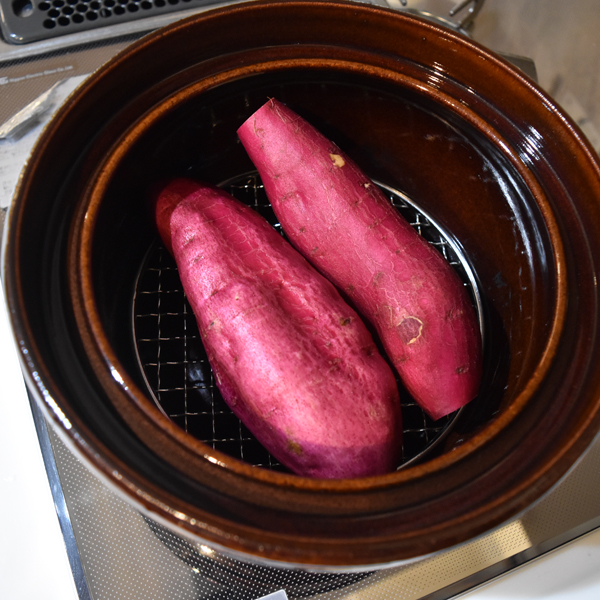

It's convenient that you can just let the pot cool down as is after heating it on the stove! Since it retains heat well, it doesn't cool down all at once, which is another point in its favor—I can make it before picking up my kids, turn off the heat, go out, and come home to find perfectly warm, ready-to-eat sweet potatoes waiting for me. With other methods of making roasted or steamed sweet potatoes, they come out piping hot and can risk burning you, so while this may seem like a small point, for someone like me who makes this regularly, it's actually a big one.

Another great point is that Nagatani-en officially publishes a recipe book. All of their cookware fits naturally into everyday life while also inspiring you with a positive feeling of "maybe I'll try making all kinds of dishes."
At first glance, Nagatani-en handles donabe that seem specialized for particular dishes, like roasting or steaming, but that doesn't mean each one only has a single use. Any of their donabe can be used for cooking rice, hot pot dishes, or simmered dishes, so first decide which item you most want to use, and give a Nagatani-en donabe a try!
▽You can find Nagatani-en's wonderfully appealing products here
GUIDE »
CONTENTS »
CATEGORIES »
- + Gifts by recipient
- + Gifts by scene
- + Clothing
- + Bags / Backpacks
- + Wallets / Card cases
- + Jewelry
- + Shoes
- + Rainy day outfits
- + Kitchen
- + Home
- + Babies / Kids
- + Japanese products
Earn Miles


Payment & Security