.webp)


.webp)


.webp)


.webp)


- トップページ/
- ZUTTO Journal/
- ブランドストーリー/
- Durable yet suppl...

Durability and suppleness through the vulcanized construction method: PRAS canvas sneakers
Have you ever heard of sneakers made using a construction method called "vulcanized construction"?
In Japanese it's known as "karyū-gama seihō" (vulcanization kettle method), referring to the technique used to bond a sneaker's upper (the top portion of the shoe) to its sole. It's a rare and precious method today, with only a few makers still using it, but it's no exaggeration to say it's one of the traditional methods that form the very foundation of sneaker making.
The canvas sneaker brand we're featuring this time, PRAS, also makes its shoes using this now-rare vulcanized construction method. Let's take a deeper look at PRAS's dedication to its construction method and materials, along with the thoughts behind the brand. The keywords are "durability" and "comfort."

What exactly is the "vulcanized construction" method?
In Japanese it's called "karyū-gama seihō," referring to the method of bonding a sneaker's upper to its sole. The upper and sole are molded together using raw, not-yet-hardened rubber, then placed in a special kettle where high heat and pressure are applied while sulfur and other vulcanizing agents react with the rubber, hardening it and fusing it together. This allows the canvas upper and rubber sole—two very different materials—to be powerfully bonded and firmly integrated as one.
This method was established in the 1840s. Before then, there had been attempts to use rubber for soles, but durability issues prevented these from becoming viable products. However, the vulcanized construction method greatly increased the flexibility of rubber, and it's said that this led various shoe manufacturers to begin producing rubber-soled sneakers in pursuit of both comfort and durability.


Shoes require materials and components with the appropriate durability. Raw rubber kneaded with the right blend, outer fabric bonded to its lining with rubber cement, and rubber tape reinforced with canvas inserted inside for extra strength—each and every component is carefully crafted.


Skilled craftspeople take the flat-cut pieces and sew them into three-dimensional form. By having a single craftsperson master the skills of multiple processes, the workshop improves production efficiency while also passing down its techniques.


The sewn upper is stretched over a foot-shaped last, the sole is attached, and rubber tape is wound around the entire shoe. This process requires a subtle sense of touch and force, and it's said that without a human hand, the finished product would be affected.

Each pair is set individually onto the lasting machine, one shoe at a time.

The process of placing the shoes into a special kettle and applying high heat and pressure at 120°C for 70 minutes is called "karyū," or vulcanization. The raw rubber, which enters the kettle in an unformed state, emerges with the elastic properties of true rubber.
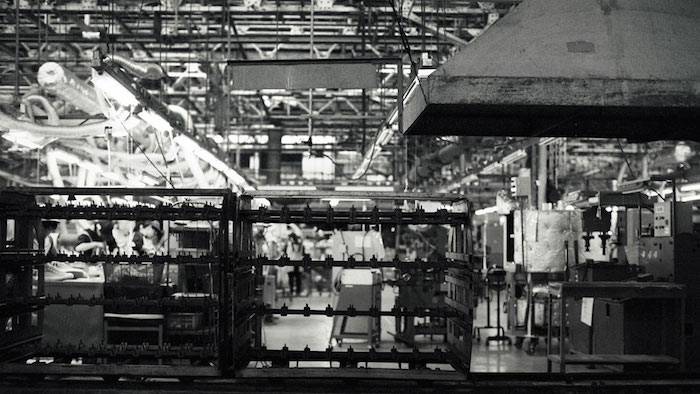

Let's look at the characteristics of the vulcanized sneakers made through this process.

・The upper and sole are strongly bonded, so there's little risk of sole separation
When adhesive is used to join two different materials like a canvas upper and rubber sole, the bond often peels apart with use. But since the vulcanized construction method fuses them together with such strength, that concern is dramatically reduced.

・Rubber tape reinforces the entire shoe
Rubber tape is wound all the way around the shoe to reinforce the boundary between the rubber sole and the upper, giving it durability against sideways movement as well. This rubber tape is also what gives vulcanized sneakers their distinctive look.

・Because bonding and molding happen simultaneously, the shoes have flexibility and hold their shape well
Compared to shoes made by gluing on a rubber sole, these bend naturally at the points that flex when you walk. Sneakers worn for a long time often develop cracks in the rubber near the big toe and little toe, but with this method, that risk is much lower as well.

The concept behind the PRAS sneakers we've introduced here is "JAPANISM PRODUCT."
Beyond simply being manufactured in Japan, the brand set out to convey the inner qualities of Japanese craftsmanship—"sincerely facing the materials," "delicate yet earnest making," and "honesty, humility, and thoughtful care." It's curious how, once you hold the product in your hands, you can sense that concept embodied within it—these are sneakers that carry a distinct atmosphere all their own.
The brand was established in 2015, but all of its production is handled by MOONSTAR, a long-established shoe manufacturer in Fukuoka. Familiar to sneaker enthusiasts, MOONSTAR began making tabi (Japanese split-toe socks) in Kurume City in the 6th year of the Meiji era (1873). Ever since, the company has pursued shoes suited to the Japanese foot, in both shape and material.
The canvas used for the upper is Kojima canvas, made in Kurashiki, Okayama Prefecture, which produces 70% of all domestically made canvas. Canvas is a thick, plain-woven fabric made from twisted cotton threads; it's breathable, sturdy, and develops character the more it's used. Kurashiki has long been known for its cotton cultivation and flourished as a major center for canvas production. The canvas born in Kurashiki carries a long history and a track record of proven quality.

The canvas is an original PRAS material. Calculating for its use as a sneaker upper, the thread density in both the warp and weft is slightly reduced compared to standard No. 10 canvas (12.6oz), resulting in a fabric thickness that's ideal for sewing.
PRAS is, in this way, a sneaker label born from combining MOONSTAR's shoemaking expertise with Kojima canvas. The creation that emerges when Kurume and Kojima are brought together—that idea, too, is embedded in the brand's name.


The PRAS sneakers made with this vulcanized construction method have a simple design. The canvas upper comes in a single unbleached color, and only the rubber portion that wraps around the shoe is offered in three colors: OFF-WHITE, BLACK, and BROWN.
You get the impression that these shoes are competing on shoemaking technique and quality of materials.

▲The red stitching at the heel makes a nice accent. The brand name appears on the rubber tape section.

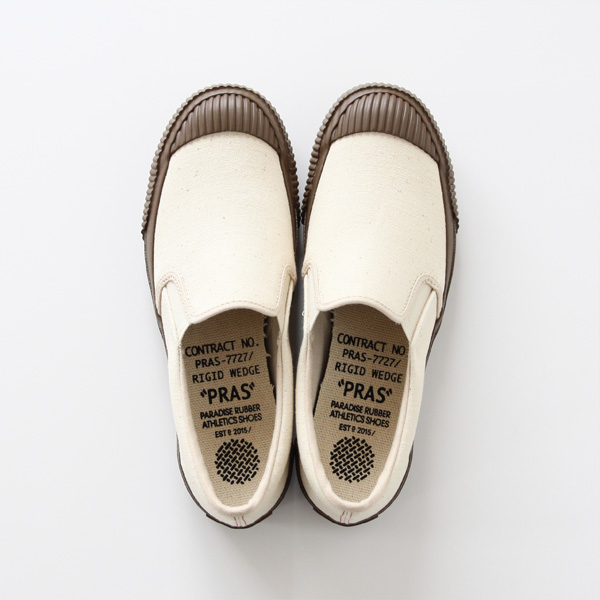
A slip-on type. With no laces, you can fully enjoy the texture of the canvas. It gives a clean, streamlined impression, and pairing it with a skirt lets you enjoy a look that isn't overly casual.


Hat: fog linenwork / Claire Linen Hat, Graphite

Since the upper is made of unbleached canvas, dirt becomes noticeable the more you wear the shoes. Many people think canvas sneakers look cool with a bit of dirt and a worn-in feel, so it really comes down to personal taste—but shoes tend to become unwearable more often because they've "gotten dirty" or "lost their shape" than because they've actually broken. So if you're aiming to wear a pair for a long time, it's worth keeping them clean.
【After wearing】
・Brush off dust easily with a shoe brush
・If the rubber part at the toe is dirty, wipe it with a damp cloth
【When there is noticeable dirt】
Vulcanized sneakers can be washed with water.
1. Remove the laces and soak the shoes in water or lukewarm water.
2. Wash with shoe detergent or a neutral detergent, scrubbing heavily soiled areas
with a brush or toothbrush.
3. Rinse thoroughly.
4. After removing excess water, reshape the shoes with newspaper and dry them in a well-ventilated, shaded area.
The key is step 3, rinsing. If detergent isn't rinsed out completely, it may leave stains, so be sure to rinse thoroughly. For step 4, always dry the shoes in the shade.
When we asked the maker, they said that basically it's fine to wash them vigorously, with no problem at all. And the real secret to making them last, they said, is washing them. Since the upper is canvas, washing it after it gets dirty from wear tightens up the weave of the canvas, so the shoes tend to last relatively longer compared to wearing them continuously without washing.

At present, only a handful of companies in Japan still make shoes using the vulcanized construction method. In fact, it's said that not a single company remains in the United States, the very country where this method was invented—which shows just how rare it has become.
It takes a great deal of labor and effort—about twice as long as making ordinary sneakers—but sneakers made with the vulcanized method have a supple, natural arch and three-dimensional shape that conforms to the foot. They also have a certain nostalgic, classic atmosphere that shoes made with other methods simply can't achieve, which is part of their charm.

GUIDE »
CATEGORIES »
- + Gifts by recipient
- + Gifts by scene
- + Clothing
- + Bags / Backpacks
- + Wallets / Card cases
- + Jewelry
- + Shoes
- + Rainy day outfits
- + Kitchen
- + Home
- + Babies / Kids
- + Japanese products
Earn Miles


Payment & Security