.webp)


.webp)


.webp)


.webp)


Welcome to ZUTTO
Free shipping for newsletter subscribers (some areas excluded)
- トップページ/
- ZUTTO Journal/
- ブランドストーリー/
- The Light of Choc...

The Light of Chochin Illuminates Tradition and the Future: Chochin-Making at Suzuki Mohei Shoten
There is something nostalgic and soothing about the light of a chochin (paper lantern). Many people find comfort in candlelight, and it may be that the warm orange glow filtering through washi (Japanese paper) offers a similar sense of healing. Perhaps the gentle light of a chochin is exactly what stressed-out modern people need.
Suzuki Mohei Shoten will mark its 160th anniversary in 2025. This long-established maker has continued to ask itself what it can offer to modern life while carefully carrying on its old traditions, sometimes combining new technologies that were the first of their kind in the industry, all in the pursuit of chochin that illuminate and enrich life today. Let's take a closer look at the deep dedication and appeal of Suzuki Mohei Shoten, which creates chochin that suit both Japanese- and Western-style rooms alike, transcending the boundary between the two.

Suzuki Mohei Shoten was founded in 1865 by Suzuki Mohei IV. After incorporating in 1951, the company came to be called "Suzumo-san" by wholesalers in Tokyo, and the affectionate nickname "Suzumo" has stuck ever since.
At the time, hand-painting was the standard practice in the chochin industry. Rather than stopping there, Suzumo chose to move forward with the times in order to better serve the everyday lives of its customers, introducing printing technology that was the first of its kind in the industry. Since then, without ever letting go of the craftsman's handiwork, the company has continued to grow alongside Japan, introducing numerous industry-first technologies along the way. As a brand, it creates products that feel both fresh and nostalgic at once, blending handcrafting techniques—which have woven together skills, human connections, and trust built up over its long history—with a hybrid of new machine manufacturing.

Suzumo's greatest strength lies in its people. The company values every connection involved—between Suzumo and the craftspeople it works with, and between the chochin and the people who hold them in their hands. Perhaps it is this warmth, this care for people, that is passed from the handiwork into the chochin themselves, warming the hearts of those who see them.

・Bringing Chochin into Everyday Life
The chochin, something everyone knows, has seen its role shift along with the changing times. In the past, a chochin was above all a light to illuminate the dark night—essentially a substitute for a flashlight. But today, surrounded as we are by more convenient alternatives, the chochin has come to mean more than just "light." In its traditional uses, it appears as an Obon lantern, a seasonal fixture at festivals and events, or a shop sign out front. This time, we turn our attention to the chochin as indirect lighting that brings a sense of calm into everyday life.

One distinctive feature of the chochin is that it can be folded flat. This "culture of folding" arose from the ingenuity of living richly within limited space—opening the lantern to give light, then folding it away when not needed. This is a point especially worth noting for those who like to keep things tidy, or who live in the city. This function, absent from ordinary indirect lighting, is precisely what makes the chochin so appealing, and it is part of its tradition.

Suzuki Mohei Shoten has always valued the convenience rooted in this folding culture while never hesitating to develop new technologies in response to ever-changing lifestyles. Born from this spirit is the Furin Chochin (Wind Chime Lantern), a piece designed to suit modern living.

Even in summer, when the daytime heat can leave you feeling utterly drained, the evenings offer a bit more relief—and it feels wonderful to open a window and let in the night breeze, soothing a body chilled by the air conditioner. What makes these quiet, nature-filled moments feel truly special, even if only briefly, is the furin (wind chime), a familiar symbol of summer.
As its name suggests, the Furin Chochin from Suzuki Mohei Shoten combines a wind chime and a chochin into one exquisite piece, delighting both the eyes and the ears. Listening to the beautiful "riin, riin" ring of the wind chime naturally brings a sense of calm to the heart.

When most people hear the word "furin," they probably picture something like the wind chimes below.

While glass and iron wind chimes are the norm, Suzuki Mohei Shoten created a large furin by covering the bell with a washi chochin. Watching the chochin sway gently, back and forth, in the breeze, you can feel the heat of summer melt away as your mind settles into calm.

Of course, its role as a "chochin" remains important too. Pulling the swaying strip of paper produces a "click," much like an electric light switch, and the chochin glows softly. Rather than a real flame, it's lit by a safe light powered by two AA batteries.
This light captures the essence of Suzuki Mohei Shoten's approach of blending tradition with cutting-edge technology. When the Furin Chochin catches the wind, its light flickers and sways, just like the flame of a real candle. This flickering effect is a unique, patented feature, and simply sitting on the sofa gazing absentmindedly at the Furin Chochin by the window offers a soothing experience for both the eyes and the ears. It's an especially welcome addition to the lives of those who find themselves caught up in the busyness of everyday life.

Since the furin lantern comes with a cord and ring, it can be hung anywhere you have a hook or similar fixture. For homes without such a spot, we also offer a stand, so having one on hand means you can enjoy it anywhere.
When hung by a window or entryway at night, it rings softly and gently even in the faintest breeze, giving the impression of a perfectly round moon floating in the air. Placed on its stand as interior decor, it's a charming furin (wind chime) that chimes quietly whenever the air stirs from a little movement in the room.

The Appeal of Handcrafted Chochin (Paper Lanterns)

Chochin are made by craftsmen through a series of steps, each requiring the use of various tools. Some tools are ready-made, while others are old traditional tools that each craftsman has fine-tuned to fit their own hands, or original tools the craftsmen have made themselves in order to work more beautifully and swiftly. This dedication to tools that bring out the craftsman's skill is an essential part of making a single chochin.

Chochin-making techniques are broadly divided into two categories.
One is the traditional "kakeito technique," in which many ring-shaped ribs are lined up and thread is wound around them.
The other is the "gurumaki technique." This is the technique used for the furin lantern.

This is a method in which a single long rib is wound in a spiral and fixed in place. It's mainly suited to making round chochin or lanterns with distinctive shapes (such as birds or moons), and allows for delicate expression of form. The plump, endearing shape and delicacy of the furin lantern's lower half are indeed the result of this craftsmanship.

(*The lantern shown in the image is not one we carry.)
Sturdy washi (Japanese paper) is stretched over this rib frame, giving the lantern its notable strength. With practicality in mind, the washi is also treated to be water-repellent. (This is essentially an indoor lantern, so please choose a spot such as under the eaves that isn't constantly exposed to rain when hanging it.)

The strip that you hold to turn on the light is made not of paper but of resin. It doesn't spoil the look, whether as a lantern or as a furin, and its durability means it can be used with confidence for a long time.

The furin lantern, completed in this way, can be hung by a window or placed in the entryway on its stand—whatever suits you. Inside is an aluminum wind chime, which rings out a high, clear, beautiful tone whenever the breeze stirs. Aluminum is light and durable, so even though this is a fairly large furin, it's reassuringly lighter than it looks when it comes to hanging it up.
Metal chimes sustain their tone longer than glass ones, so you can listen to them in a relaxed frame of mind, without feeling rushed.
▲An elegant tone rings out with a gentle "reen" in the breeze.
There are four designs for the lantern altogether. A plain design that lets you savor the simple charm of washi, and three summer-themed patterns: "goldfish," "bellflower," and "dragonfly." These motifs, long used on kimono and other Japanese textiles, each carry their own meaning.
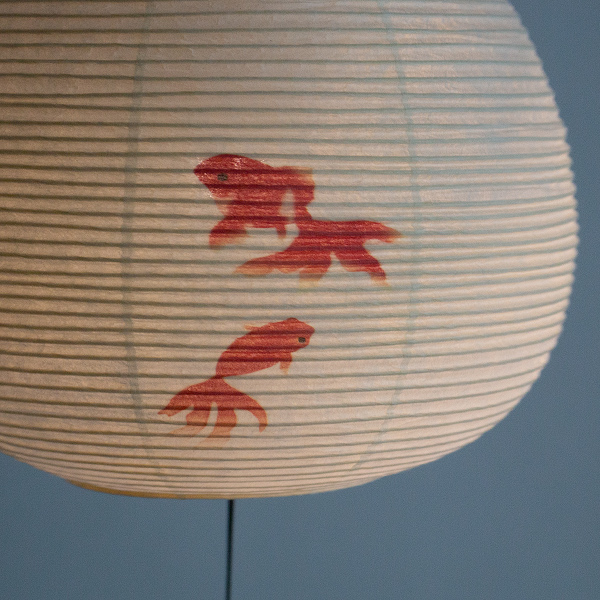
Goldfish: The red goldfish is a symbol of abundance that invites good fortune. Goldfish scooping is a hallmark of summer, and the goldfish itself is such a summer icon that it even serves as a seasonal word for summer in Japanese poetry.

Bellflower (kikyo): An auspicious motif associated with warding off evil and inviting good fortune, and one whose characters evoke the phrase "even more good luck." It's a summer flower that blooms from June to July.

Dragonfly: Since dragonflies only move forward and never retreat, they've long been considered a "victory insect," an auspicious motif that invites triumph.
Each design incorporates, in an understated way, something familiar from Japanese daily life. The front and back of the lantern feature slightly different images, so as it spins around in the wind, it's fun to watch the visible pattern change. Beyond their surface charm, learning the meaning behind each motif only adds to the pleasure of choosing one.
For those who prefer something simpler, the plain design is recommended.

Suzuki Mohei Shoten brings a richer way of living through chochin. Watching how chochin continue to evolve alongside daily life, it's strange how they evoke both nostalgia and a glimpse of the future all at once. A chochin is a light that enriches both a space and the heart. It seems worthwhile to forget the fatigue and busyness of the day, and simply listen to its wavering glow and soothing sound.
▼ Suzuki Mohei Shoten Brand Product List

GUIDE »
CONTENTS »
CATEGORIES »
- + Gifts by recipient
- + Gifts by scene
- + Clothing
- + Bags / Backpacks
- + Wallets / Card cases
- + Jewelry
- + Shoes
- + Rainy day outfits
- + Kitchen
- + Home
- + Babies / Kids
- + Japanese products
Earn Miles


Payment & Security