.webp)


.webp)


.webp)


.webp)


Welcome to ZUTTO
Free shipping for newsletter subscribers (some areas excluded)
- トップページ/
- ZUTTO Journal/
- ブランドストーリー/
- Exploring the App...

Exploring the appeal of "Noto Jofu," an Ishikawa Prefecture-designated intangible cultural asset woven from naturally cooling hemp
Noto jofu, a fabric handed down in the Noto region of Ishikawa Prefecture for some 2,000 years, might be called a hallmark of summer.
What we're introducing this time is the craftsmanship of Yamazaki Asa-orimono Koubou, now the sole remaining weaving workshop producing this fabric. Known as "cicada wings" for its translucent quality, this woven textile is deeply connected to Noto's natural environment—its refreshing summer sea breeze and high humidity—and the more you learn about it, the more it feels like a fabric woven with the wisdom of those who came before us.
Noto jofu has long been worn by ordinary people as everyday clothing, remade and passed down from parent to child.

▲ A Noto jofu stole
This single piece of fabric sits gently against the skin without clinging, staying crisp and dry even when you sweat. With its elegant appearance as a summer hemp textile, it's useful for UV protection and heatstroke prevention for those who prefer to keep their skin covered even in the intense summer heat.
First, what is Noto jofu?
Jofu refers to fine-quality hemp textiles, and among the five great jofu fabrics—alongside Echigo, Omi, Miyako, and Yaeyama—it is said to be one of the oldest in origin. Looking back through history, there was a time when Noto jofu was synonymous with hemp textiles, with 120 weaving workshops competing with one another in skill, making it the top producer in Japan. As fashion shifted from kimono to Western clothing, the number of workshops producing Noto jofu—once celebrated as the finest of its kind—has now dwindled to just one.

This textile, with its long history dating back to an era without air conditioning, has long been emblematic of summer. Poets described its translucent beauty as "semigoromo" (cicada robes), and left behind poems referring to the sixth month—when people began wearing lightweight summer clothing—as "semihazuki" (cicada-wing month).
Semi no hane no hitoe ni usuki natsugoromo narewa yorinamu mono ni ya wa aranu | Ōshikōchi no Mitsune (905, Kokin Wakashū)
Ideya ware yoki nuno kitari semigoromo | Matsuo Bashō (1687, Atsume Ku)
Thin hemp garments like Noto jofu have long been expressed this way in poetry, and it's clear that Noto jofu itself possesses not only a sense of translucence, lightness, and crispness, but is also a textile prized for its exceptional beauty.

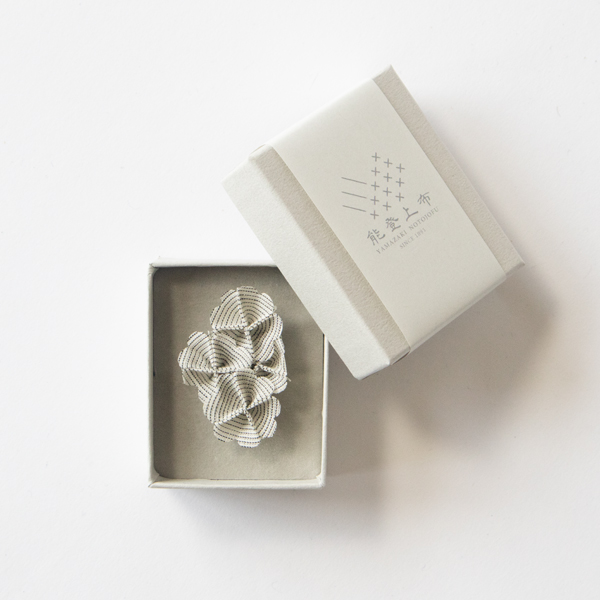
▲These are Noto jofu earrings.
It's precisely because of this fabric that such a three-dimensional shape can be achieved from such thin, lightweight material, and the texture against the skin has a refreshing summer quality.
The secret behind Noto jofu's coolness
The fabric is made from ramie (choma), a material that could be called Japan's traditional natural cooling-touch fiber. Rather than the more common linen (flax), the raw hemp material used is 100% ramie. With its high absorbency, breathability, and ability to release moisture, it's cooler than linen, and its distinctively pleasant feel against the skin has made it an indispensable material for the hot, humid summers of both the past and present.

Perhaps its unpretentious character reflects the character of the Noto region itself. It lets you wear quality effortlessly, and being suited to everyday use, it becomes softer and more comfortable the more you wash it—allowing you to enjoy and appreciate its transformation over time for years to come.

The stole has such a refreshing, breathable texture that it's surprisingly cool even when wrapped several times around your neck. For reference, we compared the feel of a staff member's well-loved stole (worn about 20 times, washed about 7–8 times) with a brand-new one.

It's hard to convey fully through photos alone, but while the new stole has crispness and deeper, sharper texture, the well-worn one has taken on a softer, gentler feel. It has indeed become noticeably softer as well. Beyond UV protection, this stole is also great for outings in midsummer, wrapped over a neck cooler as a measure against heatstroke.
For this feature, Yamazaki Asa-orimono Koubou also provided us with a video of a samue (work clothing) that had been worn for 30 years. Since samue tends to be worn even more frequently than a stole, it really shows just how long these garments can be cherished and used.
How Noto jofu is made
Noto jofu's distinctive traditional hand-dyeing techniques include "roll printing" and "comb-pressed printing."
The fabric is woven by lining up warp threads one by one, but to weave a kasuri (splash-pattern) design, the threads must be dyed beforehand. By dyeing the threads in advance using "roll printing" or "comb-pressed printing," it becomes possible to create crisp, clear patterns with minimal dye bleeding.


▲In the process of creating this kind of cross-shaped kasuri (diamond cross kasuri), patterns are applied to the thread using a hand-dyeing technique called "comb-pressed printing."
▲Striped patterns like these are woven by arranging warp threads of different colors. The number of warp threads arranged by hand reportedly reaches about 1,200.
This fabric is the result of such meticulous, careful handwork. Naturally, it inspires a desire to cherish each and every piece. It's a textile that carries both sturdy, reliable quality and a deep sense of the maker's devotion to their craft.

▲A ka-gasuri (mosquito-pattern kasuri) with thread dyed using "roll printing," Noto jofu's distinctive traditional technique.
The people weaving Noto jofu's future
The painstaking process—spinning the raw thread, dyeing it, and weaving it, all done entirely by hand—takes at least two months for a single tan (bolt of cloth), and for some pieces, several months. This is why so little of this textile is produced. And while there is only a single weaving workshop (orimoto) left, it is supported by 18 artisans and weavers. I've heard that in recent years, people from all over the prefecture, drawn to the appeal of Noto Jofu weaving, have come forward one after another to apply as apprentices, bringing new, younger blood to this intangible cultural asset.

As our interview was coming to a close, we asked the maker what they felt was the true appeal of Noto Jofu, and they told us:
That is what they shared with us.
Seeing this finely woven, delicate, and beautiful textile—infused with the passion of its makers—made us realize once again that it embodies Japan's history, culture, and a truly evocative style of craftsmanship. This interview left us wanting to carefully share its story and deliver it to those who will cherish and use a fine piece like this for years to come.

▼Click here to see the full lineup of Noto Jofu products

GUIDE »
CONTENTS »
CATEGORIES »
- + Gifts by recipient
- + Gifts by scene
- + Clothing
- + Bags / Backpacks
- + Wallets / Card cases
- + Jewelry
- + Shoes
- + Rainy day outfits
- + Kitchen
- + Home
- + Babies / Kids
- + Japanese products
Earn Miles


Payment & Security