


.webp)


.webp)


.webp)


.webp)


Welcome to ZUTTO
Free shipping for newsletter subscribers (some areas excluded)
- トップページ/
- ZUTTO Journal/
- ブランドストーリー/
- The delicacy and ...

SIWA's washi (Japanese paper) accessories, delicate and fleeting like real flowers
SIWA|紙和 was born in Yamanashi Prefecture and is
a washi brand for everyday use, made with special paper.
Unlike ordinary washi, it uses a paper called
naoron, which is water-resistant and highly durable,
allowing the brand to create pouches, bags, storage boxes,
and other items
that could never be made with ordinary washi.
This time, ZUTTO is pleased to introduce a new
series from SIWA|紙和, called【Flower Accessory】.
Wanting to learn more about this new venture into
accessories and the new collaboration with the designer,
we interviewed the brand manager of SIWA|紙和
along with the designer.

Onao, the company behind SIWA|紙和, is
a washi manufacturer based in Yamanashi Prefecture.
The company originally began as a maker of shoji paper
and hanshi paper for calligraphy, and continues that production today.
From there, driven by a desire to create shoji paper that wouldn't tear,
research into naoron began,
and in 2003, a new material three to five times stronger
than ordinary shoji paper—naoron—was completed.
Later, wanting to make new proposals for modern living
by making the most of naoron's distinctive qualities,
the company launched its own brand,【SIWA|紙和】, in 2008,
together with product designer Naoto Fukasawa.


In 2016, SIWA|紙和 released a series of paper accessories,
called Flower Accessory.
It's a rare series that, aside from SIWA's own directly-run stores,
is only introduced through ZUTTO—so this time we spoke with brand manager Ms. Ichinose to explore its appeal.

Ai Ichinose. Her warm, gentle atmosphere seems to perfectly overlap with the image of SIWA|紙和.
ーーーThis time you've introduced a new line of accessories,
which feels quite different from the SIWA|紙和 image up until now.
What led to this development?
This March (2016), we opened a store at Tokyu Plaza,
a new complex that had just opened in Ginza. To mark that opening,
as part of a planned project, we wanted to develop a new lineup of products that would expand the possibilities of washi
and share the appeal of washi with even more people.
So, as a project aimed at the women who would visit our Ginza store,
we thought we'd like to make accessories out of washi.
While looking for a designer to plan this together with us,
we felt that Ayuko Hishikawa, who is active in New York, would be the perfect fit,
and so we began working together. From there, we had meetings on Skype almost every week,
proceeding through a process of trial and error.

ーーーWhat was the reason for choosing "flowers" as
the theme for the accessories?
Since the project's theme was aimed at women, we felt a feminine
motif, so we wanted to make "flowers" the theme.
At the same time, we felt it was the perfect motif
for unveiling a bold, new development.
Designer Ayuko had also created products with flower motifs,
and we also wanted to express a decorative expression that would contrast with
the minimal SIWA|紙和 products that Mr. Fukasawa had created up until then.
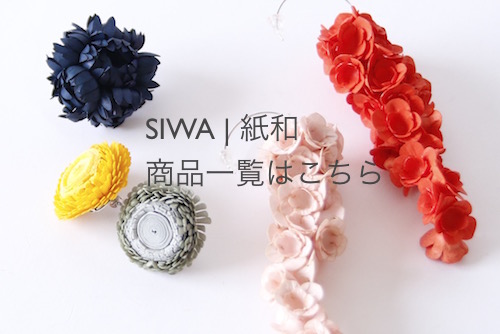
We ended up releasing wisteria, dandelion, and pink (nadeshiko) as actual products,
but during the development stage there were many other kinds of flowers as well.
Some, due to concerns about durability or because they felt a bit too similar
in image to other flowers, we reluctantly had to give up on turning into products.


ーーーThe way each flower is shaped is completely different depending on the type.
Looking closely, the craftsmanship is delicate enough to take your breath away.
Yes, when it came to the method of making them, we left it entirely up to Ayuko,
and she proposed a technique suited to each flower.
For example, with the dandelion, the center core is made by rolling naoron
round and round, and then petal pieces are layered
many times around it and combined, and finally each petal
is opened by hand, one by one.
For the wisteria, the center of each individual flower is finished into a cup-like
shape using heat, and then the petals are sewn on around it.
These are then assembled so the wisteria blossoms hang down gracefully,
and sewn together.
ーーーHow have customers responded to the accessories?
Many people have picked them up.
Some pieces even sold out completely, and we had Ms. Hishikawa make more.
Since they have real volume and a very catchy look,
many customers who discover SIWA|紙和 through this accessory series
go on to look at our other products as well.
Many customers seeing them for the first time cry out in delight,
which is an incredibly happy moment for us.
The shadows cast by the washi are beautifully subtle, and the pieces are lighter than you'd expect when you pick them up.
I think they've become products with a surprise that exceeds customers' expectations.
ーーーIndeed, you can really feel the dynamism—or rather, the strength—of the flowers.
Do you have any recommendations for how to wear them?
Since they're sold individually, one earring at a time, if you're just wearing one,
I'd recommend pairing it with a single pearl stud earring on the other ear.
The color combination and the chic overall look match really well.
Since all of them are quite large as earrings, they become an accent on their own
without needing any other accessories,
and because they're made of washi, they're surprisingly light for their size—
everyone who picks them up is surprised.

ーーーIn 2015, you also developed the
URUSHI series, in which patterns are painted onto naoron with urushi (Japanese lacquer),
and it seems like you keep taking on new challenges one after another.
"We want to explore new possibilities for washi (Japanese paper) and bring it into the lives of as many different people as possible."
That's the spirit behind what we do, so we feel we must keep challenging ourselves with new things.
There's always meaning behind things that have been done for a long time, and there are parts we carry on from tradition,
but we want to keep aiming for products that people feel they want to use right now.
ーーーCompared to the lineup at the start of the brand,
you've expanded into a wide range of areas, including fashion accessories and this time's jewelry.
When taking on something new, is there anything you keep in mind
or value as part of your branding?
We develop our products around the theme of wanting people to use washi in their everyday lives.
To achieve that, we believe it's essential to pursue new possibilities that arise not only from washi itself, but from combining it with various other materials and techniques.
We value the encounters we have, keep researching, and think seriously about what would make people feel they want to use our products.
We continue to search for ways to make products that retain the qualities of washi while still fitting naturally into daily life.


Next, we spoke with designer Ayuko Hishikawa.

ーーーHow did you feel when you first heard about this project?
I'd known about SIWA|紙和 (Shiwa) for some time,
and I was very interested in the idea that I might be able to create something out of this tear-resistant washi.
I was excited about that possibility!
The more I actually touched the material and got to know it, the more surprised I was by the range of expression this special material could achieve.
ーーーWhat approach did you take when you began working on the pieces?
I started simply by getting to know the material.
Rather than just knowing it intellectually, I actually handled it myself,
experiencing things like the texture, the character of the wrinkles created by folding it, and the firmness of the paper.
It occurred to me that applying the silk-flower (artificial flower) techniques I normally use in hat-making to this material might be interesting,
and that motifs based on natural flowers—with their crispness and suppleness—would suit it perfectly, so I began making prototypes.

ーーーI can just picture you excitedly engaging with the material!
How did you decide on the types of flowers, like wisteria and dandelion, and the colors used?
I got my inspiration from looking at real flowers.
I made prototypes of many different flowers, simply based on a sense of "wouldn't it be lovely if this flower's shape became a piece of jewelry,"
and then narrowed them down to the final forms by considering design, practicality, and strength.
Since completely different petal shapes can be expressed depending on how the paper is cut and processed,
I designed multiple flowers so people could enjoy as much variety of mood as possible.
As for the colors, I decided them by considering which shades would make the design stand out, how easy they'd be to coordinate with outfits, and the overall color balance across the series.
ーーーHaving actually made these pieces, what do you think of naoron as a material for jewelry?
I think it's a truly fascinating material that inspires creativity.
It has a crispness that fabric can't achieve, along with the interesting texture of its wrinkle patterns,
and depending on how it's processed, it can become either hard or soft.
Since even bold, dynamic pieces stay lightweight, it really expands the range of possible designs.
The difficult part was that, since it is paper after all, pursuing a design that wouldn't end up looking like a cheap craft project was a real challenge.
Overall it's a very easy material to work with,
though if I had to name one difficulty, it would be judging the right degree of heat when heat-processing it.
(If it gets too hot, it melts.)

ーーーLooking at the production process, I can see you actually use heat to shape the curves.
It seems like extremely delicate work that requires time and patience—
about how much can you make in a day?
It depends on the piece, but for something small, maybe around 5 to 8 pieces a day.
There are so many steps involved in completing a single piece
that rather than finishing one piece at a time, we work on multiple pieces in parallel at each step of the process.
ーーーIt really is such painstaking work...
Do you have any recommendations for how to wear these pieces or coordinate them with outfits?
I think pairing them with simply colored, simply shaped tops or dresses makes the three-dimensional form and shading of the accessories stand out even more beautifully.
Also, since these are made of washi, they look wonderful paired with kimono as well.
▼You can't help but be amazed by the delicate craftsmanship shown in this production video. (Please note that some items shown are not carried by ZUTTO.)
※Sound will play during playback.

Naoron, the material used in SIWA|紙和 (Shiwa) products, is washi that is nonetheless resistant to getting wet.
Naoron itself won't easily tear even when wet or pulled on,
and it's sturdy enough to make you wonder if it's really paper at all.
That said, the accessory series is delicate, since each individual part is sewn together.
Simply touching them by hand won't significantly change their shape,
but if they get stepped on or crushed, they will indeed break.
Please take care when handling these items, as described below.
◇While this paper is water-resistant, metal parts are attached to the pieces,
so if they do get wet, please dry them right away.
◇If the metal parts and the paper material are pulled strongly apart,
some pieces may come apart relatively easily, so please be careful.
◇Due to the nature of the material, darker-colored items may transfer color onto other things.
◇This material is sensitive to heat, so please do not expose it to high-temperature objects such as irons.

This time, by speaking with brand manager Ichinose-san
and designer Hishikawa-san,
I feel that I came to understand the appeal of the 【Flower Accessory】,
and, by extension, deepened my understanding
of SIWA|紙和(Shiwa)as well.
Pursuing washi (Japanese paper), a single material that has existed for thousands of years,
and shaping it into something that fits naturally into life today.
The fresh surprise and delight of picking something up because "it's lovely,"
only to discover afterward that it happened to be made of washi.
In fact, even for me, having carried SIWA|紙和(Shiwa)at ZUTTO
for many years and personally using one of their bags,
when I first held the 【URUSHI】(Japanese lacquer) series and the
【Flower Accessory】series,
I was struck by their beauty and freshness.
And listening to the two of them talk, I found myself genuinely excited
about the possibilities and future of SIWA|紙和(Shiwa).
GUIDE »
CONTENTS »
CATEGORIES »
- + Gifts by recipient
- + Gifts by scene
- + Clothing
- + Bags / Backpacks
- + Wallets / Card cases
- + Jewelry
- + Shoes
- + Rainy day outfits
- + Kitchen
- + Home
- + Babies / Kids
- + Japanese products
Earn Miles


Payment & Security




