


.webp)


.webp)


.webp)


.webp)


Welcome to ZUTTO
Free shipping for newsletter subscribers (some areas excluded)
- トップページ/
- ZUTTO Journal/
- ブランドストーリー/
- It's about time y...

A refined shirt with meticulous details, perfect for embracing the season ahead

A shirt that, once worn, gives you a crisp, put-together feeling.
A shirt that's softly feminine, exuding a sense of warmth.
Shirts come in countless materials, silhouettes, and details, but
simply putting one on can bring a sense of quiet confidence.
Depending on how you choose and style it, a shirt can be worn casually
or elegantly—it's a truly versatile piece.
Now that the season for wearing just a shirt has arrived, why not
find that special, high-quality shirt that suits you perfectly?


Know your size, know the shirt's size
How you want to wear the shirt also affects which size you should choose.
If you want a neat, body-conscious fit for business wear,
you should go with your exact size, whereas for a slightly looser fit
around the neck and body, you can achieve a more casual look.
Either way, since women don't wear neckties the way men do,
there may be less need to be so strict about sizing.
Here are the basic points to measure when checking a shirt's size.


If you want to wear a shirt in your exact size,
measure your bare body size, and use bust top +9cm or more as
a general guide for the overall body width.
If you're concerned about other specific areas, measure them in detail as well.
Comparing with a shirt you already own can also help you get a clearer idea.

How the Collar Shape Changes the Impression
Shirt collars come in an astonishing variety of shapes.
Button-down, round collar, French collar, band collar,
short point collar, horizontal collar, and more—
even subtle differences in length or angle can make a big difference
in how a shirt looks when worn.

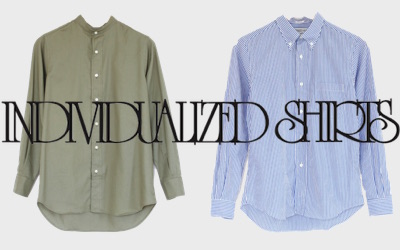
An example of collar designs from the custom-made shirts of INDIVIDUALIZED SHIRTS.
The INDIVIDUALIZED SHIRTS women's shirts featured at ZUTTO
come in two collar types: button-down and band collar.
Both give a more casual impression rather than an office-ready one,
and are easy to pair with everyday items.

Button-Down Shirt
The button-down shirt is a design where buttons at the collar tips
fasten the collar down to the front body of the shirt.
Because the collar is secured with buttons, it stands up neatly, keeping a beautiful V-zone.

Band Collar Shirt
Also called a stand collar, this refers to a design with no fold-over,
where the collar stands up along the neck.
It gives a casual impression while keeping the neckline looking clean and neat.


INDIVIDUALIZED SHIRTS are made in
Perth Amboy, New Jersey, USA, a small town
located across the water from Manhattan Island, New York.
Even today, each shirt is carefully sewn one by one at this head office factory.
In America, the brand is known as a foundational name for both men's and women's shirts,
and it has a long track record of handling the custom-order shirt division
for the button-down shirt that Brooks Brothers originally established,
and the experience and know-how cultivated over the years still speak to the trust placed in this well-established brand.
At INDIVIDUALIZED SHIRTS, the finest shirts are tailored through
cutting techniques and interfacing methods aimed at achieving a comfortable, body-hugging fit,
together with skilled sewing craftsmanship.
Here is an introduction to some of these techniques.
The Look of the Collar

What earns INDIVIDUALIZED SHIRTS such high praise is the look of its collar.
In particular, the brand's signature button-down shirt brings together every detail—
the height of the collar stand, the size of the collar leaves,
the button placement, and the shape of the collar stand—in an exquisite balance, creating a traditional American shirt.
The women's button-down shirt uses a smaller collar stand, giving it a clean, streamlined look when worn.
Fine Rolled Seam

For the side seams that join the front and back panels of the shirt,
INDIVIDUALIZED SHIRTS uses a technique called the "fine rolled seam."
There are many different ways to sew a shirt, but
this method stands out for being remarkably thin and clean, gentle against the skin, and durable as well.
However, this sewing technique requires a level of skill
that mass-produced shirts simply cannot achieve—it's a technique made possible
only because INDIVIDUALIZED SHIRTS has continued to make custom shirts all along.

Construction Yoke
The construction yoke refers to the sewing technique used at the shoulder area.
In many mass-produced shirts, the stitching on the yoke is visible from the outside,
but INDIVIDUALIZED SHIRTS uses a bag-seam construction where no stitching shows on the outside,
achieving both a beautiful finish and the durability needed for long-term wear.
Center Pleat
It's a fundamental principle among American shirt makers that a proper shirt should feature a center pleat.
The idea comes from the fact that uniforms, workwear, military attire and similar garments are made with side pleats,
and so the back features a center pleat instead,
allowing you to enjoy the distinctive look that sets it apart from other brands.

The brand's dedication also extends to the stitching and parts, all designed with "long-term use" in mind.
The stitching around the collar and shoulders is based on 18 stitches per inch (2.54cm),
reinforcing the areas that bear the most stress during wear.
While mother-of-pearl buttons are commonly used on high-end shirts, their drawback is that they're delicate.
That's why INDIVIDUALIZED SHIRTS uses buttons made of durable resin instead.
These buttons are the result of years of repeated refinement, a true point of pride for the brand.
Since the shirts are meant to be worn for a long time, the parts must be equal to that purpose.
The philosophy is that they must be able to withstand years of wear and washing.
The philosophy of INDIVIDUALIZED SHIRTS is expressed in the phrase:
Shirts are produced with 90% of the competence, but it becomes 100% as worn by our customers.
"Our shirts are 90% complete—it's the wearer who brings them to 100%."
It's clear that all of their passion and craftsmanship is always centered on the person who wears the shirt.


Shirt: LADIES BAND COLLAR SHIRTS(Chambray/Blue)
Pants: Brushed-back Wide Pants (grey size:free )
Knit cap: Cotton×Linen Cap NAVY
Bag: Canvas Bag SCCF001 BROWN/MILK
Shoes: Ingrid Black Oiled

Shirt: LADIES BUTTON DOWN SHIRTS(White)
Skirt: EASY KILT (73cm) BROWN WATCH
Bag: Shoulder Bag/Navy
Shoes: Side Gore Boots Black

Shirt: LADIES BUTTON DOWN SHIRTS(Stripe/Navy)
Bag: Austin Bucket Cognac
Shoes: Tassel Loafer Brown

Shirt: LADIES BAND COLLAR SHIRTS(Herringbone/Ol)
Shoes: Professional Antique Brown Oiled

Here's how to care for "your one shirt" that you've finally found, so you can keep wearing it beautifully for a long time.
Checking and Understanding the Care Label
First, check the care label tag.
For example, take a look at the INDIVIDUALIZED SHIRTS tag.


① Wash in water at 40℃ or below, using a gentle machine cycle or gentle hand washing
② Do not use chlorine bleach
③ Iron with a pressing cloth at a medium temperature (140℃–160℃), not exceeding 160℃
④ Dry cleaning OK—use petroleum-based solvents
Not just for shirts, checking the care label and correctly understanding what it means
is very important for keeping your clothes looking beautiful for a long time.
Don't think of it as a hassle—if there's a symbol you don't understand, check it before washing.
A Little Extra Effort Before Washing Preserves Beautiful Details
Before washing at home, take a moment to check the shirt over.
For example, the front panel is prone to food stains and other marks,
while the inside of the sleeves, collar, and neck area can develop yellowing from sweat and body oils,
so don't leave them as is—put in a bit of extra effort before washing.

If you have a stain-removing detergent, apply it directly to the area in question,
then gently rub it in or scrub it with a laundry brush to lift the stain.
If you're concerned about yellowing on the shirt, treat just that area before putting it in the washing machine.
For white or light-colored shirts, a white detergent is recommended.

This little bit of extra effort will make a real difference in how beautiful your beloved shirt stays over time.
The more care you put in, the more attached you'll become, and the more precious that shirt will be to you.
One Shirt Per Laundry Net

When washing in a machine, always place the shirt in a laundry net.
Fold the shirt neatly rather than bunching it up, and put just one shirt in each net.
The reason wrinkles form during washing is that the fiber molecules swell with water
and then become disordered as they rub against other garments.
To soften the impact from other clothing, it's ideal to have just one shirt per laundry net.
Wrinkle Prevention: Hang to Dry Before Spin-Drying Is Complete
To reduce wrinkles, avoid spin-drying the shirt completely.
By shortening the spin cycle time in the washing machine and hanging the shirt up while it still holds some water,
the shirt's own weight will pull it straight, making unwanted wrinkles less likely to form.
You could adjust the spin-dry time, or pause the cycle partway through and
take just the shirt out—that works too.
It's also important to take the shirt out of the washing machine and hang it up right away once the wash cycle finishes.
It's easy to forget and let it sit, but
If too much time passes, the wrinkles set in, and even ironing won't
get rid of them—they become stubborn wrinkles that just won't budge.
Tips for hanging: use a sturdy hanger

If you use a thin wire hanger, it won't be able to bear
the weight of the shirt, and the shoulders will droop.
By using a hanger with enough thickness at the shoulder area,
you can maintain the shirt's shape while distributing its weight evenly,
which lets the wrinkles smooth out naturally.
After hanging the shirt, use both hands to firmly smooth out any wrinkles.
Focusing especially on the collar, cuffs, button area, pockets, and underarm seams
will also make ironing easier once the shirt has dried.
Ironing for a crisp finish

If you prefer a shirt with a crisp, freshly pressed finish,
spritz the shirt lightly before ironing.
Using a laundry starch spray with a refreshing scent—like sweet musk,
ylang-ylang, or citrus—makes ironing all the more enjoyable.
GUIDE »
CONTENTS »
CATEGORIES »
- + Gifts by recipient
- + Gifts by scene
- + Clothing
- + Bags / Backpacks
- + Wallets / Card cases
- + Jewelry
- + Shoes
- + Rainy day outfits
- + Kitchen
- + Home
- + Babies / Kids
- + Japanese products
Earn Miles


Payment & Security




