


.webp)


.webp)


.webp)


.webp)


Welcome to ZUTTO
Free shipping for newsletter subscribers (some areas excluded)
- トップページ/
- ZUTTO Journal/
- ブランドストーリー/
- Believing in the ...

Believing in leather's true beauty. Visiting the craftsmanship of REN, a leather bag brand
REN is a brand that creates simple leather bags that quietly complement the wearer's style.
With a philosophy of "not making you conscious that you're carrying it" and "not asserting its presence,"
it is a truly one-of-a-kind leather brand that somehow evokes a sense of transparency.
Wanting to learn more about the appeal of REN's craftsmanship,
we visited the REN Kuramae store in Taito Ward, Tokyo.


The REN shop is just a short walk from Kuramae Station.
The moment you step inside, a faint scent of leather drifts past your nose,
and you find yourself in a space where bags in gentle hues are casually arranged.
This time, we spoke at length with Ms. Kinouchi from the store operations department
and Mr. Shirai, who oversees production management, about the brand's appeal.


---This is such a lovely shop. Seeing so many leather goods and bags lined up here is exciting.
It seems there are many series, but could you tell us about the signature series that comes to mind when people think of REN?
The defining feature of REN's craftsmanship is our use of original leather.
Starting from the raw hide—whether pigskin or goat leather—
we decide on the processing method and coloring, and working together with our tannery partners,
our bag-making begins with developing a REN original leather that exists nowhere else.
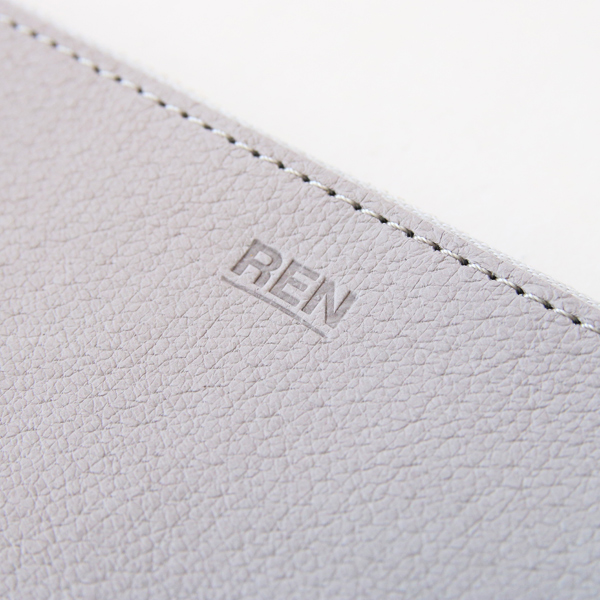
Take, for example, this leather called "HALLIE."
It's been part of REN's core lineup since the brand's founding,
and it's one of our most popular leathers, with many repeat customers.
Pigskin is naturally known for being remarkably light and supple among leathers,
which made it a perfect fit for the everyday-use bags we envisioned.

---With other leather brands, you often see horsehide or cowhide,
so I didn't know that pigskin was light and supple.
That's right, what kind of leather pigskin actually is may not be that widely known.
That's because pigskin tends to pick up marks quite easily at the sourcing stage.
Pigs are more active—and a bit more mischievous, you might say—compared to cattle or horses,
so their skin often gets scratched when they bump into each other or rub against things.
For that reason, I think it tends to be avoided by leather brands aiming for flawless, unblemished craftsmanship.
In fact, we once tried developing our own original pigskin,
but the individual variation between each piece of leather became a sticking point, and we ended up shelving it for product use.
We hesitated to introduce it to customers,
worried that having marks might come across as a negative impression.
---And yet, it's now one of REN's signature leathers.
What led to that way of thinking?
Yes, with leather, the texture of the animal's skin comes through directly in its character.
We shifted our thinking to instead embrace that as character, and show it just as it is.
By doing so, even the marks become part of what makes each piece one of a kind,
and we're able to make the most of pigskin's light, soft qualities.
Pigskin has pores that appear in clusters of three, and once processed into leather,
it becomes wonderfully supple and breathable.
Since leather is a material that's vulnerable to moisture, good breathability is a major advantage.
And by making the most of its soft, supple texture,
it's even possible to knot the shoulder strap or handle tightly to adjust it to your preferred length.

---I see, that's quite different from the smooth, glass-like shine of cordovan leather without marks,
or the substantial thickness of cowhide—a characteristic unique to pigskin.
Yes, many customers come to love that texture,
and we have quite a few repeat customers who return
to add more items in the same leather but in different colors or shapes.


---I can already imagine how fun it would be to collect all the colors.
Looking at this, there really are so many color variations.
Yes, this is an archive of limited-edition colors we've offered in the past.
Each season we release two season-exclusive colors,
and based on the coloring direction decided by our brand producer,
we work hand in hand with our tannery partners to bring each hue to life.
---Even though it's leather, there's a sense of transparency to it, somehow.
Creating such subtle shades must be quite difficult.
The dyeing of the leather is another of REN's key commitments.
Pigment dyeing is the common method for leather,
and it's something like painting a wall with a thick coat of paint.
REN, on the other hand, doesn't use pigment dyeing. Instead, we place the leather together in a large vat
and let the dye soak in slowly and thoroughly.
This produces vivid, fresh colors reminiscent of watercolor painting.
Because factors like water temperature and the humidity of the season in which the dyeing takes place can cause subtle variations in color,
this kind of delicate work relies heavily on a strong relationship of trust with our tannery partners.

Here, Shirai-san ran the sewing machine using leather from "HALLIE," and
showed us the process of making a bag.
1) The cut leather. This is REN's classic basic tote bag, made light without any lining.

2) Sewing the pieces together on a leather sewing machine. The rhythmic dada-dada-da sound is quite pleasant.
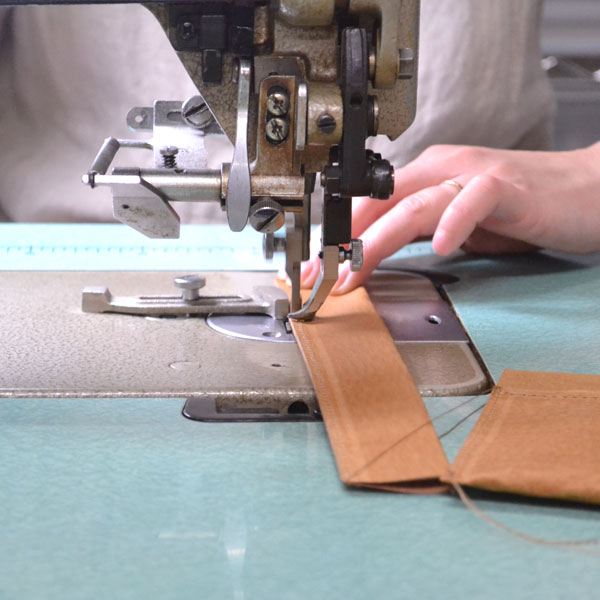
3) Pocket parts. Care is taken with every single stitch, down to the backstitching.

4) Finishing the threads and assembling each part.

5) Making the handles and the bag body's parts, then sewing them together by hand.


---Seeing the manufacturing process like this, you really get a sense of the bag's simplicity.
At the Kuramae shop, we mainly work on planning new sample prototypes and handling repair requests from customers,
and while the actual manufacturing is done with help from craftspeople around us, the production process is exactly as you've just seen.
A "bag" is something you hold, something you carry, something you use.
While it's not usually thought of as something you "wear" in that sense,
with REN, we want people to choose our bags in the same way they'd choose their clothes—
that is, with the same sensibility they'd use when selecting a shirt or a skirt.
I think not over-designing things is part of what gives the brand its "transparent" image.
Actually, the brand name REN doesn't have a clear, fixed meaning.
But it's short and easy to remember, drawing on sounds that have long existed in Japan,
and a certain flowing quality when spoken aloud—that's where the name came from.
Just as with the naming, when it comes to making things,
we try to keep things as simple as possible so that the people using them have the freedom to use them however they like. That's how we think about it.


---The newly released "GOAT MESH" for 2017SS also
has a unique appeal—it's leather, yet it has a "lightness" and "sheerness" unlike anything else.
Yes, it's REN's original leather, woven using a technique called "ishidatami-ami" (cobblestone weave),
using a generous five times the amount of leather compared to a bag made by simply cutting and sewing leather.
Leather typically has a "grain side" (ginmen) and a "flesh side" (tokomen).
The grain side is the front, and the flesh side is the back.
Usually, the front of a leather bag is smooth and glossy, while the flesh side has a rough texture,
but the cobblestone weave is distinctive in that it's woven three-dimensionally so that the leather's "grain side" shows on both the front and back of the bag.
This results in a construction that's both beautiful to look at and highly durable,
and the appeal lies in the contrast between the "sense of weight and richness" that comes from generously using goat leather
and the "lightness" that's the benefit of the mesh weave.
Although it's a new piece designed for spring and summer, you can also enjoy arranging it for autumn and winter
by putting a cute patterned fabric pouch or drawstring bag inside as an inner bag.

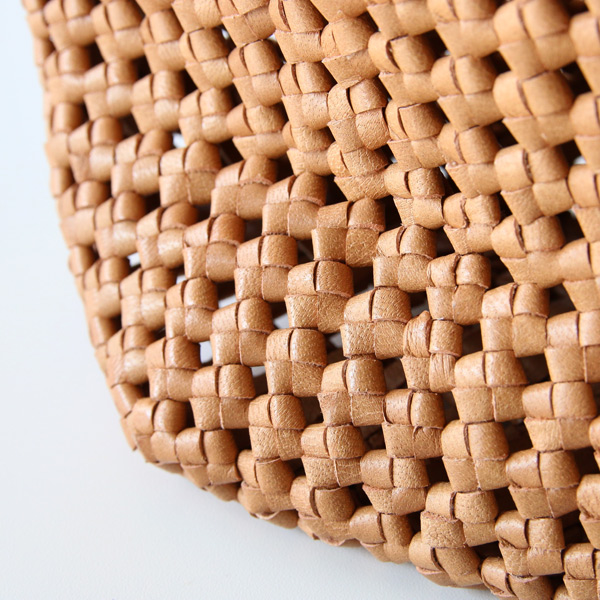
The GOAT MESH series is carefully handmade, piece by piece, by craftspeople in India.
When it comes to the technique of weaving leather, Indian craftspeople are truly meticulous and careful.
I don't think there are many Japanese craftspeople who can do the same thing.
Each piece is woven onto a wooden mold one at a time,
and a single craftsperson can only make two tote bags in a day.
That's how painstaking the work is.
Because they're handmade, there are subtle differences in size and the tightness of the weave depending on the craftsperson who made it—
that's simply a characteristic of it, but we hope you'll appreciate that as part of the charm of handmade work.
---It's fascinating to hear about making things together with craftspeople overseas.
Yes, GOAT MESH is made in India, and there's also another series called "BARE," made from goat leather, which is produced in Indonesia.
That's because eating goat meat is a common part of the culture in Indonesia,
so goat leather is widely available there, and the country also has advanced leather manufacturing techniques.
Indonesian craftspeople are extremely meticulous, and they're especially particular about their stitching.
They choose exactly where to place each needle down to the millimeter.
Having seen manufacturing sites both in Japan and abroad,
I can say there's a certain quality that comes specifically from being "made in Japan," while at the same time there are strengths unique to overseas production.
Each has its own distinct appeal, but in both cases, I think you can really feel the craftsmanship firsthand.
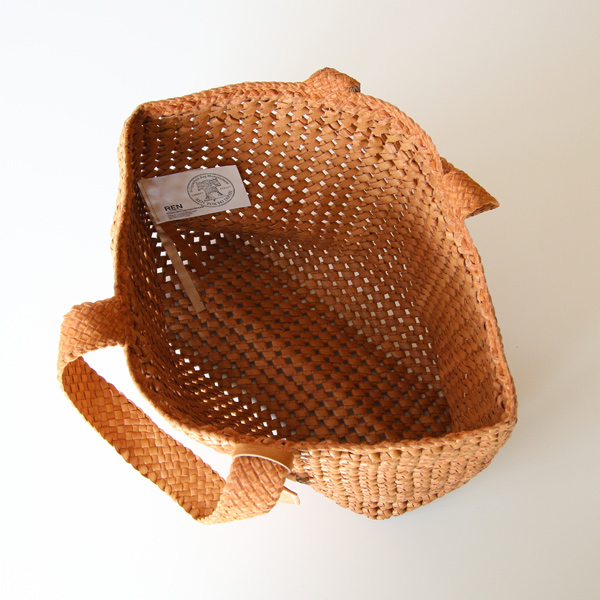

After hearing so much about the appeal of these items,
we were shown the aging of REN bags that had actually been used.
Inside the shop, there's both pigskin and goat leather,
and a wide range of items are on display, from the classic tote bag to the mesh-design series.
This time, we were shown three different types of bags: "HALLIE" (pigskin), "BARE" (goat leather),
and "GOAT MESH" (goat leather).
Each has its own distinct character, but in every case, you can see how the leather has softened and taken on a supple feel.


This is the goat leather bag. On the left is a brand-new one, and on the right is one that has aged considerably.
Same model, but the one actually in use has softened with wear, and its leather naturally sits lower at the center of gravity,
You can see how the bag's overall silhouette has softened.
She says she hasn't been especially diligent about maintenance,
but from its original matte texture as new, it has developed a pleasant sheen and a smoother feel to the touch.

Next, we asked the two staff members to show us the well-loved items they'd brought with them to work that day.
A black bag that suits her monochrome outfit beautifully.
She cinches the shoulder strap to use it as a shorter shoulder bag.
Since her job involves a lot of moving around—working at the Kuramae store while also visiting RENs other locations—
she finds this spacious bag invaluable for carrying her laptop, notebook, and documents.

Compared with the same model brand-new, on display in the shop.
"The leather has become much more supple, and I feel like it really fits my body now."

Next, she showed us a small drawstring-style bag.
It adds just the right accent to her natural style,
and here too, you can see how the leather has softened and taken on a gentle sheen.
Along with this drawstring bag, she carries a mini bag holding a tumbler and other drinks,
commuting light with the two bags together.
"This is perfect for me since I don't carry much. I ride the train to work feeling light and easy."
For both of them, leather that's been used regularly and has softened with a gentle patina has more charm than it did when new,
and each chose her bag to match her own lifestyle.

---Please tell us about how to take care of a REN bag so it lasts a long time.
The bags RENhandles are finished with as natural a processing as possible,
making the most of the leather's inherent character, so even with the same leather, the way it ages will vary greatly depending on the person using it.
If you want to prevent stains or fading, apply waterproof spray regularly.
With pale colors, the color may fade over time.
If you want to prevent fading, we recommend using a waterproof spray that contains UV-blocking ingredients.
When using the spray, hold it about 30cm away so it covers the surface evenly.
Please be careful—if you spray from too close, the liquid can soak in too deeply and cause discoloration.
That said, looking at the bags customers actually bring into the shop,
I feel that most people don't fuss too much over care, and instead enjoy using their bags freely and letting the character develop naturally.
The oils naturally present in the leather mix well with the oils from the owner's hands,
and the bag ages more and more, growing softer and richer in character.
--Finally, please give a message to fans of REN.
REN's bags are simple, both in concept and design.
There's almost no rule dictating how they must be used.
What scenes to use them in, how often to use them,
and how you want their character to develop—all of that is entirely up to the person using it, I believe.
I'd be truly happy if you used your bag exactly as you like and grew to love it more and more.


Ms. Shirai (left) and Ms. Kinouchi (right), who spoke with us this time.
Both of them carried themselves with a dignified elegance, including how they wore their REN bags,
and beneath their soft, gentle presence,
the sharp, focused expression that emerged whenever they talked about craftsmanship was wonderful to see.
▶︎REN Kuramae Store
4-13-4 1F Kuramae, Taito-ku, Tokyo 111-0051 (3-minute walk from Exit A0 of Kuramae Station on the Toei Asakusa Line)
OPEN: 12:00-19:00 / CLOSED: Mondays *Open on public holidays.

【GOAT Mesh Bag Series】


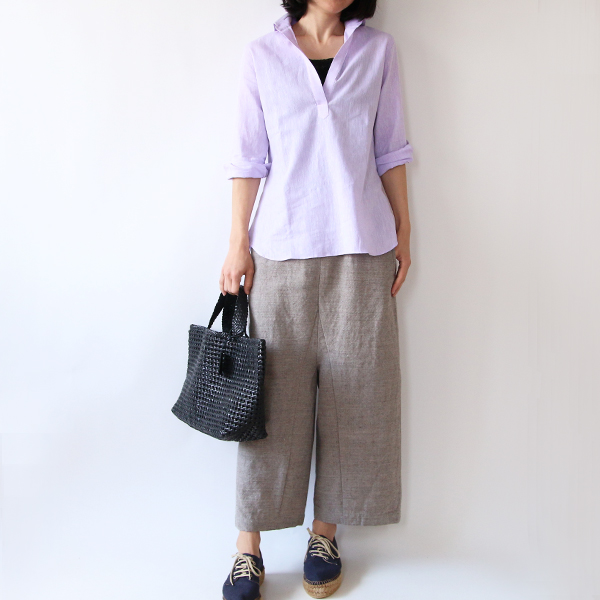
"GOAT MESH" is RENs original mesh leather, made from tannin-tanned goat leather
woven using a technique called ishidatami-ami (cobblestone weave).
It's durable and resistant to losing its shape, and the more it's used, the softer it becomes,
developing a deeper sheen and richer color over time.
The weave, which requires five times the usual amount of leather, has a substantial weight to it, yet also
possesses a sophisticated sense of transparency, along with a somewhat retro charm.
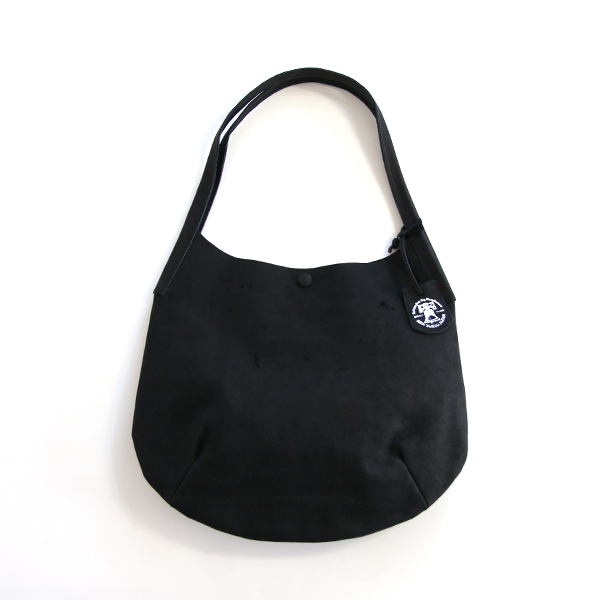

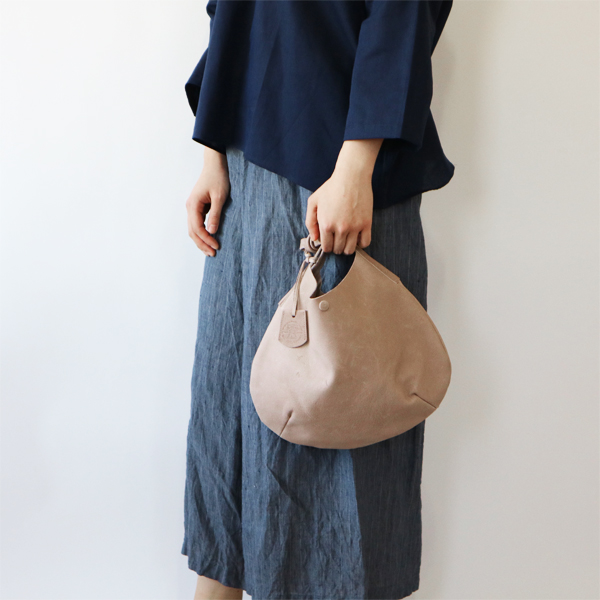
The Circle Shoulder Bag is characterized by its plump, rounded circular shape.
With its special wrapped button at the opening and slender handle, this tote bag has a distinctly feminine design.
It's made using RENs original pigskin, called "HALLIE."
The delicately made handle can be worn at its full length over the shoulder,
or tied into a knot to carry it as a handbag—giving you flexibility in how you wear it.
Scratches and color variations in the leather are proof of its natural material. Rather than hiding them with coatings, the bag is finished in a way that preserves its raw, natural character.
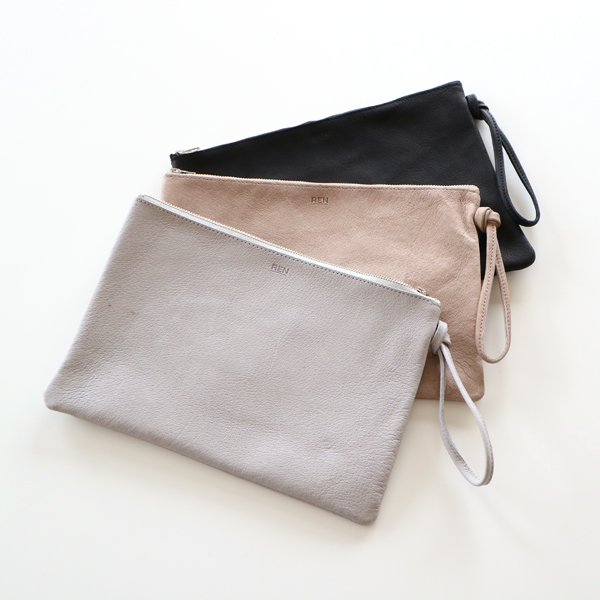
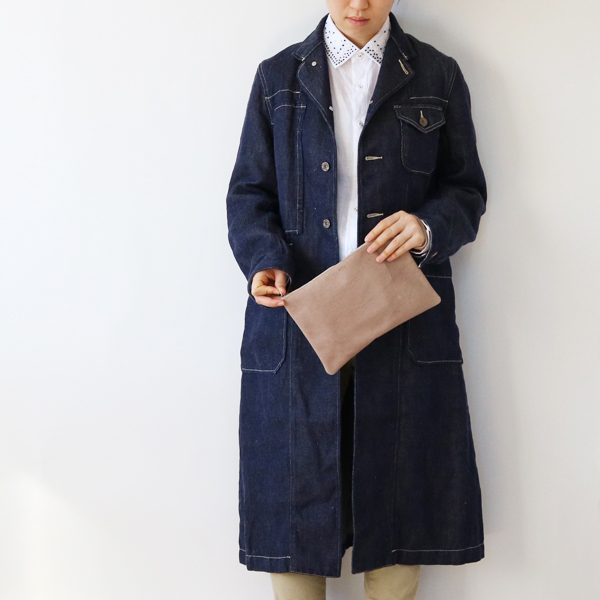

We'd also like to introduce a pouch made from RENs signature pigskin.
Its matte texture, soft feel, and natural coloring—as though dyed with watercolor paints—are all part of its appeal.
A simple pouch without a gusset is perfect for carrying small items inside a bag, but it's also handy for those times when you just want to quickly pack a handkerchief, smartphone, wallet, and lip balm and head out.
The leather cord sewn onto the body serves as a subtle accent,
and slipping this cord over your hand gives the pouch a more grown-up, sophisticated look.
Available in gentle, soft colors as well as the classic black, this is a leather pouch we'd love for men to use as well.
GUIDE »
CONTENTS »
CATEGORIES »
- + Gifts by recipient
- + Gifts by scene
- + Clothing
- + Bags / Backpacks
- + Wallets / Card cases
- + Jewelry
- + Shoes
- + Rainy day outfits
- + Kitchen
- + Home
- + Babies / Kids
- + Japanese products
Earn Miles


Payment & Security




