


.webp)


.webp)


.webp)


.webp)


Welcome to ZUTTO
Free shipping for newsletter subscribers (some areas excluded)
- トップページ/
- ZUTTO Journal/
- ブランドストーリー/
- One-of-a-kind tab...

One-of-a-kind tableware born from traditional craftsmanship and 3D digital technology
ASCEL's tableware, with its distinctive, wave-like forms.
Not only is the design unlike anything seen before, but the way it's made is entirely new as well.
The pottery is created based on designs made using a 3D printer.
Wanting to know how such distinctive tableware came to be,
we spoke with the people at secca, who create ASCEL.

(Left) Tatsuya Uemachi, (Right) Yuichi Yanai
Both representatives are graduates of the Product Design program at Kanazawa College of Art.

--- We understand you both originally designed home appliances and cameras.
What led you to make the transition from product design to tableware and ceramics?
Originally, when Yanai was working as a product designer at a major audio equipment manufacturer,
he had strong doubts about the way the things he created
were being swallowed up by an accelerating world of consumption.
Around that time, he happened to come into contact with the world of ceramics,
and he was captivated by the idea of a craft where he could express his individuality
through primitive techniques while creating products meant to be used for a long time—that's what drew him in.
Meanwhile, representative Uemachi moved to Kanazawa around the same time,
determined to build a creative collective based in Kanazawa and start a business
proposing tableware and dining tools centered around the keyword "food and making things."
The first person he consulted was Yanai, who had graduated from the same university and was doing interesting work.


Each carrying their own aspirations, the two met again after returning to Kanazawa, where they had spent their student years.
They founded secca, and using the skills they had cultivated in industrial design,
began exploring new values in craftsmanship under the banner of "future crafts."

ASCEL's tableware is unique not only in its design
but also in its method of production.
The design of a prototype made with a 3D printer is transferred onto a plaster mold,
and after the shape is transferred to clay, an original glaze is applied and the piece is fired in a kiln.
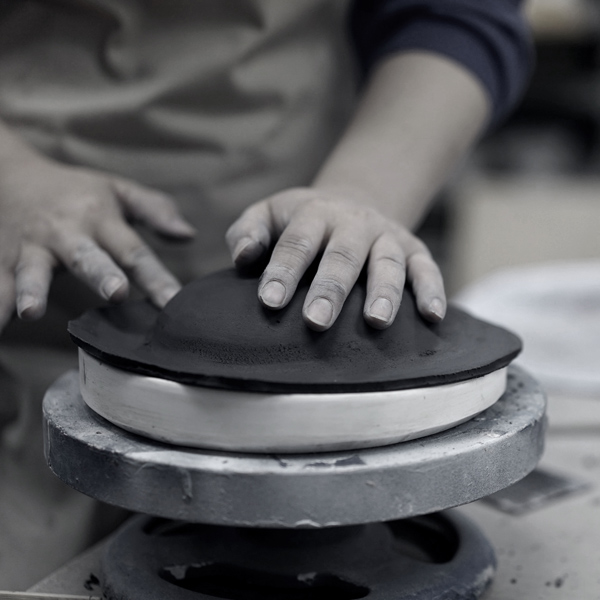
From a prototype created using a 3D cutting machine or 3D printer,
the shape is transferred onto a plaster mold, and finally transferred onto clay.

It looks almost like hats drying in the sun, but these are actually the plaster molds that form the basis of the plates.

The clay body before firing. Even at this stage, it has a beautiful presence.
Glaze is applied, and the piece is fired in a kiln to complete it.

We asked them about this method as well.
--- How did you come up with a production process that combines the analog technique of ceramics
with the cutting-edge technology of 3D printing?
Because ceramics is so primitive, it's also a world where every conceivable technique has already been tried.
When we asked ourselves what our own strength was within the world of ceramics,
the natural answer was to combine the 3D modeling skills we had cultivated as industrial designers
with the manual craftsmanship of pottery-making.
--- What kind of new perspective does this method open up?
We think of the latest technology as a tool needed to expand the range of expression
and to aim even higher.
Since ancient times, people have invented tools to get closer to the ideals they envision.
That's true not just for making things—every tool, in any field, has surely been a means of making things "better" than they currently are.
We believe that what's now called "analog" technology is the accumulated result of evolution
driven by the invention of cutting-edge tools in the past.
In other words, we believe that human creation has evolved through the combination of tools
and the skill and sensibility to master them.
So the digital tools we're focusing on now
are, in the long run, simply tools and means for expanding creative possibility—
not an end in themselves.
And using them isn't simply about cutting down on labor or replacing handwork
to make things "easier." Rather, it's about gaining an evolved form of "handwork"
that lets us challenge areas we couldn't reach before.

--- Rather than being classified as either artist-made works or mass-produced goods, how do you define your genre?
Quite simply, we're working with the intention of cultivating "secca" itself as a genre.
Being based in Kanazawa, we're often asked, "Is this Kutani ware?"
But as we see it, Kutani ware is something that came about long ago when makers in this region,
each creating pottery in their own individual way, happened to influence one another,
and their common traits were later classified into a category, forming a kind of brand.
While we respect that context, our guiding principle at secca is not to settle into an existing category from the start,
but to freely explore, in our own time, the values we want to offer.
As a result of making things we truly believe in, we may eventually be classified into some category or another,
but if that happens, our ideal is for that category to be one uniquely our own—
simply, "secca."


What we're introducing on ZUTTO
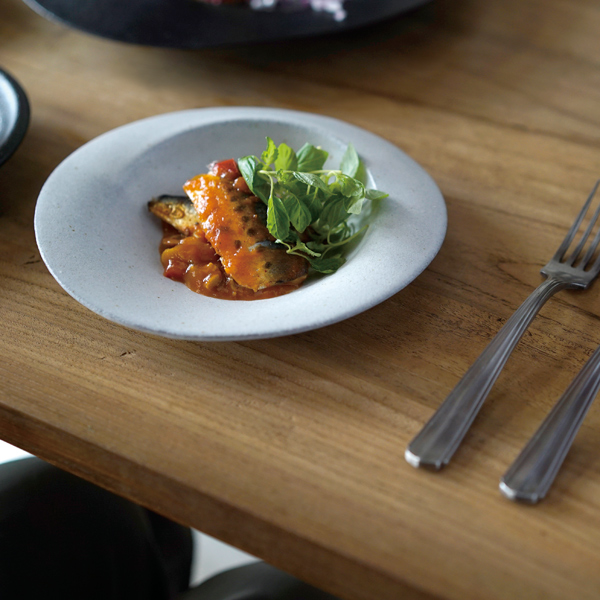
are the SCOOP series and WAVE series, both featuring wave-like designs.
These are plates with mysterious forms unlike anything you've seen before,
At first glance it looks strikingly modern, yet there's also a certain nostalgic quality to the design's modernism.
You might worry whether it's actually practical to use, but
the shape wasn't designed simply to be interesting—
there's real meaning behind this form. By raising part of the rim,
it becomes easier to scoop up food right to the very last bite.
The pieces can also be stacked for storage, so they don't take up much space,
and since the surface has a water-repellent finish, cleaning is easy too.

WAVE Series

――― Both the SCOOP series and WAVE series have such distinctive designs.
What intention lies behind the form these pieces take?
Both series carry on the concept of "landscape ware," which Yanai originally developed during
his own independent work.
I believe the relationship between food and a vessel is similar to the relationship between architecture and the land.
In the same way an architect considers the undulations of the land, the air and temperature that flow through it, and thinks about
what kind of building to construct on that site and what value it will create—
we hope that, in the same way, the form of a vessel can become, for a chef,
an idea that leads to new expression. That's the kind of vessel we aim to create.
Wanting more people to experience the formal ideas born from this thinking,
we started ASCEL, the brand under which scoop and wave are offered.
Rather than the kind of sharply distinctive forms made for professionals, we hope that through everyday use,
cooking, plating,
and eating can all become just a little bit
"better" than usual—that's the kind of catalyst we hope these pieces can be.

――― You combine raw materials to create your own original glazes
yourselves, I understand. What determines the colors and textures you settle on?
We decide with an awareness of how the pieces will coordinate with the many different "colors" found in daily life.
Since our foundation is as industrial designers,
as a result, we've developed the habit—in a good sense—of stepping back and looking at our own work with a cool, objective eye.
For the user, our vessels are only ever one part of their life,
and even just thinking about the tabletop alone, there are surely other dishes and utensils they treasure and use.
With that in mind, we aim for ASCEL vessels to harmonize with those other pieces and with the food itself, while still allowing
that person's own everyday life and character to come through.
That's why, rather than overthinking our own identity, we place importance on the question of
what color, shape, and material will let a piece stand out as a distinctive point within an overall sense of harmony.


――― Finally, I'd like to ask about Kanazawa itself, this place.
From the standpoint of craftsmanship, what would you say sets it apart from other regions?
I think it's that there are people here who support the creation of new culture.
Looking at it objectively, when it comes to the value of tradition and culture, I get the impression that people tend to fall into one of two camps: those who place importance on "preserving" it,
and those who place importance on "nurturing" it.
What I find distinctive about Kanazawa is that so many people here carry the latter mindset.
It's said that Kanazawa, originally as a policy of the Kaga domain, invited in specialist craftspeople from various regions, along with people who would today be called producers, and by encouraging creativity in this way,
demonstrated to Edo that it had no intention of waging war, and thereby avoided conflict.
As a result, a wide variety of crafts developed here,
and I believe that behind this lies the way culture was nurtured through the chemical reaction that comes from actively mixing in outside blood.
That same spirit is carried on today, and the very people who lead Kanazawa are the ones who
welcome "outsiders" like us most warmly, and support us wholeheartedly.
In this place, where tradition is carved open through the nurturing of culture, there's a phrase everyone here seems to agree on:
"Tradition is a continuous succession of innovations."
I believe this phrase captures the very essence of this place.


GUIDE »
CONTENTS »
CATEGORIES »
- + Gifts by recipient
- + Gifts by scene
- + Clothing
- + Bags / Backpacks
- + Wallets / Card cases
- + Jewelry
- + Shoes
- + Rainy day outfits
- + Kitchen
- + Home
- + Babies / Kids
- + Japanese products
Earn Miles


Payment & Security




