


.webp)


.webp)


.webp)


.webp)


Welcome to ZUTTO
Free shipping for newsletter subscribers (some areas excluded)
- トップページ/
- ZUTTO Journal/
- ブランドストーリー/
- From fabric-makin...

From yarn to dyed finished product, an integrated production process. The clothes-making of FACTORY
Color, shape, texture.
When we pick up a piece of clothing, we sometimes unconsciously sense its identity and feel an impulse to try it on. Design and color alone are not enough—it is only when the texture and comfort of the fabric come together that a garment is truly complete. This is an obvious truth, yet one that is difficult to notice.
The clothes of FACTORY are, without exception, exceptional pieces that reflect an unwavering dedication to every step of the clothes-making process. It's curious how, without a single word, the shape, the color, and the texture all communicate that everything has meaning. This time, we'll unravel the story behind the clothes of FACTORY.
Integrated production. Because they truly seek something good

The brand's predecessor was a single boutique that opened in 1978. It started out as a shop selling clothes sourced from other manufacturers, but in 1983, the policy shifted to manufacturing all products in-house. A factory was built behind the store, and the brand "FACTORY," which develops original wear, was born. Starting with a single sewing machine, the brand began with the desire to deliver the best clothes they could create to as many people as possible. However, the first wall the brand ran into was that "there is no fabric that matches our ideal" and "there is no color that matches what we envision."
In the sense of sourcing ready-made fabric and "tailoring" it, they were indeed making clothes—but when they encountered the frustration of being unable to obtain fabric with the material, quality, color, and nuance they envisioned, they realized that if they truly wanted to make clothes in the fullest sense, they needed to start from the yarn and the fabric itself. "FACTORY," as its name suggests, means "workshop." It is a brand name that embodies, just as it says, the careful craftsmanship of doing everything in-house—from fabric making and pattern (paper pattern) making to sewing and dyeing.

"Whether or not a single garment made with care turns out well
depends, I think, on whether the staff involved in making the clothes can picture the finished garment."
These are the words that this brand, which holds in-house integrated production as its philosophy, cherishes as its standard for clothes-making. For instance, when it comes to cutting, each piece of fabric is aligned along the grain and layered by hand before being cut. Being able to carefully craft every stage—while keeping in mind the texture of the finished material, the silhouette of the completed pattern, and the image of a person wearing it, garment by garment—is the greatest strength of doing everything from fabric making to dyeing with their own hands.
You can feel it when you touch it. A passion for fabric making
Here, we'll introduce a few of the original fabrics distinctively used in FACTORY's clothes.
【Belgian Linen】

This fabric uses yarn from Belgium (the Kortrijk region), carrying the title "EUROPEAN FLAX," awarded to the world's finest linen. While many producers spray growth accelerants to keep manufacturing costs low, this flax is instead grown on nutrient-rich land, harvested deliberately only once every three years, and allowed to grow long fibers under the vast sky's moderate rainfall, abundant sunlight, and winds sweeping across the land. The raw linen material is then mercerized (treated for luster and strength) by the power of nature alone. This yarn, supple and lustrous enough to bring horsehair to mind, delivers a luxurious, comfortable texture without the itchiness or stiffness typical of linen.
【Peruvian Cotton】

Among the world's three great cottons (Sea Island cotton, Egyptian cotton, and Peruvian cotton), this cotton material uses cotton flowers from the Piura region in northern Peru. While often lumped together simply as "cotton," cotton is grown in various places, each production area having its own distinct characteristics. In the Piura region, temperatures remain above 30 degrees Celsius year-round, with large temperature swings between day and night, and the cotton is cultivated in coastal fields that receive moderate rainfall during the rainy season. Thanks to the rich soil and stable, moderate climate, the yarn spun from long, oil-rich fibers becomes supple, lustrous, and smooth in texture.
【Bamboo Cotton】

While rayon is typically made mainly from wood pulp, this is a unique fabric made from that same component derived from bamboo. This bamboo rayon offers excellent suppleness, antibacterial properties, and moisture absorption and release, making it a popular choice for bedding and baby clothes. At FACTORY, yarn is produced using a blend of 70% bamboo rayon and 30% cotton. This precise ratio was developed to create a material with everyday fashion appeal, drawing on bamboo's characteristics while incorporating cotton. It feels light and pleasant against bare skin, like walking alongside the wind itself.
The secret of three-dimensional patterns that breathe life into clothing


Fabric is flat. But clothes are three-dimensional. Whether a garment looks beautiful when actually worn, and whether it remains comfortable to wear over time, depends—without exaggeration—on the making of the pattern (paper pattern).
FACTORY's design patterns are created at the FACTORY design office in Tokyo. Staff who have gained experience at collection brands and honed their pattern-making skills through practice create every shape using three-dimensional cutting, repeating sample sewing again and again. In doing so, they continually pursue clothes-making that is uniquely FACTORY's own—comfortable to wear regardless of trends, and, as they put it, "simple, yet somehow unique."

This next stage is where the garment truly takes shape—the sewing process (stitching together the cut fabric pieces). Naturally, sewing is also handled by the staff at their own workshop. During sewing, subtle adjustments are made throughout to shape the finished silhouette. For a shirt, this means rounding the cuffs just so, or fine-tuning the collar to fit the body of the garment—details that, surprisingly, make all the difference in the finished quality. This dedication to pattern-making and sewing is something you can truly feel once you put the garment on.


Take this shirt, for example. With its overall wide silhouette and long sleeves, you might wonder what kind of shape it will actually take once worn. But when you put your arms through the sleeves, the shirt takes on a three-dimensional form, creating a truly beautiful silhouette.
A gentle silhouette that seems to hold air within it skillfully covers the midsection, offering a relaxed fit without ever looking sloppy—instead taking on a somewhat modish feel. The pattern is full of thoughtful details, such as dolman-sleeve-like armholes and tucks placed at the back of the neck, elevating the way it can be styled. It's also unique in that the sleeves use elastic rather than buttons. Even a simple shirt like this one takes on three-dimensional drape once worn, with the resulting shadows completing a truly beautiful piece. This is a feat made possible precisely because of the three-dimensional pattern-making.
The gentle expression born from garment dyeing


Looking at the finished products after sewing and ironing, you'll notice they're all in their raw, undyed color (the natural color of the fabric itself). In fact, most of the garments made by FACTORY undergo what's called garment dyeing—a process in which the dyeing takes place after cutting and sewing are complete, once the piece has already taken the shape of a finished garment. This produces a soft, rustic texture quite different from the look of yarn-dyed fabric. The fabric is cut and sewn while still in its unbleached state, then washed at high temperatures before being carefully dyed piece by piece. Since fabric can stretch or shrink after dyeing depending on its properties, the paper patterns are made in advance to account for each fabric's shrinkage rate. This means customers can rest easy knowing there's little risk of shrinkage even after the garment arrives in their hands. Even for the unbleached, natural-colored products, going through the process of washing at high temperature → softening → steam drying allows the sewing thread to blend into the fabric, resulting in that same rustic, gentle texture.
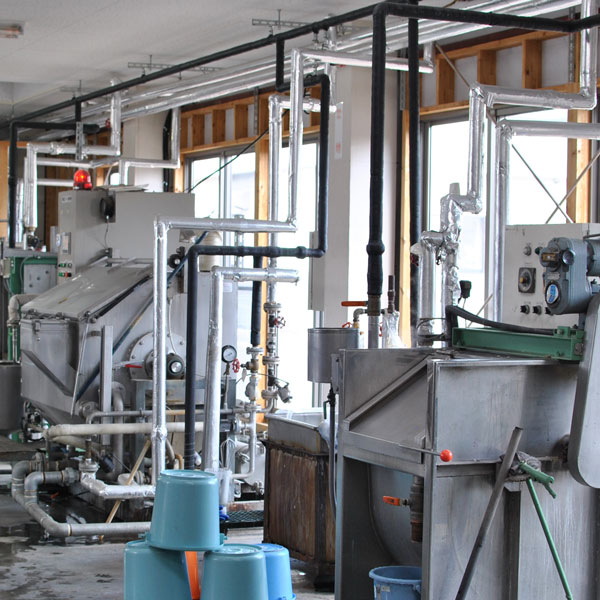

In fact, garment dyeing is an extremely labor-intensive process. As mentioned above, not only must the pattern be designed with the shrinkage from dyeing calculated in advance, but the finished garments—sewn with cotton machine-sewing thread that's notoriously difficult to work with—must then be dyed using a drum washer machine. One has to imagine garments of all different shapes moving around inside the drum; and since these are natural materials, the garments take on color while, in a sense, "breathing," depending on the temperature, timing, and condition of the water during dyeing.
Although the dyeing itself is done by machine, it differs from a process where a fixed dye formula and dyeing steps are simply followed. Here, a dyeing technician essentially converses with the garment as the color develops, giving it the feel of hand-dyeing. The reason for this commitment to garment dyeing is that, unlike yarn-dyed fabric, the fibers tighten firmly and the sewing thread bites into the cloth, creating a sense of unity that feels like a one-of-a-kind piece—all born from the wish that each customer will find it to be their favorite item.
FACTORY's garments, captivating in their details
Now, let's actually take a look at the garments FACTORY has created.
[Peruvian Cotton Tuck Sleeve Wide Shirt]


It's the Peruvian cotton material that creates a soft gentleness along with an exquisite balance—relaxed, yet never veering into sloppiness. The tricky thing about shirts is that you only truly appreciate their quality once you're wearing them, if the material suits the silhouette. What fully brings out this shirt's silhouette is its cotton, which feels wonderfully soft against the skin. Worn, it feels crisp and comfortable, and the surface has a subtle sheen that catches the light almost like silk. Because a wide silhouette shirt like this creates three-dimensional drape when worn, this fabric's texture really brings out the design's distinctive character. The hand-dyed colors come in two options: white and light beige. Pair it with slim denim or tapered pants for a natural, grown-up look, or dare to pair it with a heavier silhouette like a long skirt or gaucho pants for a more modish finish.
[Cotton-Linen × Belgian Linen Pullover]


The Cotton-Linen × Belgian Linen Pullover is a unique piece that combines contrasting materials—a knit body with linen sleeves. The cuffs feature gathered elastic for a feminine touch of volume, and it looks lovely whether you wear the sleeves down for a relaxed look, or push them up slightly to reveal your wrists for a more feminine style. The knit body uses yarn that combines Peruvian cotton with Belgian linen, bringing together the airy softness of cotton and the crisp texture of linen, while the contrast with the sleeves made of high-quality Belgian linen creates an eye-catching design.
[High-Waist U-Line Pants]


At first glance these look like simple cotton pants, but once you put them on, you'll appreciate just how precisely the silhouette has been calculated. Try them on, and you'll notice they've been designed to make the lower body appear in a U-line shape. There's a natural roundness around the hips, and the silhouette falls straight down from there—so even though it's a fuller cut, the legs still look beautifully shaped. The fact that this wide silhouette reads as refined rather than loose is a testament to the skill of FACTORY, a brand well known for its pattern-making expertise. The length runs a bit long, so we also recommend rolling up the cuffs to show a bit of ankle.
【Roll-up Pants】

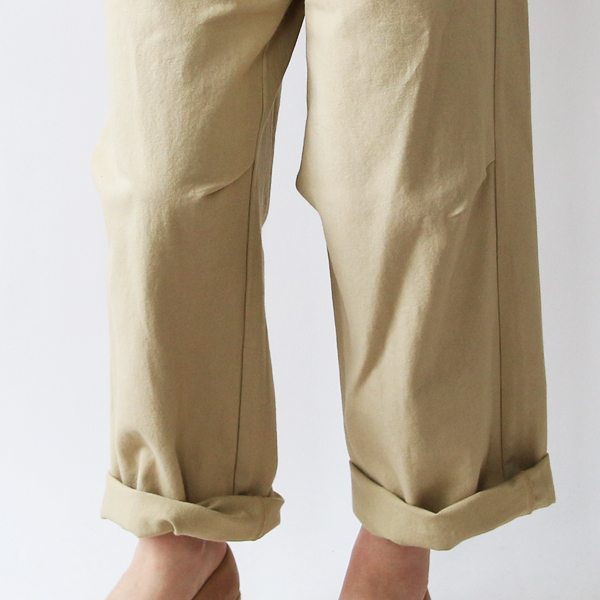
This is a piece where, despite its simplicity, you can spot careful attention to detail unlike anywhere else. Meant to be worn rolled up at the hem, it has a longer length and a relaxed silhouette that doesn't constrict the body, with a coin pocket set only on the right-side pocket. What's more, there's actually a diagonal pleat placed around the knee area, so instead of simply falling straight down, the fabric curves slightly inward—making this a three-dimensional bottom with exquisitely calculated construction. In the pursuit of comfortable wear, there's also elastic running from both sides of the waist around to the back, which is a nice touch.
No detail has been overlooked in the back design either. The hip area features an asymmetrical design where the fabric paneling—and the stitching that follows it—slopes down toward the right side. The right-side pocket is made deep, like a work pant pocket, creating visual interest. The large pocket also has the added benefit of making the whole body look slimmer.
【Sarouel Pants (Peruvian Cotton / Bamboo Cotton)】


Sarouel pants are known for their deep-rise pattern. When standing straight, they can look like a skirt at first glance, but they're actually constructed like a long culotte, which means they're easy to move in and comfortable to walk in. The waist features a gathered elastic and drawstring design, making them stress-free and comfortable to wear. While they subtly cover the shape of the thighs and calves, the length reveals the ankles, so the way you pair them with shoes or sandals opens up a range of styling possibilities. And because the hem tucks inward, they appear more compact than a typical long skirt.
What looks like a simple, straight-falling silhouette is actually a pair of sarouel pants with subtle, clever details—and what makes them so interesting is how different they can look depending on what you pair them with, whether it's a casual t-shirt with sneakers, or an airy thin knit with leather lace-up shoes. You can also enjoy a different look by pairing them with leggings in spring and wearing them on their own in summer.
▶︎See all clothing made by FACTORY

GUIDE »
CONTENTS »
CATEGORIES »
- + Gifts by recipient
- + Gifts by scene
- + Clothing
- + Bags / Backpacks
- + Wallets / Card cases
- + Jewelry
- + Shoes
- + Rainy day outfits
- + Kitchen
- + Home
- + Babies / Kids
- + Japanese products
Earn Miles


Payment & Security




