


.webp)


.webp)


.webp)


.webp)


Welcome to ZUTTO
Free shipping for newsletter subscribers (some areas excluded)
- トップページ/
- ZUTTO Journal/
- ブランドストーリー/
- Basque Shirts Bui...

The clothes-making philosophy of Fileuse d'Arvor: Basque shirts pursuing both flexibility and durability
Softness, comfort, and durability.
Somewhat contradictory elements, brought together through techniques nurtured by history
—this is what Fileuse d'Arvor's clothes-making achieves.
Our very idea of what a "Basque shirt" is may change a little after learning about it.


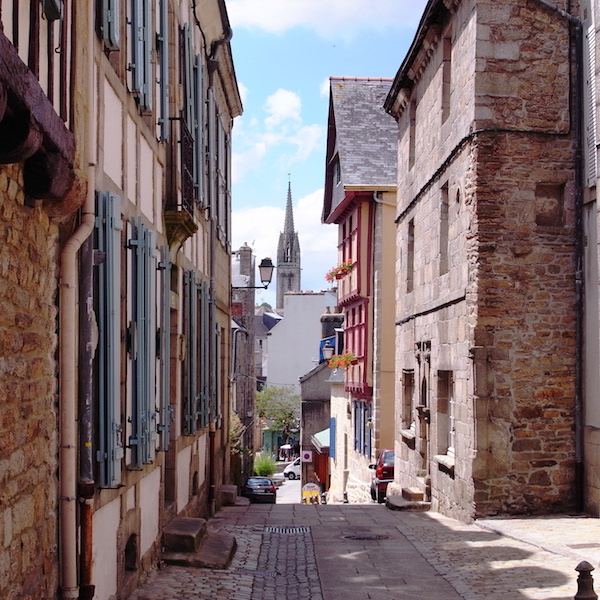
Fileuse d'Arvor was founded in 1927
in the port town of Quimper, in the Brittany region of northwestern France.
Brittany lies close to England, and as a region caught between France and England,
it is a place where cultures intermingle. Though part of France, it retains strong traces of Celtic culture,
giving it a fascinating history.
Being a coastal location, Fileuse d'Arvor has, since its founding,
handled a wide range of knitwear products centered around marine wear.
The fact that the brand name includes 'Fileuse,' meaning "one who spins thread,"
shows that this region had its own deeply rooted culture
of hand-spinning.
In Quimper, while waiting for their husbands who worked in fishing to return,
the women left behind would knit the sweaters
that the men wore—this was a common scene in ordinary households.
The illustration featured
in Fileuse d'Arvor's brand logo is said to depict this very lifestyle.

The item held by the wife waiting for her husband by the seaside is a traditional French
spinning wheel, and the scene depicts her shearing the wool from the sheep standing beside her
and spinning that wool into thread.
This gives a real sense of conviction—that this is a technique nurtured not just by a single maker,
but by the textile industry shaped by the region and its way of life.
Fileuse d'Arvor
continues its activities today as the oldest supplier of marine sweaters in the Brittany region.

At Fileuse d'Arvor,
they use cotton from Italy's OLYMPIAS company,
a standard material also used by many well-known brands.
While the knitting machines have been updated over time,
in pursuit of the same texture as when the brand was founded,
skilled artisans fine-tune the machinery to recreate the craftsmanship of that era.


Fileuse d'Arvor uses a generous amount of thread and employs a unique knitting method
called "vintage rib."
The stitches are fine, giving the fabric a distinctive flexibility.
It has a solid durability, yet it is never stiff or coarse.
The sense of the fabric conforming to your body from the very first wear is a real pleasure.

The brand describes the fit not in terms of stretching or shrinking, but rather as "moving."
This concept captures how the vintage rib
repeatedly expands and contracts, both vertically and horizontally, as you wear it,
gradually fitting your body more closely with each wash.
In France, this process is described as "moving"—neither stretching
nor shrinking, but rather reflecting the contours of your body as you wear it over time,
offering the distinctive experience of a garment that becomes uniquely yours.
In terms of softness and fit, another reason we recommend this shirt is that
it doesn't feel stiff when worn as a jacket, and doesn't pull uncomfortably
when you bend your elbows.
Fine stitching also means the fabric doesn't need to stretch unnaturally,
which helps it "resist losing its shape."
Even after washing, the stitches won't tighten up and become stiff.
This is a brand that has grown by never neglecting the care needed to ensure softness and comfortable wear,
while preserving the beauty and function of the garment as clothing.

Bag: Daniel&Bob / Leather Tote Bag THELMA
Stole: INOUITOOSH / Stole KISU


A defining feature of Fileuse d'Arvor's Basque shirts
is that they are designed with "long-term wear" and "ease of wearing" in mind.
Looking at the shoulder area, you can see that a double layer has been added to prevent stretching.
This can be considered an excellent feature in terms of allowing the shoulders to move naturally
and ensuring ease of movement.
It's remarkable that this universal sewing specification, which other makers cannot replicate,
is actually registered as a trademark in France.

There is also a different ingenuity built into this short-sleeved cut-and-sew top.
This top is based on a sweater the founder originally made at a fisherman's request,
to be worn aboard fishing boats.
To increase durability and ease of movement,
the neckline is a somewhat wide boat neck,
and at the shoulder area, which tends to bear the most strain, the front panel is extended
around to the back of the shoulder and sewn there,
shifting the seam away from the point of greatest stress.
Because of this high durability, the design is said to have remained almost unchanged since the brand's founding.
The image below shows a Fileuse d'Arvor Basque shirt
made and worn since the early 1960s.


Left: Basque shirt from 60 years ago / Right: Brand new

Basque shirt from 60 years ago
The stitching around the neck is starting to fray a little, but
the knit itself remains extremely sturdy, with no loss of shape.
The fine, tightly condensed stitches haven't changed since the old days.
The double-layered construction at the shoulders is also a point of brand pride that dates back to that era.
Compared to a new piece, repeated wearing and washing
have brought out a softness and a lovely texture in the fabric.
Looking at the tag at the neck and the brand emblem on the arm,
you can sense the changes of history, while the brand's dedication to clothing itself remains unchanged,
and you realize it has been passed down faithfully through the years.


Looking at it from the front, there is a patch on the lower right hem. This is
the flag emblem of the French Navy aircraft carrier JEANNE D'ARK, which was supplied as a uniform,
and it was something only official suppliers were permitted to attach.

Fileuse d'Arvor came to handle the French military's uniforms
because the brand's own reinforced stitching at the shoulders and other details
were highly regarded even as workwear specifications, and
because production was carried out 100% in France, it is said.
At the time, the production of uniforms for state-run organizations was entrusted to French companies,
and this was a case where the brand's dedication to craftsmanship and domestic production was recognized.
With the retirement of the aircraft carrier JEANNE D'ARK, the brand has since withdrawn
from work related to the French military, but
the flag emblem stitched onto the cut-and-sew garments tells the story of that achievement.

In late April, as the weather turns warmer, you can put away your spring coat
and go out wearing nothing but a cotton cut-and-sew top.
From long sleeves and short sleeves to half pants,
let's take a look at the Fileuse d'Arvor lineup.

First, in a very French way, why not try a marine look?
That sounds nice. The classic combination of a white-based cut-and-sew top with navy stripes
comes with a "shoulder cutout" design where the stripe pattern is absent
from the shoulder to the upper arm, giving it a clean, sleek look.
Clogs: dansko/Professional Black Oiled
The half pants worn in the image above are also
from Fileuse d'Arvor.

Even in half-pants form, being knit fabric, they don't lose that mature, refined impression.
Pairing them with a Basque shirt creates a casual sense of unity, and
they also go well with more polished items like a white shirt or heeled sandals.
The half pants also come in khaki.

Bag: ROBERTO PANCANI/[Special Order] Rattan × Leather Bag (S) BEIGE

Having one plain Basque shirt on hand is incredibly useful.
It's not swayed by trends, so you can wear it for a long time, and it seems destined to become a staple piece.
Even when paired with wide-silhouette bottoms or vividly colored accessories,
it never feels out of place and blends in effortlessly.
Pants: FACTORY/Peruvian Cotton Pinstripe Sarouel Pants
Clogs: dansko/Professional Black Oiled
Hat: DAY STROWS/Straw French Casablanca

With short sleeves, the look turns into an instantly cool, refreshing marine style.
Since the Basque shirt itself is a classic shape and design, we recommend having fun
with your accessories to coordinate the outfit.
Stole: INOUITOOSH/Stole MR HULOT
Watch: ROSENDAHL/ARNE JACOBSEN Watch CITY HALL
Shoes: chausser/plus by chausser Lace-Up Shoes BR

It can be worn as casually as a T-shirt, but it isn't quite as casual as one,
so it retains just the right amount of refinement.
The plain short-sleeve version comes in two colors: white and navy.
Pants: fog linenwork/[Special Order] Linen Wide Pants
Bag: PATRICK STEPHAN/[Special Order] 3-Way Leather Pochette 'enveloppe' GREY
Sandals: SUICOKE/SUICOKE Sport Sandals GRAY
【 About Washing 】
Since it's valued for its durability as workwear,
you don't need to be too careful when washing it — feel free to wear it often and machine wash it without worry.
To avoid shrinkage or loss of shape, please avoid using a dryer.
▼You can find the Fileuse d'Arvor brand page here

GUIDE »
CONTENTS »
CATEGORIES »
- + Gifts by recipient
- + Gifts by scene
- + Clothing
- + Bags / Backpacks
- + Wallets / Card cases
- + Jewelry
- + Shoes
- + Rainy day outfits
- + Kitchen
- + Home
- + Babies / Kids
- + Japanese products
Earn Miles


Payment & Security




