


.webp)


.webp)


.webp)


.webp)


Welcome to ZUTTO
Free shipping for newsletter subscribers (some areas excluded)
- トップページ/
- ZUTTO Journal/
- ブランドストーリー/
- A watercolor-like...

Stoles dyed with the vivid delicacy of watercolor paintings. A visit to marumasu's craftsmanship
The wisdom behind the name "dyeing"
marumasu's stoles possess the vivid freshness of a single watercolor painting, and the flowing texture they take on when worn is their true charm. Just as artists have long sought new pigments to recreate the beautiful colors found in nature, the pursuit of beautiful color has been one of humanity's most fundamental desires since ancient times. Yet reproducing beautiful color on fabric is truly a formidable art. Here, we unravel the wisdom behind the name "dyeing."


1901: From the culture of Tokyo Yuzen

marumasu's workshop is located in Shibamata, Katsushika-ku, Tokyo. This area was once lined with workshops producing Tokyo Yuzen, the fabric used for kimono, and Marumasu Senshoku, the parent company of marumasu, also worked on Tokyo Yuzen kimono when it was founded in 1901.
1901 corresponds to Meiji 34. From there, through the Taisho, Showa, and Heisei eras, the demands placed on "dyeing" changed with the times, and the company came to handle dyeing for a variety of fashion industries. It was amid this evolution that marumasu was born in 2011.
What characterizes the stoles marumasu creates is the elegance of their vivid coloring and the delicacy of their melting, luxurious texture. Drawing on the knowledge unique to a long-established workshop as well as chemical theory, they carefully blend dyes, adjust pH, and control salt content according to the harvest timing and season of the materials before dyeing. Valuing the feel and texture above all, they deliberately sacrifice efficiency and take their time in dyeing, resulting in stoles that are vividly colored, comfortable to wear, and capable of taking on many different expressions depending on how they are draped.

A design that leaves room for possibility in how it is displayed
In Japan's fashion world, marumasu's stoles are said to be "as elegant as overseas artwork," yet when exhibited at overseas exhibitions in London, Paris, and elsewhere, they are instead praised as "very Japanese and unique."
Without using any figurative motifs, the brand creates designs from the perspective of how many variations can be generated using colorful hues and abstract, geometric patterns.
Precisely because it is a factory brand that once worked on kimono, marumasu inherits a distinctly Japanese aesthetic sensibility, while continuing to pursue the possibilities of abstract design so that it is not confined to a single way of presentation, but can be arranged in many different ways.
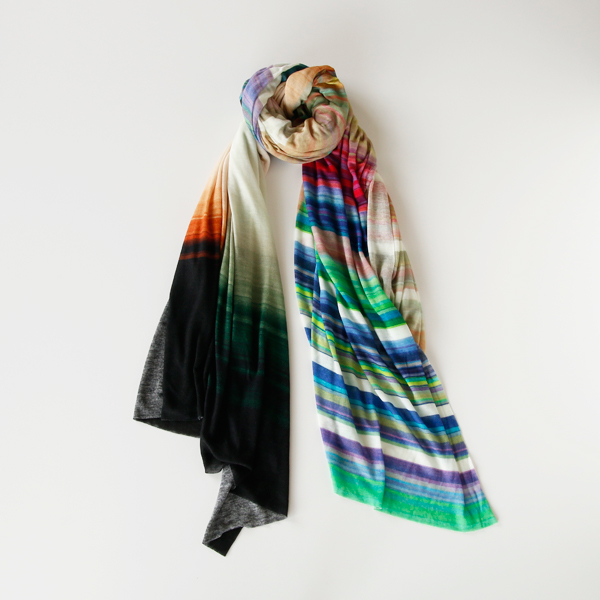
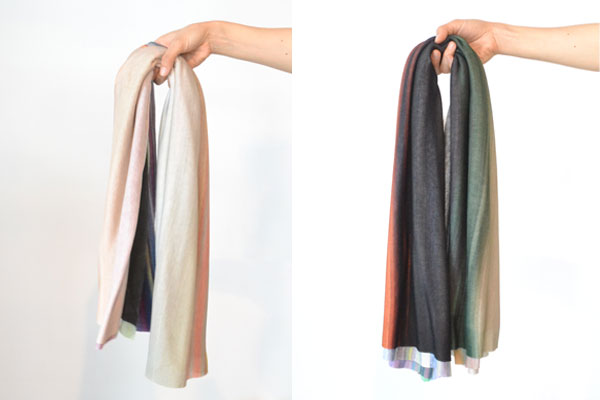
For example, this stole, named "STRATUM BORDER DOUBLE," is a large piece measuring 100 x 175 cm, scattered with various gradations of color.
On one side, vivid red, blue, green, and white are arranged in a rhythmic pattern, creating a design reminiscent of geological strata. On the other side, pale brown and green evoke the impression of Saturn and Jupiter.
"The color balance is beautiful when it is spread out wide and draped around the body."
"The impression changes depending on which side you show on the outside when it is folded."
"The drape when it follows the body's contours brings out beautiful shadows."
With these various perspectives in mind, marumasu decides on colors, color combinations, and designs as if painting a single picture.
Dyed slowly, with painstaking care
The printing methods used for marumasu's stoles include several types, such as "silkscreen" and "inkjet printing," but all share the common trait of taking time and care to dye and print slowly. The photo shows an inkjet-type machine printing marumasu's original designs onto cotton fabric.

The basic principle is the same as a household inkjet printer—it is a very large machine for fabric that can be computer-controlled so that colors are applied beautifully. While the latest high-speed machines can dye as much as 1,000 meters in a single hour, marumasu deliberately chooses an older-style machine instead, printing at the slow pace of about 10 scarves' worth per hour, taking great care in the process. This reflects their passion for handling delicate materials with care and expressing beautiful colors at a quality they can be truly satisfied with, no matter how much time it takes.


This is a scene where a craftsman stays close by, feeding the fabric into the machine while checking its condition by hand. Even with computer control, the ideal quality cannot be achieved without the human hand. Before printing, the fabric that will become the base of the stole is starched, giving it a very crisp, stiff texture that seems far removed from the image of a soft stole. This starching process prevents bleeding and results in a beautiful finish.
marumasu is skilled at working with both woven fabrics like this cotton material and knit fabrics. For the stretchy knit fabric, they maintain their own consistent quality control throughout every process—"dyeing," "washing," and "drying"—to reproduce beautiful colors while never sacrificing the comfort felt against the skin. This is the strength of a factory brand that are true professionals of "dyeing."

Breathing life into fabric, transforming it into a stole

Some of the printed fabrics use delicate materials such as cashmere and silk. These delicate fabrics are placed in a generous tank of water and washed slowly, gently, by hand—a process repeated again and again to remove the paste and excess dye. Because only a small number of pieces are washed at a time, this step also takes time, but it ensures an even, carefully finished result for every single piece.
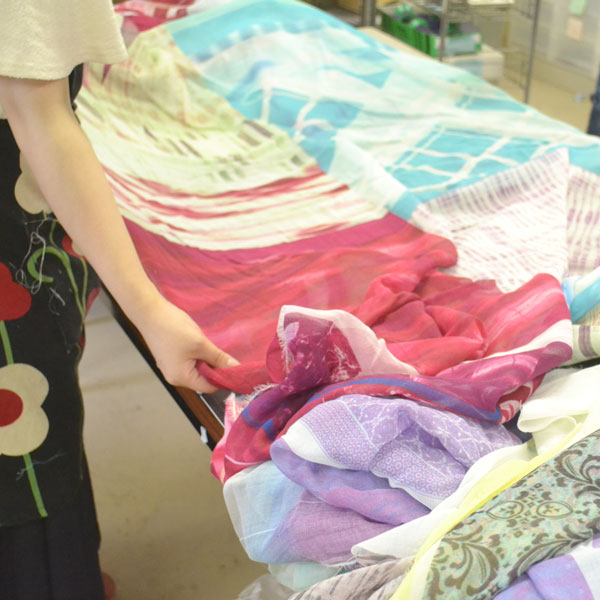
Once the fabric has gone through the processes of "printing," "washing," and "drying," it is given life as a stole through the work of human hands. The colorful fabric, running several meters in length, is printed with the designs of multiple stoles at once. This is then cut by hand into the shape of each stole.


The fringe is made by pulling out several weft threads, leaving only the warp threads exposed. Making this fringe is, in fact, also done by hand. It is through this finishing process—carried out with great care, one piece at a time—that "fabric" transforms into a "stole."

Being a factory that designs

One of the unique aspects of marumasu is the philosophy that "designers dye the fabric with their own hands." In fact, the staff member overseeing the fabric printing mentioned earlier is one of the designers who creates the fabric patterns. Likewise, the staff who handle the finishing work—cutting the stoles and making the fringe—are the same people who have worked as sales staff at the flagship store in Ginza.
A design only truly becomes fabric once it has been printed, and a stole comes vividly to life only once someone wears it. What colors emerge once the fabric has been dyed and the excess dye washed away? What kinds of styling can be proposed once a customer drapes it around her body? The greatest strength of marumasu lies in the fact that everything, from design to dyeing, is considered with the goal of making the stole look most beautiful when worn.


Photo above: Color samples from an earlier era. Even now, the colors look fresh and vivid.
Photo below: A photograph capturing marumasu's dyeing work of the past. It was printed not on paper, but on fabric.
The art of styling: one stole, countless looks

After hearing at length about marumasu's approach to making things, we asked them to demonstrate some actual ways of styling their stoles. Our guide was Mayumi Fukuda, marumasu's sales and shop manager. She showed us the many styling arrangements she has studied while working at the flagship store in Ginza.
How much can a knot change things? — Silk Scarf
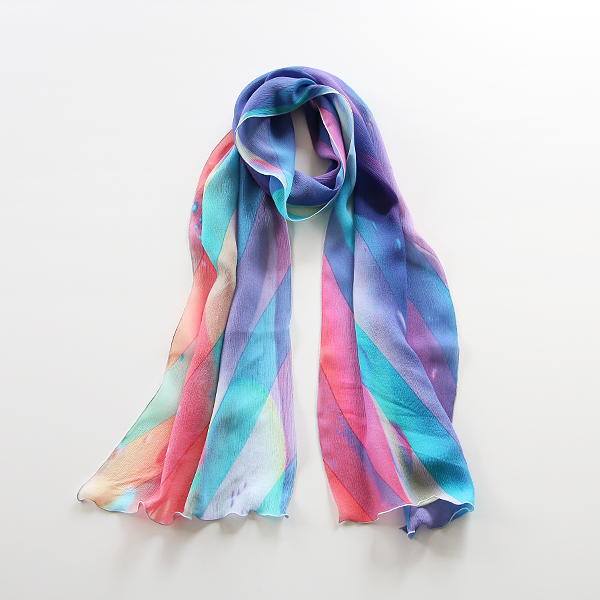
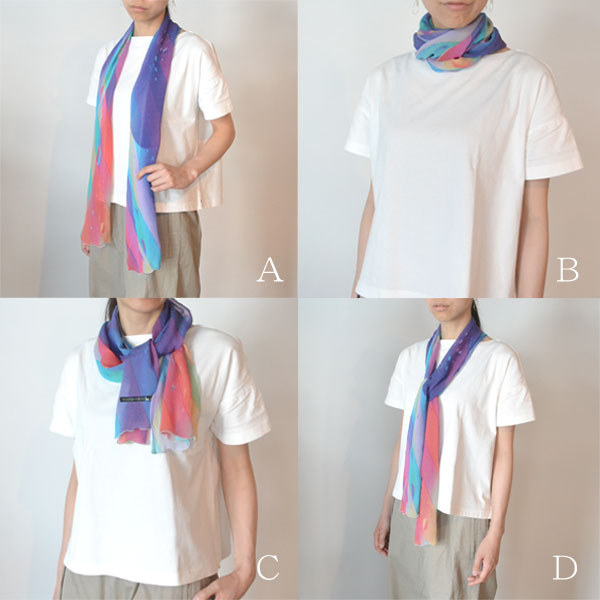
First, an arrangement made simply by changing the way the scarf is tied. This is the compact "DROP STRIPE," measuring 30 cm wide by 160 cm long and made of 100% silk. The frilled edges at both ends, when wrapped quickly around the neck, take on the look of a corsage, bringing out a feminine touch.
A: Left long and untied, the vertical line is emphasized, giving a crisp, dignified look.
B: Wrapped twice around for a compact fit. Also functional as protection against UV rays and air conditioning.
C: Tied loosely, letting the airy softness of the silk stand out.
D: Tied into a large knot, it takes on the feel of an accessory.
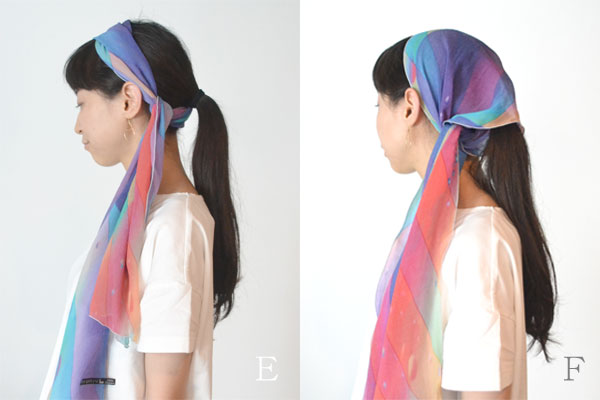
The narrower model is also easy to use as a hair accessory, and simply wrapping it quickly opens up a range of arrangements. As in E, folding it tightly, tying it into a single knot, and letting both ends hang long creates a fashionable finish. F, on the other hand, is arranged with plenty of width left loose, giving it an ethnic feel. Just adding one scarf to a simple ponytail makes all kinds of hair arrangements possible.
Enjoying the drape and suppleness — Knit Scarf

Next is a stole made of knit material—one of marumasu's signature, standard lines. It uses a fabric knitted with extremely fine gauge from a blended yarn that combines the softness of tencel, the sheen of silk, and the suppleness of cashmere.
In its large size, it can be draped to cover you down to the waist, yet being thin, it folds down to the size of a paperback book, and it can be worn all year round—a truly functional piece. Because knitted fabric has more stretch than woven stoles, it can be wrapped generously around the shoulders without any constricting stress, and it also has the advantage of leaving little trace even after being tied into a knot.
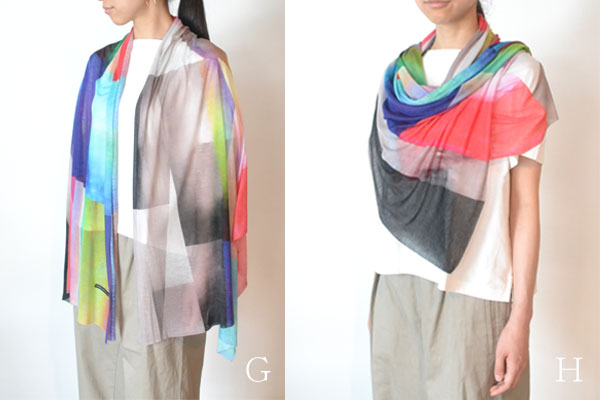
"KLEE BLOCK" is a piece inspired by the paintings of Paul Klee, expressing passionate color through bold planes.
G: Making the most of its 65 × 170 cm presence, worn simply.
H: A variation on G. Creating a natural drape and rolling it up gives an elegant impression.
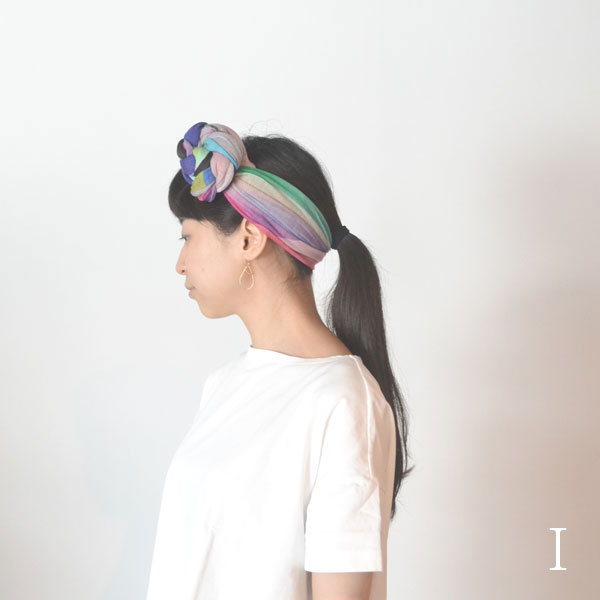
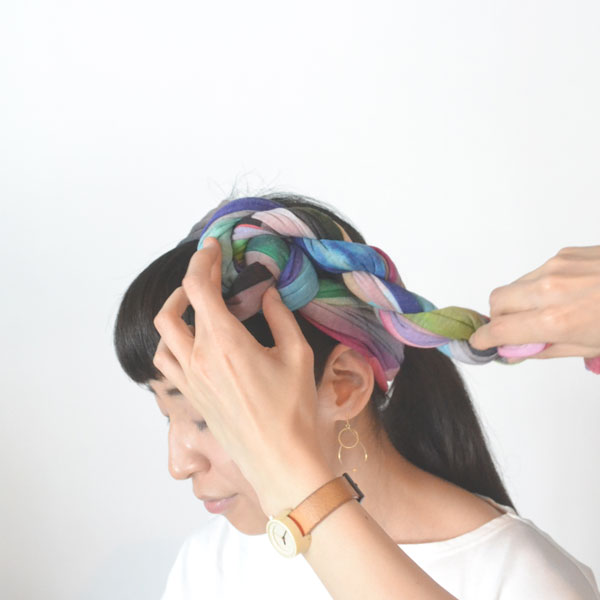
A hair arrangement that makes the most of the knit's thin, supple qualities. The image is of a flower-like motif, packed generously with beautiful color. It looks complex, but the method is actually very simple.
Pass the folded stole through beneath the knot of a ponytail, and tie a knot near the forehead. From there, twist both ends of the stole together as if making a cord ("koyori"),
and form them into a bun. Since the ends of the stole can simply be tucked into the seam to hold everything in place, this arrangement can be done quickly, without any special tools.
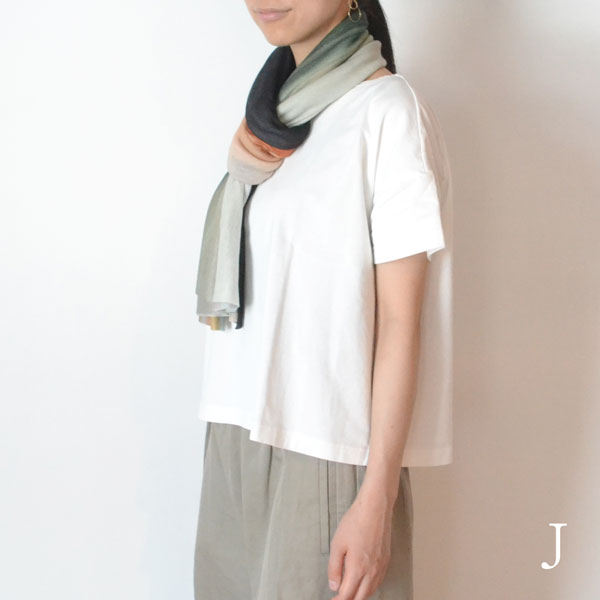
Here is an arrangement that lets you use even a large stole compactly. The drape of the knit fabric, together with the moderate volume created by the layered folds, gives a calm impression around the neck. Since only a small area of the fabric is visible on the outside, which part you choose to show—in other words, how you fold it—can make it look like an entirely different stole. That's what makes this arrangement so interesting.
The sense of wearing color

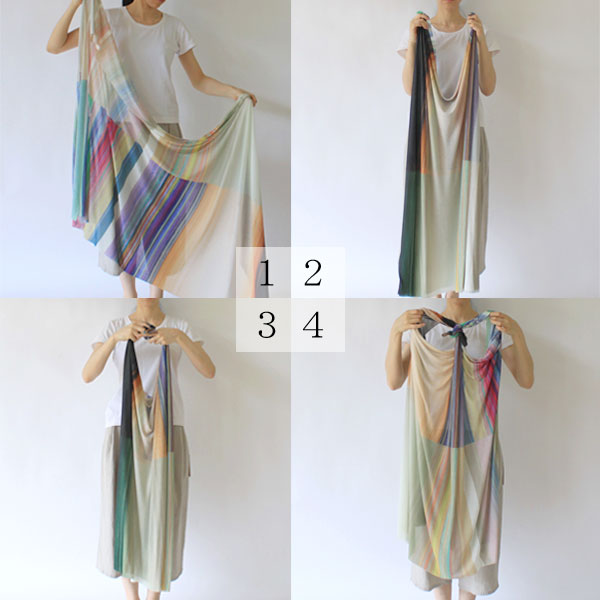
And here's a recommended arrangement using a single 100×170cm stole. Just by making one knot, you can wear it like a long cardigan.
1: Fold the long side in half.
2: Hold the "loop" up top and align both ends.
3: Tie the aligned ends together twice with a square knot.
4: When you open up the knot, armholes form as shown in the diagram.
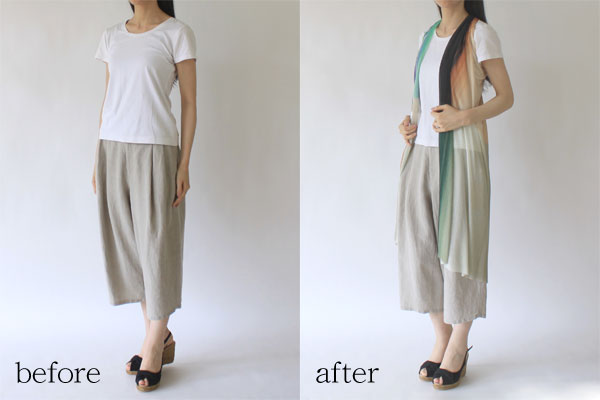
Stole: STRATUM BORDER DOUBLE, Belt: 90132G THIN7mm BELT, Bottoms: Belgian Linen Tuck Wide Pants (discontinued), Bag: 3way Leather Pochette enveloppe GREY (discontinued), Shoes: Turban Design Espadrille Sandals (discontinued)
Even just adding this to a simple outfit of a plain cut-and-sew top and bottoms creates such a beautifully three-dimensional look that at first glance, you might not even recognize it as a stole. It's made simply by folding and tying, but by looking at it as something to "wear," it instantly becomes a sophisticated arrangement. If you bring the left and right hems together to create drape, it takes on the elegant atmosphere of a cache-coeur silhouette, making it fun to coordinate with accessories like belts or brooches.
This is a way of enjoying the stole that goes beyond the idea of "wrapping" it, offering instead the feeling of "putting on another layer."
【Achieving an airy arrangement with the bias-cut technique — Cotton Scarf】
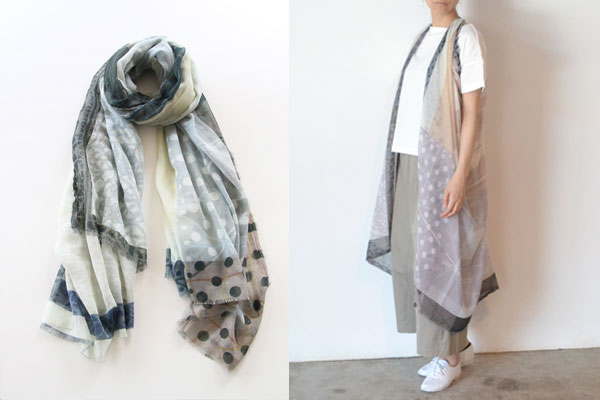
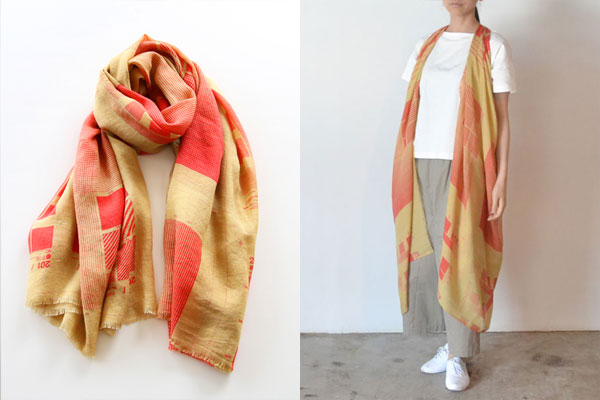
Both of these are the same cardigan-style arrangement, but the scarf material here is "cotton."
While knit is a material with stretch and drape, this cotton stole is woven, so it holds air and gives a soft, airy feel when worn. Even with the same arrangement, the impression changes so much depending on the material and pattern.
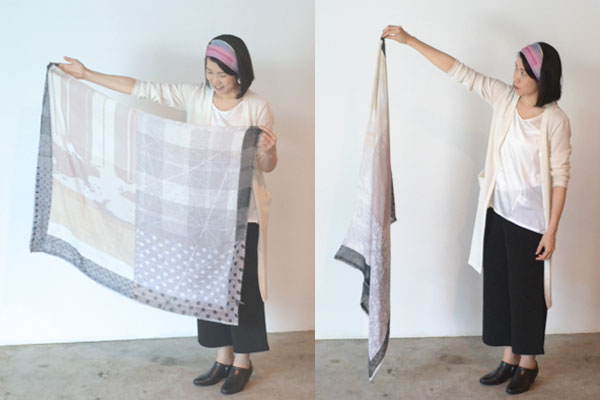
Also, when using a "woven" stole, mastering the "bias-cut technique" greatly broadens the range of expression. Bias refers to folding diagonally against the "grain" of the warp and weft threads seen in woven fabric.
The photo on the left shows folding parallel to the grain, while the photo on the right shows the bias fold. In the case of a knit stole, the fabric stretches under its own weight, so folding in the bias direction isn't suitable, but for woven stoles with less stretch, we encourage you to enjoy the bias-cut technique as well.
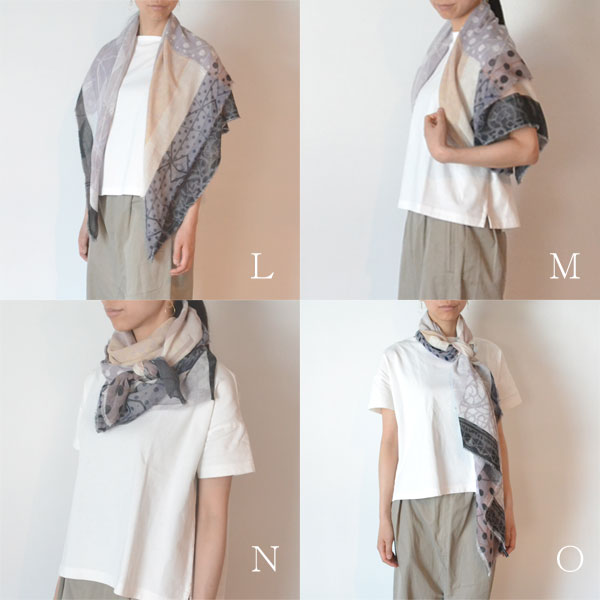
L: An arrangement where you fold it like origami to make a triangle and drape it from the shoulders
M: A further variation on L. Bring the two sides of the triangle to the back and tie them for a bolero-like look.
N: Fold into a triangle, roll it up, and tie once. The overlapping corners create volume.
O: Fold the stole on the bias to create pleats, and let it hang long for an elegant look.
We've introduced many arrangements so far, but what makes stoles so interesting is that, without limiting their use, you can show them off in countless ways depending on your ideas.
Even with the same stole, we continue to learn every day as we talk with customers in the store, helping them find the piece that suits the image of the clothes they usually wear, or suggesting choices and arrangements to match their makeup tones or hairstyles—always exploring new ways for stoles to be worn.
Even something as simple as "making a knot" or "draping it over the shoulders" can completely change the impression it gives with just a little ingenuity. Take the classic women's hairstyle, the ponytail, for example: tying it high gives a lively impression, letting it hang low creates a calm atmosphere, and loosening a few strands near the tie gives an effortlessly chic look.
In the same way, we would be truly delighted if you could freely enjoy marumasu stoles according to your mood.
▼Shop info:
MARUMASU GINZA
Tokyu Plaza Ginza 3F-12, 5-2-1 Ginza, Chuo-ku, Tokyo
11:00–21:00
▶︎See the full lineup of marumasu stoles here

GUIDE »
CONTENTS »
CATEGORIES »
- + Gifts by recipient
- + Gifts by scene
- + Clothing
- + Bags / Backpacks
- + Wallets / Card cases
- + Jewelry
- + Shoes
- + Rainy day outfits
- + Kitchen
- + Home
- + Babies / Kids
- + Japanese products
Earn Miles


Payment & Security




