.webp)


.webp)


.webp)


.webp)


Welcome to ZUTTO
Free shipping for newsletter subscribers (some areas excluded)
- トップページ/
- ZUTTO Journal/
- 選び方・使い方/
- 3-way versatility...

Versatile in 3 ways for any coordination—ZUTTO's exclusive akebi basket
A basket bag creates presence just by carrying it, becoming the focal point of an outfit.
With their cool, refreshing impression, basket bags make you want to carry them once summer arrives, but
the akebi basket that ZUTTO has made this time is meant to be something
you'll want to use regardless of season or outfit.




Unlike bags made of fabric or leather, basket bags lack flexibility, so
most are made as hand-carry types, but
so that you can change how you carry it to match your outfit,
this exclusive item has been made with a 3-way design, which is rare for basket bags.

The shoulder strap can be adjusted in length, letting you wear it crossbody or over the shoulder,
and if you remove the strap, it becomes a hand-carry bag.
This has become an akebi basket bag that's easy to pair
with all kinds of styles, from casual to feminine.
<3-Way Styling>

Worn over the shoulder for a light, breezy style. Not too casual, not too polished—just the right balance. (Model's height: 158cm)
Dress: 120%LINO / Linen Shirt Dress
Sandals: ITALO CARLI / Strap Sandals BEIGE

A crossbody style that suits casual outfits and keeps both hands free. (Model's height: 158cm)
T-shirt: CAMBER / 8oz MAX WEIGHT CUT POCKET T-shirt
Pants: FACTORY / Peruvian Cotton Sarouel Pants

Remove the shoulder part and it becomes a hand-carry basket bag, suited to a feminine, calm coordination. (Model's height: 158cm)
Sandals: dansko / VERA Black Burnished
The shoulder strap is also finished with leather on the front and hanpu (cotton canvas) on the back.
This is out of consideration for the back side that touches your clothing,
so that color transfer from the leather's fading won't stain your clothes,
and it also serves to prevent the leather from stretching out over long-term use.
Of course, we hope you won't put anything too heavy in the akebi basket,
and there isn't much risk of the leather stretching from weight anyway,
but we designed it this way with long-term use in mind nonetheless.

This exclusive item, the akebi basket (plain weave, "guni-de" handle, with shoulder strap), has
enough capacity to hold a smartphone, a long wallet, a paperback book, one 350ml bottle, and a mini pouch.
But packing it too full won't look smart, so
please keep your belongings to the essential minimum.


Last year's exclusive akebi basket was also well received, and
this year again, we've wrapped leather around the akebi basket's handle.
What's different is that the leather part is now removable.

With the leather part attached, the marks left by the akebi vine won't press into your hand,
making it less likely to hurt whether you grip it tightly or carry it over your arm.
Wrapping black leather around the akebi basket, which has a relaxed feel,
gives it a crisp, tightened impression that changes the overall look.
It looks just as fitting in autumn or winter, so please feel free to use it regardless of the season.

What we paid particular attention to with the leather part was
sewing it in a three-dimensional shape so that it wouldn't pull tight or sag
when wrapped around the curved handle.
This lets it follow the curve of the akebi handle, fitting your hand comfortably.
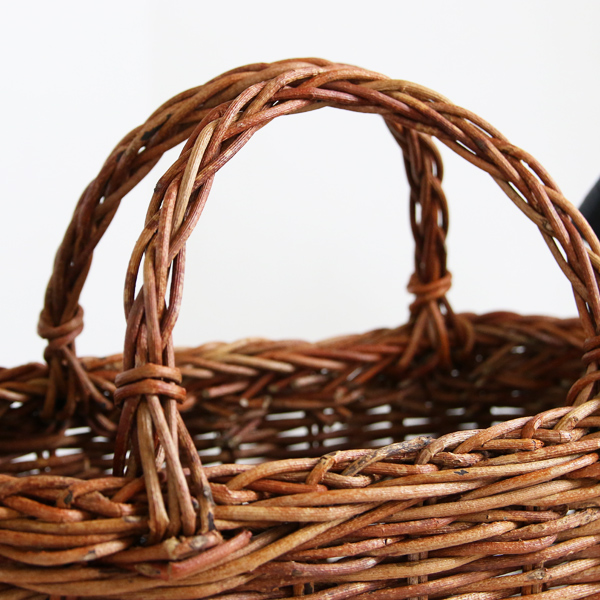
When you remove the leather part from the handle, the akebi handle
is finished in the "guni-de" style.
"Guni" is a word from Aomori meaning "three-strand braid."
In other words, the akebi vines are braided into three strands to form the handle.
This gives the handle strength despite its slender form,
achieving both cuteness and durability.


Akebi is a type of vine plant, one that relies on other trees for support to
extend its stems upward toward higher places.
Its purple fruit is sold for food, and its vines are used for basket weaving.

Did you know that akebi baskets are made over a long span of time?
Each year, akebi vines are harvested around autumn, then dried for about six months to a year.
This is because the core of the vine needs to be dried thoroughly.
Then, starting one to three days before the actual weaving begins, the vines are soaked in water,
and once softened, the nodes are removed and the weaving begins.
Akebi baskets have elasticity, and I think they're
relatively easy to carry, even among baskets in general.
As you use it, a natural sheen gradually develops,
giving you the pleasure of "raising" it over many years.
The material itself is sturdy, offering the advantage
of being repairable and usable for a long time, meaning it can be cherished across generations.
Isn't it wonderful to think that a basket you once used
might be used again by your children, or even your grandchildren, in the next generation?
Now a rare material and a craftsman's skill
Compared to 20 years ago, the harvest volume of akebi vines has apparently
dropped to about 10%.
There seem to be various factors, such as forest deterioration due to a decline
in the number of people working in forestry, and the effects of climate change, but
it seems true that the raw material for weaving akebi baskets has become scarce.
For this reason, Miyamoto Kogei never wastes any akebi vine.
Since it's a natural material, the color, thickness, and length naturally vary.
Some vines are darker, almost blackish, in color, but
rather than let these go to waste, they are used for
inconspicuous areas such as the bottom of the bag,
keeping the overall balance of the bag intact while making sure not to waste any of this precious akebi (Japanese chocolate vine).

The way a single vine is woven into a three-dimensional form is nothing short of masterful craftsmanship.
Aligning the weave, keeping the shape and size of the entire basket consistent, and
giving it the strength and usability needed for
everyday use is truly remarkable.
The craftsman assesses the characteristics of each individual piece of material and, drawing on years of experience,
decides which part of the basket it should be used for.
It would be a waste to turn a basket made from such precious material and the craftsmanship of akebi basket makers—now dwindling to just a handful—
into a bag that's only used during the summer.
The shoulder strap allows you to change how you carry it,
and the leather parts let you change its impression—
all so that you'll want to use it for a long time.

Akebi is a material that is inherently highly durable,
and combined with the skilled weaving of an experienced craftsman, an akebi basket can be cherished for years to come.
Akebi crafts have become rare due to a shortage of both material and weavers,
but they were originally created and developed as everyday tools for daily life.
Rather than putting it away, using and handling it daily is the best form of care.

For daily care
After use, brush off any dust along the weave with a dry scrub brush or similar brush.
Moisture is the enemy
Just like leather goods, baskets don't do well with moisture.
Rather than putting it away when not in use, it seems best to keep "using" it—
for instance, by displaying dried flowers in it or
using it as storage.
If you really must put it away, please store it in something breathable,
such as a paper bag.
Do not apply oil
There seem to be various opinions on how to bring out the shine of basket bags,
but according to the craftsmen at Miyamoto Kogei, the beautiful sheen that develops from the natural oils of your hands while using the basket—
without applying any oil—is what looks best.
(Oil will cause the basket to darken.)
Also, brushing with a dry scrub brush will bring out a slight sheen.
For stubborn stains
For stubborn stains, wash the basket with water.
Scrub with a brush, without using any detergent.
When drying, always dry it thoroughly in the shade.
We recommend washing it in the morning on a sunny day.
If a stem breaks
With use, the stems may sometimes break or bend.
If this happens, push it back inside or trim it with scissors.
Since the stems are dry, they won't come undone or fray.
Miyamoto Kogei also accepts repairs, so
please contact ZUTTO Customer Support for more information.
▼[Special Order] Akebi Basket (Regular Weave, Guni Handle, with Shoulder Strap) — Go to Product Page

GUIDE »
CATEGORIES »
- + Gifts by recipient
- + Gifts by scene
- + Clothing
- + Bags / Backpacks
- + Wallets / Card cases
- + Jewelry
- + Shoes
- + Rainy day outfits
- + Kitchen
- + Home
- + Babies / Kids
- + Japanese products
Earn Miles


Payment & Security