


.webp)


.webp)


.webp)


.webp)


Welcome to ZUTTO
Free shipping for newsletter subscribers (some areas excluded)
- トップページ/
- ZUTTO Journal/
- お手入れ・エイジング/
- Column: How to Ch...

Column: How to choose leather shoes you'll want to use for years.
What the pandemic taught us about the value of owning things that last

plus by chausser Plain Toe Shoes BL
With fewer occasions to go out, when we do head out on weekends we've started choosing shoes we actually "want to wear." What makes a shoe worth wearing differs from person to person, but the main reasons usually come down to good looks, versatility that suits any outfit, and above all, comfort while walking.
Among such shoes, lace-up leather shoes that mold to your feet more with each wear are top contenders as timeless staples you'll want to keep using for years. Their unisex design suits any style and never grows tiresome.
Precisely because these shoes fit your feet and stay comfortable for so long, it feels more natural to have them repaired and keep wearing them rather than wearing them out and buying new ones. This time, we bring you a column on "shoe shapes that are easy to repair"—something one of our staff members realized anew after sending a pair in for repair.
What a staff member learned about cost-effectiveness after having shoes repaired
This column started when a staff member took a pair of patent leather shoes, purchased four years earlier, in for repair. She had worn and loved them for their comfort, but since the edges and soles had worn through, she was told the repair would cost more than half the original purchase price.

She was fond enough of the shoes that she considered going ahead with it anyway, but learning that the repair wouldn't restore them to like-new condition—it would only be a stopgap measure to hide the damage—made her feel the cost wasn't justified, and she decided to let them go. That's when she resolved that next time, she would choose shoes she could repair and wear for ten years.
Shoes you can wear for a long time depend not just on looks but, even more importantly, on being "constructed for easy repair and maintenance." This renewed her interest in shoes whose soles can be fully replaced—something she'd been curious about for a while.
Shoes with fully replaceable soles
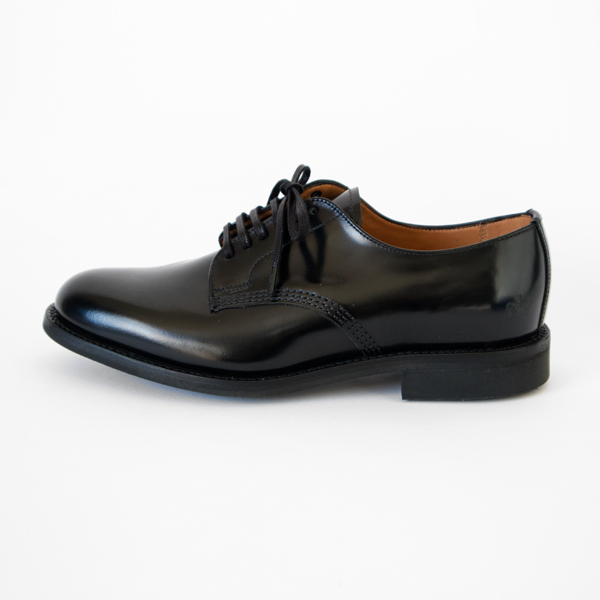
OFFICER SHOE 1831 Black / SANDERS
Goodyear welt construction—have you heard of it?
Genuine leather shoes are mainly made using this Goodyear welt construction or Blake construction, so the terms are probably familiar to office workers who often wear leather shoes.
Goodyear welt construction is a method in which the insole, upper, and a thin strip of leather called the welt are sewn together first, and then the outsole is stitched on. Compared to other methods, it uses more parts, requires more stitching, and has a more complex structure overall.It contains a thick layer of cork, which reduces foot fatigue, and the shoes mold to the shape of your feet far more than shoes made with other methods.
The resulting shoes are sturdy and highly practical, and the soles can generally be replaced around three to six times. This varies depending on how you wear them and how often you have them maintained, so it's only a rough guide, but even if you replace the sole once every two or three years, the shoes could last around ten years.
To mention the drawbacks as well, there's the stiffness when first worn and the cost. Because sturdy parts are used, the sole is stiff at first and needs to be broken in gradually. And as mentioned above, the complex construction that allows for long-term use also tends to make these shoes pricier than others.
How does this differ from other shoe construction methods?
The other main methods are cement construction and Blake construction.
Cement construction refers to a method where the sole is attached with adhesive rather than stitched.

For example, these shoes use cement construction. They're resistant to rain and valued as work shoes as well.
Many such shoes soften and mold to your feet quickly once you start wearing them, and like Goodyear welt construction, they resist rainwater well. Once the sole wears through it can't be replaced, so repairs tend to be stopgap fixes, but these shoes are relatively affordable and easy to use in everyday life without worry. They're also a good choice for trend-conscious leather shoes, or as an entry point for those new to leather shoes who aren't sure how much use they'll get.
Blake construction is, like Goodyear welt construction, sewn together, but the upper, insole, and outsole are all stitched through together in one pass, giving it a sleek, streamlined design.

For example, these shoes are made with Blake construction. The result is a delicate, feminine shoe.
Generally weaker against rain, this method produces a delicate look that wraps around the foot. Many of these shoes can actually have their soles replaced too, but each replacement damages the insole, so repairs are usually limited to one or two times. For shoes worn daily, even with maintenance, the lifespan is typically around five to six years. Since they're comfortable to walk in and have a feminine delicacy to them, you might say cement-constructed shoes and Goodyear welt shoes each contribute the best of their qualities to this in-between option.
For long-term use: daily care and knowing when to send shoes for repair
If you're going to invest in Goodyear welt leather shoes, it's worth paying attention to their care and repair too. Here are some maintenance ideas you might try.
Use a shoe fitter (shoe tree) to avoid deeply creasing the leather when walking
Walking creases are unavoidable, but if they become deeply set into the leather, the shape of the shoe can be thrown off, and the upper can start to deteriorate from that point. That's why we recommend using a shoe tree regularly.

A shoe tree absorbs moisture from wear and helps prevent mold, while also making it easier to care for the leather with creams and other products. Woodlore also offers shoe trees for women's shoes. They're spring-loaded, easy to use, and require little effort, so it's worth having one on hand. (Please note that a shoe tree does not have the effect of smoothing out creases that have already set in—it's simply an item for preventing the shape from collapsing.)

Keep a brush by the entryway, and quickly brush off dirt as soon as you get home
Occasional maintenance with creams and oils is important, but nothing beats daily care. After putting in the shoe tree to help the shoe keep its shape, try giving it a quick, light brushing with a brush kept by the entryway. This alone makes a big difference in how long your shoes last.

For example, here is the Andree Jardin Shoe Care Kit, a set of 5 items. It's compact and doesn't take up much space, so we recommend keeping one tucked in the corner of your shoe cabinet.
Even with Goodyear-welted shoes, the upper can't be replaced, so make time for maintenance once a month
With Goodyear welt construction, the sole—which wears out—can be replaced, but the upper leather that has molded itself to your feet over time is irreplaceable and one of a kind. It's disappointing when unsightly creases form, or when dirt is left untreated and becomes impossible to remove.

If you wear your shoes heavily for things like your daily commute, make sure to set aside time for maintenance at least once a month. We recommend making it a routine that fits comfortably into your schedule—for example, the last Sunday of the month, or the first Saturday of the new month.
Don't wear the outsole down to the last minute. Send shoes for repair before they lose their shape or the cork wears away
And finally, it's important not to keep wearing your shoes right up until they need it, just because "the entire sole can be replaced." Rather than waiting for a full sole replacement, having small, regular repairs and maintenance done is ultimately more economical, and your shoes will last longer. Once the sole starts to wear down, it's a good idea to consult about repairs and figure out the best timing for having the work done.
Leather shoes our staff would like to wear for the next 5 or 10 years
The staff member whose experience inspired this article decided to look through ZUTTO's lineup of Goodyear-welted shoes to find a pair they'd like to wear going forward.
- Staff member's foot size:
- Pumps: 24cm
- Sneakers: 24.5cm
First, the classic SANDERS MILITARY DERBY SHOE 1830 Black.

This is a Japan-exclusive collection, designed from the last (wooden shoe form) based on the archive of military shoes held by SANDERS, an official supplier to the UK Ministry of Defence (MOD). This open-laced cap-toe shoe is one of the collection's signature styles. While "military shoes" might bring to mind something rugged and chunky, this pair strikes a balance between sharp style and a rounded, playful charm.

"It's a lace-up shoe with a certain refined, English-gentleman quality, so it pairs wonderfully with denim. The outsole uses a high-grip studded sole from ITSHIDE, and I liked that it doesn't slip the way a leather sole would, making it light and easy to walk in for everyday use. I usually wear shoes in the 24cm to 24.5cm range, and I found that size 4H = 24cm fit perfectly."
Next, the PALANCO Wingtip Leather Shoes BLACK.

"These shoes have a wonderfully refined quality that's hard to put into words—a wingtip with dimension and movement rather than a flat look, and despite being Goodyear-welted, they don't feel bulky, making them easy for women to style. When I tried them on, I found the insole fit better than any other shoe I considered this time. I think the cushioning at the heel makes a big difference.

With a sleek toe and delicate wingtip detailing, I think these would work well with soft dresses or skirts too. The SANDERS shoe I mentioned earlier tends to take center stage on a woman due to its chunky look, but these dressier shoes should blend in more naturally."

And then, the chausser (Chausser) ※plus by chausser plus by chausser Plain Toe Shoes BL.

"Honestly, this is a shoe I've had my eye on for a while. The rounded, plump form of the toe makes it easy to imagine the beautiful last it was crafted from, and I was moved to find such a lovely shoe among a lineup otherwise known for its mannish impression. I imagine wearing these mainly with thin socks or tights, so I'm drawn to the design's subtle curve at the ankle, which makes it look slimmer. Size 24.0 fit perfectly."

We asked the people at chausser (ショセ) some questions about their Goodyear welt-construction shoes.
A: For customers who are worried about slipping, or who want to wear their shoes even in light rain, we do sometimes apply a sole cover right away, even to brand-new shoes. However, for Goodyear welt-construction shoes, we don't actively recommend adding a sole cover, since it takes away from the natural flex and breathability of the leather sole.
When the shoes are new, the leather sole has a kind of film on it, and a thin coat of wax is applied to the surface as a finishing touch, which gives it a shine. But once you start walking on asphalt and similar surfaces, that surface wears down, so the shoes don't end up being all that slippery. Also, since a repair called "full resoling," where the entire sole is replaced, can typically be done two or three times, you can still have your shoes repaired even if you wear them without a sole cover.
That said, we'd ask you to avoid wearing leather-soled shoes in rainy weather, and to be careful on tiled floors in train stations or on manhole covers, since even experienced wearers can find these surfaces slippery.
A: For the heel, since we use a rubber material at the point that touches the ground, it's time for a repair once the wear reaches the seam where that material joins the rest of the heel.
For the toe area, in the case of leather soles, wear tends to show first at the point where the most pressure is applied, so we advise bringing the shoes in for repair around the time the cork filling starts to become visible.
A: This isn't limited to Goodyear welt-construction shoes, but the most common requests by far are about heel wear and requests to add a sole cover. It's a good idea to keep an eye on these points.
A: There are various reasons, including the construction method, how the shoes are worn, and regular care.
[Construction method]
If we're making a comparison, Goodyear welt construction lasts longer than cement (glued) construction. (As mentioned earlier, since full resoling is possible, the shoes can last much longer as long as the upper isn't too damaged.)
[How they're worn]
We don't recommend wearing the same pair every day, since it's important to let the leather rest and to keep the inside environment of the shoe in good condition. It's better to decide on a frequency, such as wearing them once every two or three days, or to rotate between several pairs you own.
[Care]
Leather is similar to human skin in some ways—regularly cleaning off dirt and keeping it moisturized helps maintain its strength and makes problems less likely to occur, which in turn lets you use the shoes longer. We recommend caring for them about once every two to three weeks, but if that's difficult, doing so once a month should still be fine.
Brands featured here
・chausser (ショセ) ※plus by chausser
If you want shoes that will last a long time, choose ones you can carefully maintain. We hope this has been helpful as you think about choosing your next pair of shoes.
See the full lineup of lace-up shoes here

GUIDE »
CONTENTS »
CATEGORIES »
- + Gifts by recipient
- + Gifts by scene
- + Clothing
- + Bags / Backpacks
- + Wallets / Card cases
- + Jewelry
- + Shoes
- + Rainy day outfits
- + Kitchen
- + Home
- + Babies / Kids
- + Japanese products
Earn Miles


Payment & Security




