


.webp)


.webp)


.webp)


.webp)


Welcome to ZUTTO
Free shipping for newsletter subscribers (some areas excluded)
- トップページ/
- ZUTTO Journal/
- お手入れ・エイジング/
- Comparing How Two...

Comparing how two people use it: The "MATEVARI Fuki-urushi Bowl" edition
This time we're featuring the MATEVARI fuki-urushi bowl from Gato Mikio Shoten, a piece that two ZUTTO staff members have come to love using. In an age overflowing with things, what you choose to own and use is entirely up to you—but there's always a reason behind choosing the same item as someone else. We asked these two staff members, who both cherish the same bowl, about their "everyday experience" with it—what they have in common, and where their approaches differ.
This time, our two users are as follows.
Product Planning, M:
Plans special-order items and events. The careful, deliberate type who likes to think things through before deciding. Lives with her husband and daughter—a family of three.
Editorial, S:
In charge of editing the Yomimono column. Her motto: "keep possessions few, but go all out on the things that really matter." Lives alone.
Two different people, one shared reason for choosing the same bowl

S: For me, it was love at first sight—I saw it on set the moment we decided to carry it at ZUTTO. I'd always thought of urushi (Japanese lacquer) bowls as somewhat formal and stiff; aside from ones at my parents' house, I'd never used them myself. So I was genuinely surprised to see how modern a fuki-urushi finish could look. I loved the smooth texture and the plump, charming shape, so I bought one for myself. I've been using it ever since we started carrying it at ZUTTO, so it's been about three years now.
M: I only started using mine about half a year ago, so it's relatively new for me—but actually, I didn't buy it from ZUTTO... (laughs)
S: Wait, even though you could buy it here?!
M: I knew you'd react that way (laughs). What happened was, I bought it directly at Gato Mikio Shoten's own store. While traveling through the Yamanaka region of Ishikawa Prefecture, I happened to come across their brick-and-mortar shop. When I picked one up again in person, I thought—yes, this is really good. Since Yamanaka is the birthplace of Yamanaka lacquerware, it felt special to bring one home as a travel memento from that very place. My whole family picked out our own favorites there.
M: There are three of us at home—me, my husband, and our daughter—so we each picked what we liked. We ended up with two in cherry and one in keyaki (zelkova). Keyaki isn't currently one of the types ZUTTO carries, unfortunately, but compared to cherry, its grain is much more pronounced, which really brings out the individuality of each piece. Personally, I'm the type who likes matching kitchen items, so part of me thought three cherry bowls would look nicer together—but in the end, everyone's own preference won out.
S: I love that—choosing bowls to match your family. That's something to aspire to. By the way, who was the one who picked the bold keyaki grain?
M: That was our daughter. She seems to really love the grain pattern—if I ever serve her food in someone else's cherry bowl by mistake, she gets upset about it (laughs).
S: I see—choosing it yourself must make you feel more attached to it. I've grown really fond of my cherry bowl too. ZUTTO carries three types—cherry, maple, and oak—and among them, cherry had the calmest, most subtle grain. At the time, I'd been living alone for about three years, and I was in the process of gradually replacing the makeshift kitchenware I'd first bought with pieces meant to last. I chose with the long term in mind—something that would blend naturally with my other tableware and cutlery.

The role the fuki-urushi bowl plays across different lifestyles
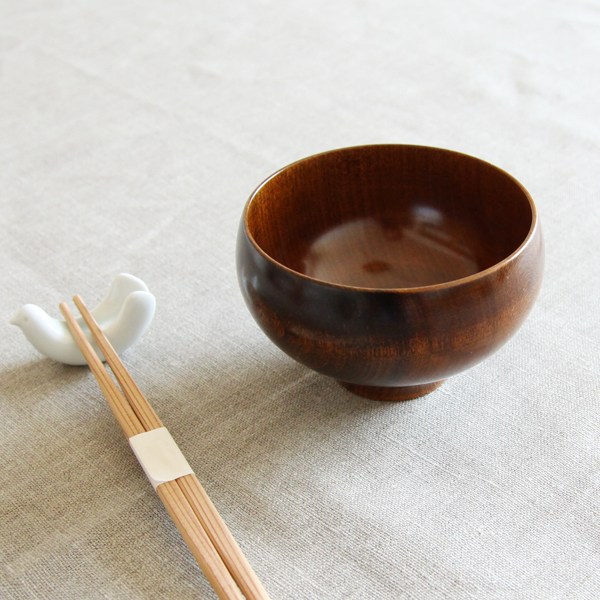
M: Since everyone in the family has their own set of dishes at the table, we have a full range of tableware at home. Besides this fuki-urushi bowl, we also have black and vermilion lacquer soup bowls, and we tend to rotate between them depending on the mood. Through my work at ZUTTO, I've had plenty of opportunities to see and handle urushi-coated products over the years, so I thought I already knew their appeal—but the fuki-urushi finish really does have its own distinct charm. It doesn't appear at every single meal, but it's definitely one of the pieces we keep coming back to.
S: For me, it's almost the opposite—I feel like there isn't a single day I don't use it (laughs).
M: You mean you use it as a soup bowl every day?
S: Actually, I use it for plenty of things besides soup. Sometimes like a salad bowl, sometimes to hold small pieces of cut baguette. When I'm in the mood for a quick bowl of ochazuke, I reach for this fuki-urushi bowl too. In my mind, it's less like a traditional Japanese dish and more like a small, tall wooden bowl. I've always tried to keep the number of things I own to a minimum, but thinking about it in terms of function, I've realized that for a single-person household, you really don't need that many different types of tableware to get by.
For instance, I'll set it on a Takahashi Kogei plate and use it for breakfast, like this—here it's filled with yogurt and granola.

MATEVARI Fuki-urushi (Cherry), Cara Plate (M), Aino Aalto Tumbler (Clear)
M:What an interesting way to use it! I've only ever used mine in "the classic miso soup bowl" kind of way, but since a bowl really is a wood bowl, if we broaden how we think about using it, it might surprisingly work well for things like yogurt or ice cream too.
S:Yes, the fact that it's fine to put soup in it is one of the great things about urushi (Japanese lacquer) bowls, so when you think about it, they can actually be used for all sorts of purposes.
What Time Reveals: Comparing the Aging Process
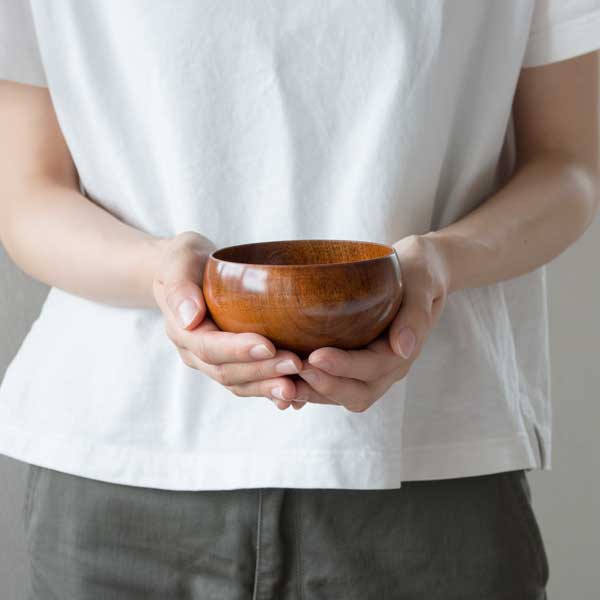
S:I've used mine continuously for almost three years now. But even compared to a new one, I don't really see any noticeable difference. There's no chipping or fading, and I think the fact that it holds up so well is thanks to the urushi finish. I'm looking forward to seeing what kind of changes appear as I keep using it for even more years to come.

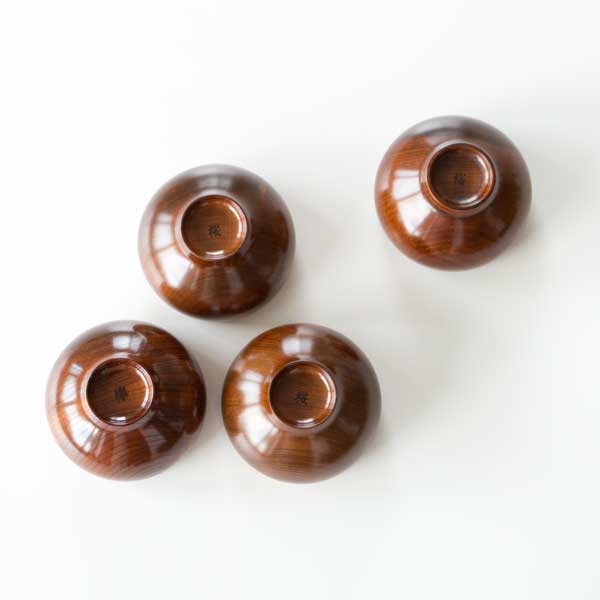
M:Since I've only had mine for six months, I haven't really noticed any particular changes yet. I feel the same way—I'm looking forward to seeing what kind of aging awaits. But more than the aging itself, what I find really interesting is seeing the individual differences when you line up three of them like this. Of course different types of wood have different grain and character, but even the two made of sakura, though they're the same wood, each have their own distinct expression. Thinking that this is a vessel that will keep spending time with my family going forward, it somehow makes me feel a sense of warmth.
Things Fellow Owners Want to Ask Each Other Quietly: "How Do You Handle This?"
What kind of dishware do you use it with?
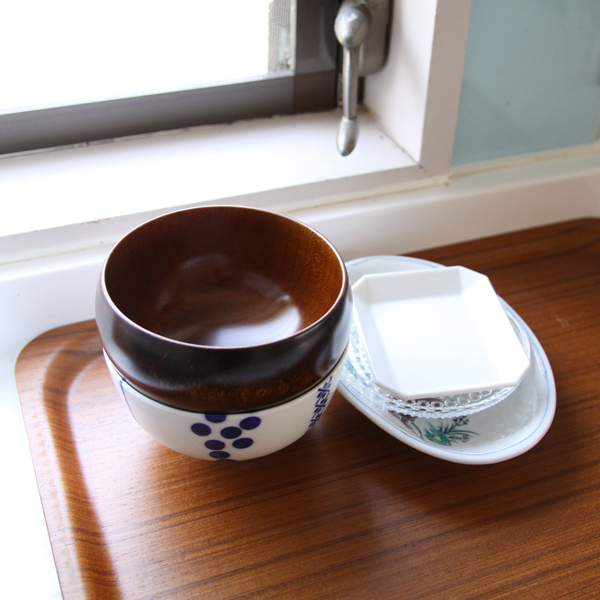
M:I think it's interesting that you use it in so many different ways—as a salad bowl, or for yogurt at breakfast—but how does it pair with your other dishware?
S:It goes well with any kind of Japanese tableware. Among the items featured on ZUTTO, I use it with Azumaya's inban rice bowl and Miyamoto Taisando's Kutani ware. I recently added TOJIKITONYA's kohiki rim plate, and I've really noticed how the color of fuki-urushi (wiped lacquer) among all the white dishware gives the table a nice sense of contrast and focus.
At first I wondered if it would look out of place with anything other than Japanese-style plates, but once I actually tried it, it surprisingly matched well with Western-style plates too. I mentioned the breakfast example earlier, but it also looked great sitting on top of Takahashi Kogei's plain wood plate. That's because fuki-urushi retains just the right amount of the wood's natural texture. That was a happy discovery.
After washing, do you wipe off the moisture or not?
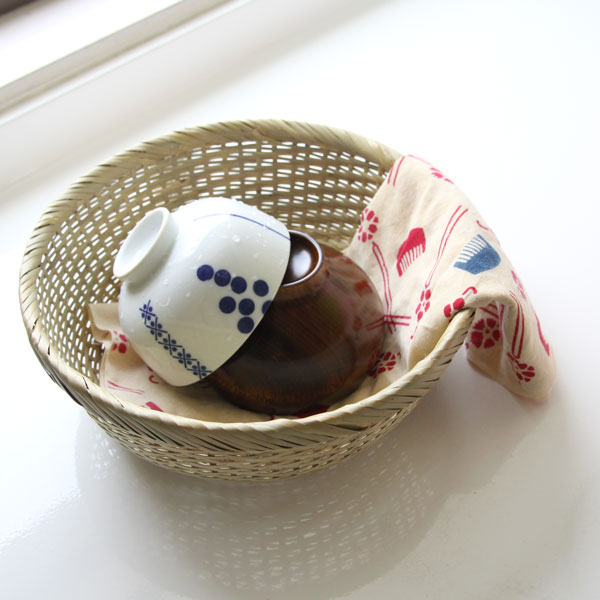
M:Once I'm done using it, I always wash it right away and dry it right away too. Since it's fuki-urushi, I don't think I need to be that nervous about it, but... the base material is still wood, so I feel like it's not good to let it stay in contact with water for a long time. How do you take care of yours?
S:How admirable! (laughs) I used to do the same thing when I first started using it, but lately I've gotten a bit lazy, and more often than not I just wash it and then leave it to air dry.
M:On the other hand, how is it letting it air dry? Is there anything that concerns you about that?
S:So far it seems surprisingly fine, actually. About the only thing is that water droplet marks remain a little after drying, but the bowl itself doesn't seem to warp or stain or anything like that. Still, washing and drying it right away really is the basic rule, so I should probably follow your example... (sweat)
Size Considerations When Used by the Whole Family

S:I really like the idea of children using the same urushi bowl as the adults, but is there anything that concerns you about the size or usability?
M:My daughter, who's turning five this year, uses hers without any issue. Since the bowl is originally on the slightly smaller side as far as bowls go, I think it's a size that's easy for both women and children to use.
S:I love the idea of the bowl growing alongside your family. I'm a little envious (laughs).
M:I think a bowl that keeps you company through living alone is also quite nice! With these kinds of timeless staples, you can always buy more later on, and you can adjust the number or how you use them to match your family size or lifestyle as things change.
S:That's true. Being able to choose and use something according to your lifestyle, and enjoy doing so, might be one of the special qualities of simple, unwasteful objects like this.
▶︎About Gato Mikio Shoten
Founded in 1908 in Yamanaka Onsen, Ishikawa Prefecture, as a woodworking shop, Gato Mikio Shoten is a Yamanaka lacquerware brand built on highly skilled rokuro (wood-turning lathe) techniques. Its guiding concept is "fueki ryuko"—the idea that things which never change, and things which keep up with the times, can coexist. The brand regards the unchanging traditional techniques of Yamanaka lacquerware as "fueki" (the unchanging), and design born from a sensibility that lives in the present as "ryuko" (the changing), fusing the two to create new lacquerware. This stance seems to be woven directly into their forms, made from natural wood and urushi. While keeping their skilled rokuro turning and their glossy urushi finish—as lustrous as fine furniture—intact, they create things that fit naturally and effortlessly into contemporary life.
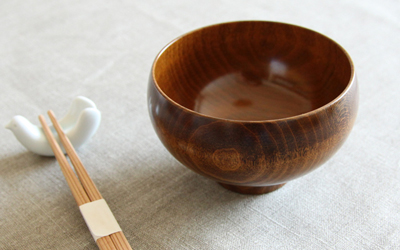
▶︎Two People Compare Their Everyday Experience: Kurashiki Ishō's "Drawer Box" Edition
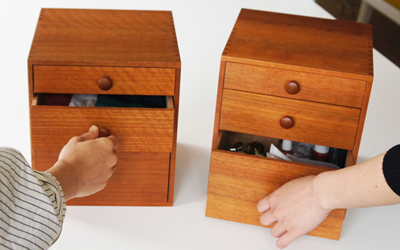
▶︎Two People Compare Their Everyday Experience: fog linenwork's "Linen Massage Bath Mat" Edition
GUIDE »
CONTENTS »
CATEGORIES »
- + Gifts by recipient
- + Gifts by scene
- + Clothing
- + Bags / Backpacks
- + Wallets / Card cases
- + Jewelry
- + Shoes
- + Rainy day outfits
- + Kitchen
- + Home
- + Babies / Kids
- + Japanese products
Earn Miles


Payment & Security




