


.webp)


.webp)


.webp)


.webp)


Welcome to ZUTTO
Free shipping for newsletter subscribers (some areas excluded)
- トップページ/
- ZUTTO Journal/
- ブランドストーリー/
- 【BRAND STORY】The ...

【BRAND STORY】The story behind ao's nameraka tenjiku series, made with comfort in mind. A limited-quantity ZUTTO exclusive edition has also arrived.
"ao, a factory brand from Itoigawa City, Niigata Prefecture"
Touching gauze fabric brings a gentle feeling that seems to soothe the heart. What if the gauze commonly used for baby clothes could be made into garments for adults, while keeping that same soft touch? Born from this idea, ao can be considered a pioneer of gauze clothing—a factory brand born out of a sewing factory in Niigata Prefecture, with many loyal fans who return again and again to purchase its products.
This time, wanting to learn more about ao as we introduce the exclusive nameraka tenjiku long T-shirt, we once again spoke with Igarashi-san, the brand's representative.
The item we're featuring is the "nameraka tenjiku" series. Made by knitting two layers of smooth, thin fabric woven from ultra-fine 100% cotton thread into a single piece, this series has a softness that seems to hold air within it, along with a refreshing quality that gently brushes the skin's surface—perfect for the coming season, which is why we chose it.
【ZUTTO Exclusive】Nameraka Tenjiku Long T-Shirt

This time, we asked ao to make thisnameraka tenjiku long T-shirt exclusively for us
First, let's talk about the exclusive long T-shirt. Since our planning staff had been a longtime wearer of the nameraka tenjiku cardigan, we asked for an item that would let people experience the quality of the material even closer to the skin—and that request led to this exclusive long T-shirt.

The neckline is a moderately snug crew neck. It looks natural worn alone, and it's also easy to layer—a basic shape overall. While ao usually offers this style with three-quarter sleeves, for this exclusive version we made the sleeves nearly full-length. This makes it easy to wear as an inner layer during the chilly early spring days as well. The key point of this exclusive item is that it can be worn over a longer stretch of the year, and works both as an inner layer and on its own—a long-sleeve T-shirt for either purpose.

Once the weather warms up, wear it on its own.

The colors are basic white and black. We recommend getting both colors.
>> Go to the product page for the exclusive Nameraka Tenjiku Long T-Shirt
【A True Classic Cardigan】Nameraka Tenjiku Crew Neck Cardigan
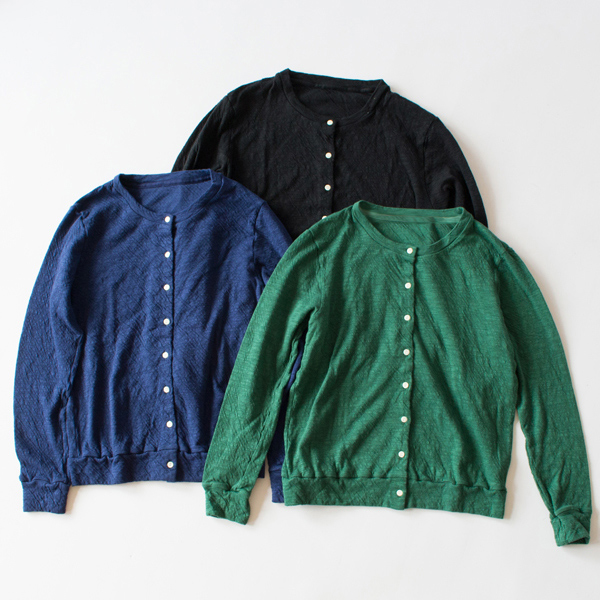
From left, clockwise: the new color tetsukon (iron navy), black, and tokiwa (evergreen)
We've expanded the color range of a cardigan we had already been carrying. To keep it easy to mix and match, we've kept the design simple without unnecessary details. It's lightweight and folds down small, making it handy to bring along when traveling.


>> Go to the product page for the Nameraka Tenjiku Crew Neck Cardigan
From here, we bring you our interview with Igarashi-san, the brand's representative.
On the Nameraka Tenjiku Series and Gauze Material
"This series was created quite close to the time the brand itself was founded. It's now grown to account for about 40% of ao's annual sales volume, making it our main material—but when we first launched the series, we really struggled (laughs), since it was gauze, and also a cut-and-sew (knit) fabric that sewing factories had rarely handled before.

We've improved the nameraka tenjiku series about four times now. To begin with, gauze is extremely difficult to handle—its shrinkage rate is higher than anything you'd typically hear of in commercially available clothing."
"Yes. The shrinkage rate varies depending on the lot, but combined lengthwise and widthwise, it can shrink by 30 to 40%. Calculating roughly 15 to 20% shrinkage in each direction, that means the garment length alone can shrink by 7 to 8 cm. Generally speaking, a shrinkage rate of around 5% is considered the acceptable limit.

One way to deal with a high-shrinkage material is to use an anti-shrinkage agent, but that would compromise the very thing we value most—the wonderful texture of gauze against the skin. So we chose not to go that route, and instead worked to make it possible by fine-tuning each individual step of the process.

A look at the production process for this exclusive long T-shirt. This kind of garment-making is only possible because we manage production from start to finish, in-house.
As a result, we now dye the finished products and have stabilized the shrinkage rate to about 1.5% in both length and width, accounting for shrinkage in advance. What we value most is minimizing processing as much as possible. Back then, even the fabric suppliers kept double-checking with us, asking, 'Are you really sure you don't want to do anything to it?' They worried it wouldn't hold up as a finished product. That just shows how standard heavily processed fabric is in this industry.
During development, after receiving the fabric, we measured the shrinkage rate piece by piece. Then, factoring in the shrinkage rate that emerged, we would rework the pattern each time. Furthermore, we accumulated sizing data by measuring the sewn garments both before and after washing, and through this research built up a body of knowledge about exactly what matters for improving dimensional stability (that is, for reducing the shrinkage rate).
To get into the details, the tension (pressure) when stacking the raw fabric has to be consistent, and the tension when measuring shrinkage rate has to be consistent too, right down to the number of stitches per inch when sewing, the interlining, and how much the hands pull the fabric. On top of that, areas that have been sewn shrink less than areas that haven't, so that has to be factored in as well. It also varies depending on the dye used.

So unless all these processes connect properly, that "softness against the skin" can't be achieved. It looks like something that should be simple, but it's actually quite difficult. I think the quality of the fabric that comes out of this process is something our customers can feel, and that's likely connected to why we have so many repeat customers.」

A sticker attached to the sewing machine. You can sense the affection with which the tools are used.
"Yes. Prioritizing the 'texture of the fabric' has always been a core principle for us. We want customers to pick up, wear, and feel the fabric's inherently gentle texture, achieved by placing as little stress on the fabric as possible. Even something as small as the sizing (glue) applied to the material—we choose types that damage the fabric as little as possible, and we specify exactly how it should be removed when we make our request. We're careful at every stage to make sure the garment ends up in as relaxed a state as possible."

"Stabilizing the shrinkage rate has always been a given premise, but as for the materials that come before that stage, over these 18 years we've worked with a cumulative total of about 100 different types. Of the materials we currently offer, about 80% are our original materials. Some of them we've specified ourselves, right down to the yarn and the weave, and had them made to our own specifications."
"One reason is that it's a double-layer tenjiku (a type of jersey knit) material—the side against the skin is Supima cotton, while the outer side uses Supima slub yarn. By deliberately using slub yarn, which has an uneven texture, we create expression on the surface. And then the shrinkage rate adds the crinkle on top of that. There's also the diagonal creasing on the surface, right?

The crinkled surface.
If we tried to eliminate this, we'd have to apply some kind of finishing process to suppress it, and we don't do that. Also, because it's a tenjiku material knitted in a circular knit, it's inherently a material that skews diagonally by nature. To suppress this skewing, we use yarn on the reverse side that's been twisted (twisting applied to the yarn) in the opposite direction. Also, unlike ordinary tenjiku, we knit it with a wider gauge spacing, which results in a looser-density, gauze-like knit fabric. That's why we call it "gauze tenjiku." Even the knitting machine is set up in a way that isn't typically done."

So this overall texture comes from the uneven slub yarn, the crinkle caused by the shrinkage rate, and the characteristic diagonal creasing unique to tenjiku material. As a side note, at first, when we specified tenjiku with nothing added, what came back had so many things that weren't even wrinkles but more like tucks, to the point where it couldn't even be sewn—it was really tough (laughs). It took many rounds of back-and-forth before we finally arrived at this fabric."
"Yes. The fabric supplier helped us enormously too, teaching us all kinds of knowledge. I'd go so far as to say that without the person in charge at the time, ao today wouldn't exist."
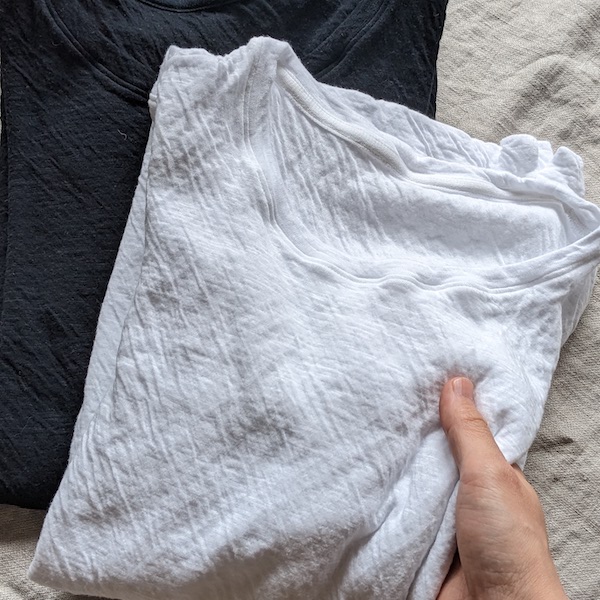
ao's clothing, shaped by the involvement and experience of countless people
"Yes. This marks our 18th year since the brand was born. As for Biso Igarashi, the sewing factory that gave birth to ao, it's been around for about 55 years since its founding, but before ao's start, it mainly did OEM work for other companies, working primarily as a sewing factory for blouses.
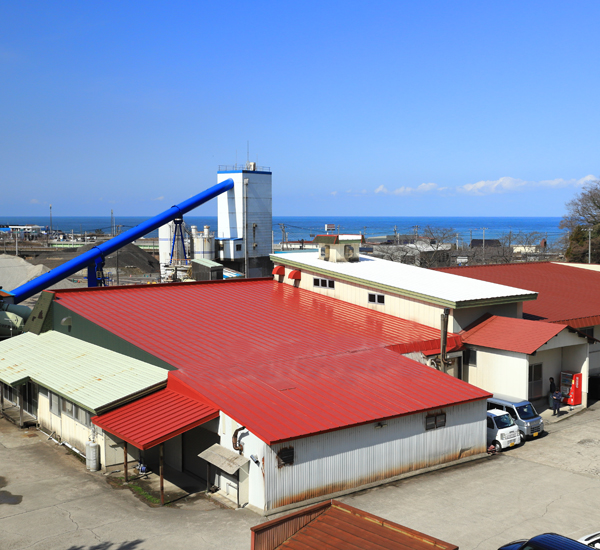
Biso Igarashi, a sewing factory in Niigata that has been doing sewing work for many years.
Looking back on 2005, we were also doing business focused on functionality, somewhat removed from what ao is today. At the time, a wave of overseas production was sweeping the industry, and it was an era when we had to compete on cost. So what we chose to do was launch a factory brand that made use of our own in-house techniques."
"At the core of it was a desire to 'value natural materials.' From there, it was the perspective of the director at the time of launch—'If it's natural material, wouldn't gauze be interesting? What if we turned something with such a wonderful feel against the skin into clothing for adults?'—that led to the gauze wear we have today.

"At the time, there weren't many clothes made of gauze, so I thought that if we had clothes with a nice feel against the skin, customers would surely be pleased. Brands specializing in a single material were rare back then. Handling the fabric was also difficult, so people around me were completely against it (laughs)."

"There were really so many things that became possible thanks to the cooperation of the fabric shop we'd been working with for years. Also, when we first launched the brand, we mainly developed things by asking other brands to collaborate with us, and the experience gained from each of those collaborations became the framework for ao's clothes-making. I feel this is a brand that everyone helped raise together. Now, ao products make up 30 to 40 percent of our factory's total production."
"Comfortable to wear" isn't just about "how it feels against the skin"

"That's right. It started when we had a shop in Paris in 2010, and a Swiss doctor specializing in cancer treatment asked us a question. She said, 'I want to find some way to care for patients whose skin becomes sensitive during treatment. The fabric feels so nice that I'd like to use it, but do you have any materials showing specific numerical data?'

We didn't have any such materials, so I couldn't give her a concrete answer. Even after returning to Japan, that question kept nagging at me, so I visited a university known for quantifying wearing comfort and had them run an experiment. Over the course of a year, 30 to 40 test subjects were tested three times each."
"The one we quantified was our standard 40-count double gauze. At the time, we were the first to get a result showing that stress actually 'decreased.' 'Feel against the skin' is about 'touching,' isn't it? But when you actually wear something, it becomes about 'comfort of wear.'

Through that experience, I learned how to improve 'wearing comfort' in every aspect—fabric processing, the way threads are woven, patterns, and sewing. What matters most for 'wearing comfort' is 'stretch.'
Since we're a sewing factory, I had always thought increasing strength was what mattered most, but I realized that parts sewn with many layers of stitching may be strong, but they can actually become a source of stress when worn. Stitching suited to the material, the angle of the pattern, how the pressure of the garment feels on the body, the texture of the fabric against the skin—all these elements combine to create 'wearing comfort.' I think we were able to achieve this because we can manage every step of the process ourselves."

ao's clothes have stretch, allowing them to fit the body gently and comfortably.
"Through that experience, our understanding was updated on exactly how and where things should be made, and what kinds of processing don't work well. Everything we've developed based on that knowledge draws on this experience, and it all connects to ao's clothes today."

▼See the full lineup of ao products here

GUIDE »
CONTENTS »
CATEGORIES »
- + Gifts by recipient
- + Gifts by scene
- + Clothing
- + Bags / Backpacks
- + Wallets / Card cases
- + Jewelry
- + Shoes
- + Rainy day outfits
- + Kitchen
- + Home
- + Babies / Kids
- + Japanese products
Earn Miles


Payment & Security




